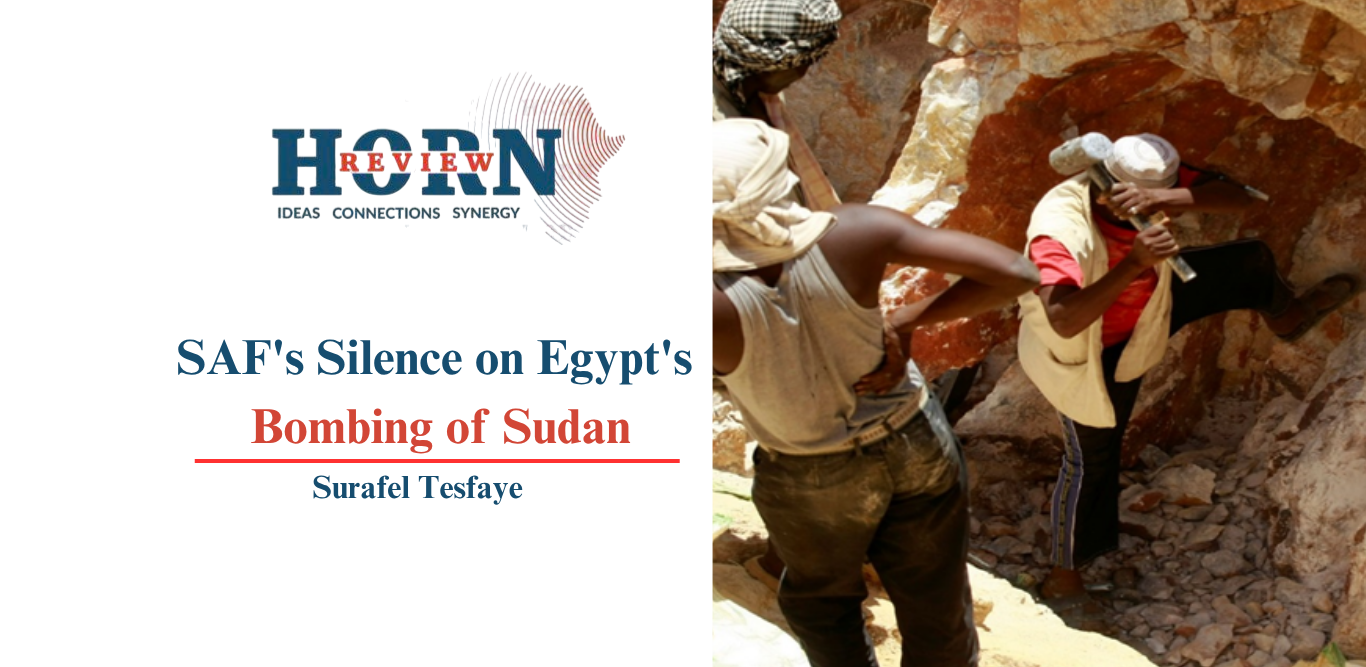
On June 17, 2026, Egyptian military drones and artillery struck artisanal gold mining camps in the eastern border zone near the Halaib Triangle, along the shared frontier of both countries. The targets were not military positions, and the casualties were not fighters from the Rapid Support Forces. Rather, the dead were civilian miners from the Bisharin and ‘Ababda tribes, who were independent operators working the gold fields of the River Nile and Red Sea states. In response, the Sudanese Armed Forces, which is Egypt’s most important ally in the war against the RSF, chose not to condemn the attack. There was no official statement, no diplomatic protest, and no public outrage. Instead, the SAF responded with strategic silence and deployed troops to the border zone. This sequence of events reveals a calculated dynamic of survival, sovereignty, and strategic dependency between two allies who are also wary neighbors.
To make sense of the SAF’s decision to stay silent and deploy troops rather than confront Egypt, we must first look at Cairo’s strategic objectives and the timing of the attack. The airstrikes were calculated moves designed to protect Egypt’s economic interests in the border region. Reports indicates that Egypt relies heavily on illicit gold smuggling across its porous border with Sudan. Research from Chatham House suggests that up to sixty percent of Sudan’s unofficial gold production flows into the Egyptian economy, helping Cairo generate hard currency while keeping its domestic financial pressures contained.
Initially, Sudan’s civil war worked to Egypt’s advantage because the chaos allowed more gold to flow across the border, boosting Egypt’s reserves and providing a much-needed economic lifeline. However, as the war dragged on, the situation became increasingly difficult for Cairo to manage. Unregulated mining camps expanded dangerously close to Egyptian lines, and this expansion disrupted Egypt’s gold supply while diminishing the economic benefits it once enjoyed. These camps became hubs for smuggling weapons and fuel, and they also became sites of violent clashes with Egyptian border guards. As previously reported by Sudan Tribune, before the airstrike, miners stated that Egyptian border guards had burned mining equipment, torched temporary shelters, and fired live ammunition to force workers away from areas near the Al-Ansari and Al-Ogaidat mining sites.
This explains why Egypt’s strikes were designed to disrupt the independent tribal supply chains that were undercutting state-dictated prices and challenging Egyptian border control. By wiping out the lawless markets, Egypt forced the gold trade back into official channels, transforming a chaotic black market into a controlled, government-to-government transaction. This was not simply about border security; it was economic warfare by other means, aimed at forcing the gold flow into state-controlled hands.
This dynamic reveals a central paradox within the entire incident. Why would Egypt bomb a region that supplies the very gold stabilizing its own economy? The answer is that Egypt’s strikes were never intended to stop the gold flow itself, but rather to crush the autonomous networks operating outside of state regulation. Because these independent miners were undercutting state-dictated prices and driving border instability, Cairo used military force to dismantle their operations entirely. By disrupting these lawless markets, Egypt successfully funneled the gold trade back into official state channels where authorities could easily dictate the terms. The SAF leadership is fully aware of this economic logic, which is precisely why it chose to stay silent.
Consequently, a public condemnation of Egypt would have destroyed the military alliance that the SAF depends on to survive its war against the RSF, making silence the only viable option. However, Cairo’s dependency on the SAF also acts as a limiting factor because the Egyptian government views the RSF as an existential threat on its southern border. If Egypt had continued to bomb the eastern border, it would have destabilized the Red Sea and River Nile states, which serve as the SAF’s last secure strongholds. Had these regions collapsed into tribal warfare, the SAF would have lost its grip on the entire area, severely weakening its position in the broader civil war. Egypt simply cannot afford to destroy its own ally’s home base, which explains why the strikes stopped within days. Ultimately, Cairo had to halt its military campaign because protecting the SAF’s rear area is a far more important strategic interest than controlling a single gold mine.
This reality is underscored by the fact that Egypt produces only a modest amount of gold domestically. Consequently, its gold reserves increased dramatically after the start of Sudan’s civil war because significantly more gold entered Egypt through illicit channels. This influx was further encouraged when the Egyptian government removed import duties on gold. Even SAF officials are fully aware of this arrangement, recognizing that Egypt’s economic dependence on Sudanese gold has created a complex, mutually beneficial relationship that neither side can afford to rupture. Ultimately, this economic codependency has shaped the exact way both countries approach border security and military cooperation.
The main question remains: why did the SAF deploy troops to the border? The deployment serves multiple purposes, all of which are rooted in state survival rather than confrontation. First, there is the vital issue of internal legitimacy. Because the SAF claims to be the sole legitimate government of all Sudan, it cannot afford to do nothing when a foreign military strikes inside its borders and kills Sudanese civilians. Moving troops to the area is a theater of national defense, a calculated move meant to signal to the Sudanese public that the army still defends its territory and its citizens. The public needs to see a response, even if that response is carefully calibrated to avoid an actual confrontation with Egypt.
Second, the deployment is about pacifying powerful tribal border networks, particularly because these mining areas are heavily armed and run entirely by local tribes. Following the strikes, anger against Egypt has been boiling among the Bisharin and ‘Ababda clans, prompting the SAF to deploy soldiers to act as a buffer. The military needs to prevent angry tribes from launching retaliatory cross-border attacks against Egyptian border guards. If a Sudanese tribal militia kills Egyptian soldiers, Cairo might feel forced to launch a massive retaliation, escalating the situation into a catastrophic diplomatic and military crisis that the SAF cannot afford. Consequently, the troops are standing between the furious tribes and the Egyptian border, preventing a local cycle of revenge from turning into a full-scale international war.
Third, the deployment is primarily about gold control. As noted previously, up to sixty percent of Sudan’s gold is smuggled informally across the border into Egypt. Both the SAF and Egypt benefit from this illicit trade, as the gold is washed into formal Egyptian and other markets to secure liquidity and weapons for the SAF. However, the economic chaos of the civil war has caused unregulated mining camps to expand dangerously close to Egyptian lines, so the SAF is deploying troops to establish official regulatory checkpoints. Just days before the strike, the Sudanese government had ordered an emergency crackdown on unregulated mining, and the SAF is using this military deployment to forcibly implement those laws, seize control of the gold markets, and ensure that the revenue goes directly into its war chest.
This operational shift accentuates a high-stakes situation for the SAF, as the military relies heavily on gold revenues from these eastern states to buy the weapons and fuel needed to fight the RSF. Furthermore, Port Sudan, which serves as the SAF’s primary strategic stronghold, sits directly in the heart of Beja and Bisharin tribal territory, meaning the military cannot afford to alienate these clans without risking its last safe haven. If the eastern border collapses into chaos, the SAF faces a catastrophic outcome: it would lose its ultimate economic lifeline and be forced to either abandon or violently defend the Red Sea coast, its only remaining gateway to the outside world. A prolonged confrontation with the tribesmen would trigger this exact scenario, which is why the SAF has chosen to absorb the blow and manage the situation through indirect means.
From a strategic standpoint, these civilian clans should never have been a target for Egypt, especially since Cairo cannot afford to jeopardize its alliance with the SAF. This deep geopolitical dependency explains why the SAF remained completely silent after the airstrikes, choosing instead to deploy its own soldiers to secure the border zone on Egypt’s behalf. Furthermore, Egypt is restricted from launching further airstrikes inside Sudan because targeting innocent civilian populations would violate international law and draw severe global condemnation. Because Cairo cannot risk deeper, direct military involvement, its ally, the SAF, must absorb the operational risks and manage the border situation to keep the broader alliance intact.
In the end, the Sudanese government’s official narrative regarding this troop deployment is simply a political game and a geopolitical trade-off between the Egyptian and SAF leadership. The claim that the SAF deployed soldiers to prevent local tribal conflict is entirely illogical. Because the tribesmen were killed by a foreign third party, Egypt, there is no inherent reason for the clans to fight each other. Instead, the SAF is actually stepping in to protect a highly lucrative gold mining region that serves as its primary economic lifeline. The deployment is a strategic move to ensure that the gold fields remain under SAF control, that the revenue stream continues uninterrupted, and that Egypt’s economic interests are secured without further military escalation.
In a broader sense, the situation appears to be a foreign policy crisis, but in reality, it is a carefully managed trade-off between two allies. Since a significant amount of Sudan’s gold production is not captured in official statistics, and the released figures are merely indicative of what the authorities wish to make public, various actors have long benefited from the conflation of security and commercial interests in Sudan. The SAF’s strategic silence, the deployment of troops, and the calculated avoidance of confrontation all point to a deep understanding between Cairo and Khartoum. Ultimately, both sides recognize that their long-term survival depends entirely on managing this delicate balance.
Egypt needs Sudanese gold to stabilize its economy, and the SAF needs Egyptian support to survive the civil war. Consequently, the airstrike and the subsequent military deployment are not signs of a rift but are instead indicators of a complex, unspoken arrangement that allows both states to pursue their interests without breaking the alliance holding them together. In the long run, this incident will be remembered not as a crisis, but rather as a testament to the absolute pragmatism that defines Sudan-Egypt relations in an era of war and economic uncertainty.
By Surafel Tesfaye, Researcher, Horn Review