In 2026, Somalia’s political economy is undergoing a profound, if under-reported, reconfiguration. While international attention remains fixed on the Federal Government of Somalia (FGS) in Mogadishu, real leverage over the country’s most strategically valuable resources, lithium, cobalt, rare earth elements, and other critical minerals, is migrating outward to the Federal Member States (FMS). This shift has crystallized into what can be termed Mineral Federalism: a de facto decentralization in which regional authorities assert direct control over subsoil resources, negotiate independently with foreign partners, and exchange extraction rights for security and infrastructure. Far from the centralized vision enshrined in law, power now flows through regional capitals, mining camps, and contested mountain ridges.
Somalia’s formal legal framework for mining has long sought to centralize authority. The foundational Mining Code of 1984 vests primary responsibility for licensing, exploration, and extraction in the central government, a structure reinforced by the National Mineral Resources Policy of 2019 and the new mining law approved by Parliament in early 2026. These instruments explicitly aim to modernize the sector, attract responsible investment, curb illegal mining, and ensure that resource revenues serve national development. Article 44 of the Provisional Constitution further requires that natural resource allocation be negotiated and agreed upon between the FGS and the FMS. In theory, this framework assumes that the federal government possesses both the regulatory monopoly and the security capacity to enforce its rules across the territory.
The ground reality, however, reveals a widening gulf between statutory intent and operational practice. The 1984 Code and its 2026 successor presuppose that only federally licensed operations enjoy legitimate status and that the FGS can guarantee the security necessary for large-scale investment. Yet in practice, security provision has become the critical enabler of Mineral Federalism. In much of the periphery, federal forces lack the reach to protect remote mining sites. Instead, local darawish (paramilitary forces), clan-affiliated militias, and hybrid security arrangements, often directly funded or equipped through mining concession deals,have stepped into the vacuum. This creates a direct inversion of the legal logic: mining operations that bypass federal licensing can still secure effective protection, while the Mining Acts’ centralizing provisions remain unenforceable without corresponding control over who actually guards the mines.
A clear illustration is the March 2026 Memorandum of Understanding signed between the FGS and the U.S. state of West Virginia for cooperation on critical minerals. Presented in Mogadishu as a federal strategic victory that would channel technical expertise and integrate Somalia into global supply chains, the agreement has had limited traction on the ground. Many of the most promising deposits sit in territories administered by FMS such as South West State and Galmudug. Regional leaders have treated the federal MoU as advisory rather than authoritative. Several states have moved to establish their own mineral authorities and have begun signing exploration and development agreements directly with foreign partners. These arrangements frequently include explicit or implicit security components: foreign companies or their backers provide drones, surveillance technology, training for local forces, or logistical support in exchange for access. The result is a self-reinforcing “security-for-mining” trade-off. Regional administrations gain military autonomy from Mogadishu, while the companies obtain operational protection that the FGS cannot reliably deliver. In this way, the very security mechanisms that make extraction viable simultaneously undermine the enforcement of the 1984 Mining Code and the 2026 law.
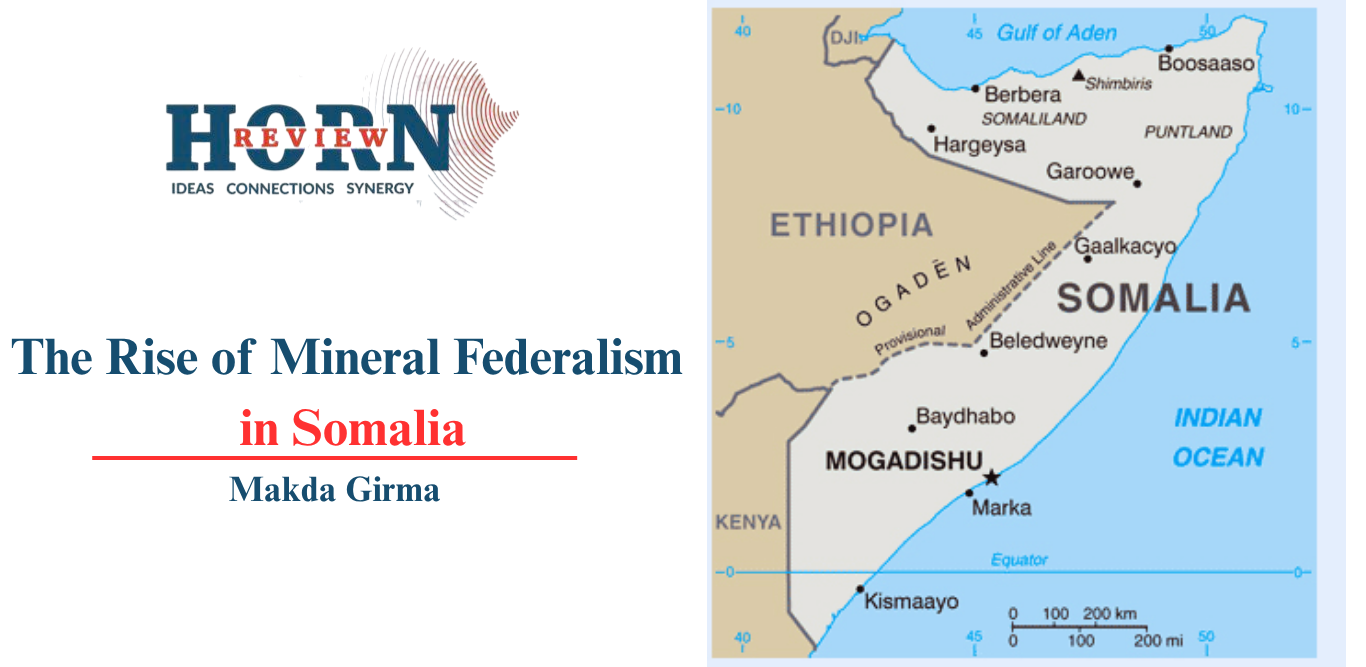
This pattern is most acute in the emerging “Lithium Belt” of the Golis Mountains and the Milxo region in northeastern Somalia. Geological indicators point to significant lithium and gemstone potential in these rugged highlands, raising their strategic value in the global energy transition. Yet Milxo and surrounding areas constitute a classic governance void, with overlapping claims by Puntland, Somaliland, the FGS, and the newer SSC-Khatumo administration. Field observations from early 2026 indicate that only about six percent of mining entities operating in these high-value zones hold formal federal licenses. The vast majority function under local protection agreements, informal state-level deals, or unregulated arrangements. Here, the link between mining legislation and security is particularly stark: the Mining Acts declare federal licensing mandatory and envision state-provided security, yet the actual safeguarding of sites, and the collection of protection fees or royalties, rests with local darawish and affiliated forces. These actors often operate under the direction or patronage of regional authorities rather than the FGS, effectively creating parallel licensing and revenue systems that the formal law cannot reach.
The SSC-Khatumo administration has emerged as an especially nimble player in this environment. By developing its own mineral strategy and asserting authority over licensing and revenue in disputed zones, it seeks to convert resource potential into political legitimacy and administrative control. Local security provision becomes both a practical necessity and a political instrument: by guaranteeing protection for mining operations, often in partnership with external investors, it strengthens its claim to govern the area more effectively than competing authorities. This dynamic directly challenges the centralizing premise of Somalia’s mining legislation. While the 2026 law seeks to bring order, transparency, and federal oversight, the reality of who protects the mines determines who effectively controls them.
Compounding the tension is the persistent absence of a trusted revenue-sharing mechanism. Earlier frameworks such as the 2018 Baidoa Agreement have faltered amid mutual distrust. Regional finance officials question whether royalties sent to Mogadishu would be equitably redistributed or centrally captured. Without credible fiscal rules, independent oversight, or enforceable dispute resolution, FMS see little incentive to surrender control over assets that can directly fund the very security arrangements sustaining local operations. The new mining law may introduce stronger regulatory language, but its success hinges on enforcement capacity that remains elusive where security lies outside federal hands.
External actors have adapted rapidly to this fragmented landscape. Middle powers such as the UAE and Qatar increasingly pursue direct relationships with FMS for extraction rights and infrastructure packages. Turkish engagement, prominent in offshore oil through state-linked entities, also extends to broader resource interests. Meanwhile, Australian junior mining companies, renowned for operating in high-risk frontier jurisdictions, have shown particular interest in pre-reconnaissance and early-stage exploration across FMS territories, including lithium prospects in and around Somaliland-adjacent areas. These agile, ASX-listed firms are more willing than major multinationals to navigate the complex security and political environment, often negotiating directly with regional authorities. Their involvement further entrenches the bypass of federal institutions and illustrates how security realities shape which companies can actually operate.
The deeper stakes extend beyond economics to the nature of sovereignty. Mineral Federalism poses a fundamental question: can resource-driven decentralization foster a more stable, balanced federation in which regions have genuine stakes in peace and governance, or will it accelerate fragmentation into semi-autonomous “company-states” governed by bespoke deals between local elites, mining firms, and private security arrangements? Optimists highlight potential benefits localized job creation, reduced aid dependence, and stronger incentives for regional investment in stability. Pessimists point to risks of elite capture, environmental harm, and parallel power structures that erode national cohesion. Historical precedents across Africa suggest the outcome is not inevitable; it will depend on whether Somali leaders can construct credible institutions for revenue sharing, regulatory coordination, and conflict management before competitive pressures solidify division.
As of April 2026, the trajectory remains fluid and contested. The FGS continues to pursue high-profile international partnerships and constitutional adjustments aimed at reasserting authority. On the ground, however, junior explorers conduct surveys, regional authorities issue local licenses, and security arrangements tied to mineral concessions proliferate. The Golis Mountains and Milxo are no longer peripheral backwaters; they have become strategic theaters where Somalia’s federal experiment faces its most consequential test. The “green gold” beneath these contested ridges is forcing a reckoning with the country’s federal character, one that may ultimately redefine sovereignty in a 21st-century Horn of Africa.
This is not merely a story of mining or economic development. It is a sovereignty story. In an era when control over critical minerals carries geopolitical weight once reserved for oil, power in Somalia is diffusing from the center outward, enabled by the practical realities of who actually protects the mines and the growing gap between formal Mining Acts and those realities. How Somalia navigates Mineral Federalism, whether it becomes a catalyst for more resilient federalism or a driver of deeper fragmentation, will shape not only the country’s future but the stability of the broader region. While the world watches presidential palaces in Mogadishu, the decisive negotiations are occurring in regional halls, mining camps, and the mineral-rich folds of the Golis. The age of Mineral Federalism has arrived. Its resolution will determine whether Somalia’s subsoil wealth becomes a curse, a unifier, or a transformer.
By Makda Girma, Researcher, Horn Review