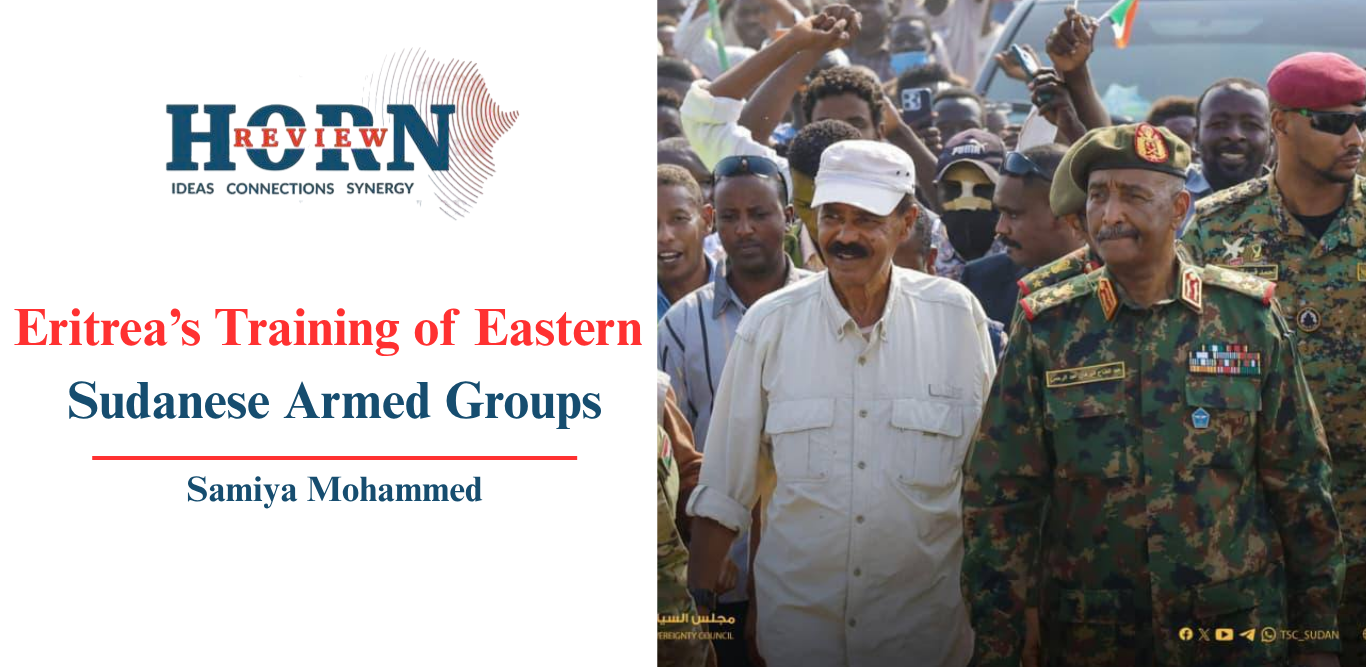
The Horn of Africa is currently experiencing a period of intersecting armed conflicts, state dispersal and intensified intervention by regional actors. While international attention remains concentrated on the large scale internal war in Sudan between Forces a parallel development of a consequence is opening along Sudan’s eastern periphery with a growing body of documented evidence indicating that the State of Eritrea has undertaken a systematic programme to train, equip and field Sudanese militias recruited primarily from tribal constituencies in eastern Sudan.
The 605-kilometre border between Eritrea and Sudan does not function as a sharp demarcation separating distinct national spaces however as a permeable zone of ethnic, social and economic interconnection. Transnational communities like the Beja, Beni Amer and Rashaida peoples inhabit both sides of this frontier. Their cross border kinship structures, pastoralist livelihoods and established trade routes have rendered formal state boundaries nearly abstract in daily practice while simultaneously leaving these communities open to instrumental use by both Sudan and Eritrea.
During the war that preceded Eritrea’s formal separation, Sudanese territory served as rear base for the Eritrean People’s Liberation Front. Sudan’s generally permissive posture provided the movement with logistical and humanitarian access. The act of mutual interference however came out soon after 1993. As the regime of Omar al-Bashir consolidated its position in Sudan relations with Eritrea became increasingly strained. Through the 1990s Eritrea accused Sudan of hosting, training and sponsoring the Eritrean Islamic Jihad. In a corresponding move Eritrea severed diplomatic relations in 1994 and began hosting the Sudanese opposition coalition known as the National Democratic Alliance an umbrella body that included political parties and armed factions from Sudan’s peripheral regions and among them the Sudan People’s Liberation Army and elements from eastern Sudan. Eritrea extended training facilities, logistical assistance and political space to the Alliance thereby engaging in a parallel form of proxy pressure on the Bashir government. This period established a clear modus operandi in which both governments regarded the territory and dissident populations of the other as legitimate instruments of leverage.
Relations were partially normalized around the turn of the millennium but the underlying distrust and the grammar of proxy warfare persisted into the 2000s and 2010s. Alliances continued to fluctuate with the shifting scope of internal insurgencies however Eastern Sudan became a particular focus. The Beja Congress and other armed groups intermittently challenged Sudan’s rule and their proximity to Eritrea made them natural candidates for tentative or active support depending on the state of bilateral relations. Under the rule of President Isaias Afwerki Eritrea thus honed a specific capacity for asymmetric influence. This relies on a network of training camps, arms supply lines and deep often opaque alliances with tribal and political elites across its borders. The objective is consistently to create depth and buffer zones by co opting and militarizing borderland communities the regime seeks to manage threats at arm’s length ensuring that no hostile force can establish a staging ground on its periphery. Ideological consistency is subordinated to this goal of regime survival. The enemy is not defined by a fixed political character but by its potential to destabilize the government. This trait pattern is the essential framework for interpreting Eritrea’s intervention in the current Sudanese civil war.
The outbreak of full scale war between the SAF under General Abdel Fattah al-Burhan and the RSF, in April 2023 presented Eritrea with an opportunity. Eritrea cast its lot firmly with the SAF viewing al-Burhan’s reconstituted military establishment as the most likely to provide a predictable, state centric counterpart capable of controlling the border which Eritrea perceives as expansionist force with its roots in Janjaweed militias and deep connections to transnational commercial networks. The choice for the SAF therefore aligns perfectly with the historical logic of its border security doctrine which a buffer must be constructed and the raw material for that buffer lies in the very same cross border tribal constituencies that have been the subjects of geopolitical competition.
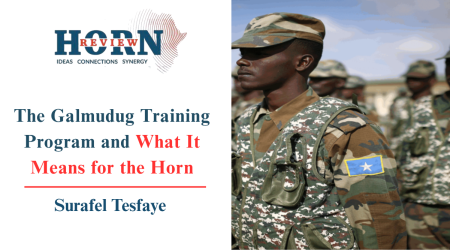
The documented evidence of this intervention is not speculative. Multiple reports from late 2023 and throughout 2024 detail a network of at least half a dozen training camps in Eritrea’s Gash-Barka region which is directly adjacent to Sudan’s eastern states. These camps are not just hosting refugees but are actively training, organizing and arming thousands of Sudanese fighters. The primary recruits are drawn from the very communities with familial ties to Eritrea like the Beni Amer, the Beja and the Rashaida. The groups being forged in these camps include the Eastern Corps which is a Beni Amer-dominated force reportedly led by figures like Al-Amin Daoud under the banner of the United Popular Front for Liberation and Justice factions aligned with Minni Arko Minnawi’s Sudan Liberation Movement which have migrated their operational focus eastward and elements of the Eastern Sudan Liberation Forces. Estimates of the total number of fighters who have undergone or are undergoing training range into the many thousands with one particularly detailed suggesting a figure as high as fifteen thousand personnel. These newly trained and equipped units are then deployed back across the border integrating with or operating in coordination with SAF formations particularly in the eastern axis encompassing Gedaref and Kassala states.
This process carries dangerous implications for the internal activities of Sudan’s war and the country’s future coherence. While the immediate objective is to bolster the SAF’s manpower pool and secure the eastern front, the method is replicating the very pathology of militia empowerment that lies at the heart of Sudan’s tragedy. The formal arming and integration of ethnically defined tribal militias under a military command is not a strategy for building a unified national defense however it is a recipe for long term fragmentation. It empowers sub state actors and local warlords deepening ethnic divides and sowing the seeds for future intercommunal conflict. Eastern Sudan home to the port of Port Sudan has seen a resurgence of tensions including violent clashes between different Beja factions and between eastern communities and other internally displaced populations. By accelerating the militarization Eritrea’s intervention risks creating a self sustaining cycle of violence that will be exceptionally difficult to disarm and reconcile once and if the broader war concludes. The state is not being strengthened and it is being outsourced to armed client networks whose loyalty is contingent and transactional.
The historical precedent is bare and recent just as the vacuum in post Qaddafi Libya provided an incubator for militant groups and illicit economies that destabilized the entire Sahel so too could a protracted Sudanese civil war offer new operations for extremist organizations including those that have historically operated along the Red Sea and in Somalia.
Eritrea’s officials frame this intervention as a purely defensive measure and a necessary act of national self preservation to protect its sovereignty and territorial integrity from the chaos emanating from Sudan. The permanent mobilization and militarization of border societies under the logic of preemptive security inevitably escape the control of their state sponsor generating autonomous violence. The current strategy in Sudan is not extinguishing a fire and it is pouring accelerant on a blaze .The likely outcome is not a stable SAF victory and a controlled border but a multi sided stalemate in which the central state’s monopoly on violence is fatally hollowed out replaced by a patchwork of armed territories governed by warlords who having been essential yesterday become the central problem tomorrow.
Eritrea’s documented training of Sudanese militias is a tactical episode in a distant civil war. It is the logical extension of a deeply ingrained culture of proxy warfare and the instrumentalization of transnational identity which is a modus operandi whose history in this neighbourhood is a chronicle of managed chaos that inevitably becomes unmanageable. Eritrea is not fortifying a stable periphery but actively deepening the fragmentation of the Sudanese state and ensuring that the war’s fault lines calcify along communal lines. The shadow war Eritrea is fighting today is planting the seeds for the open conflicts of tomorrow and the entire region will pay the price for this destructive inheritance.
By Samiya Mohammed, Researcher, Horn Review