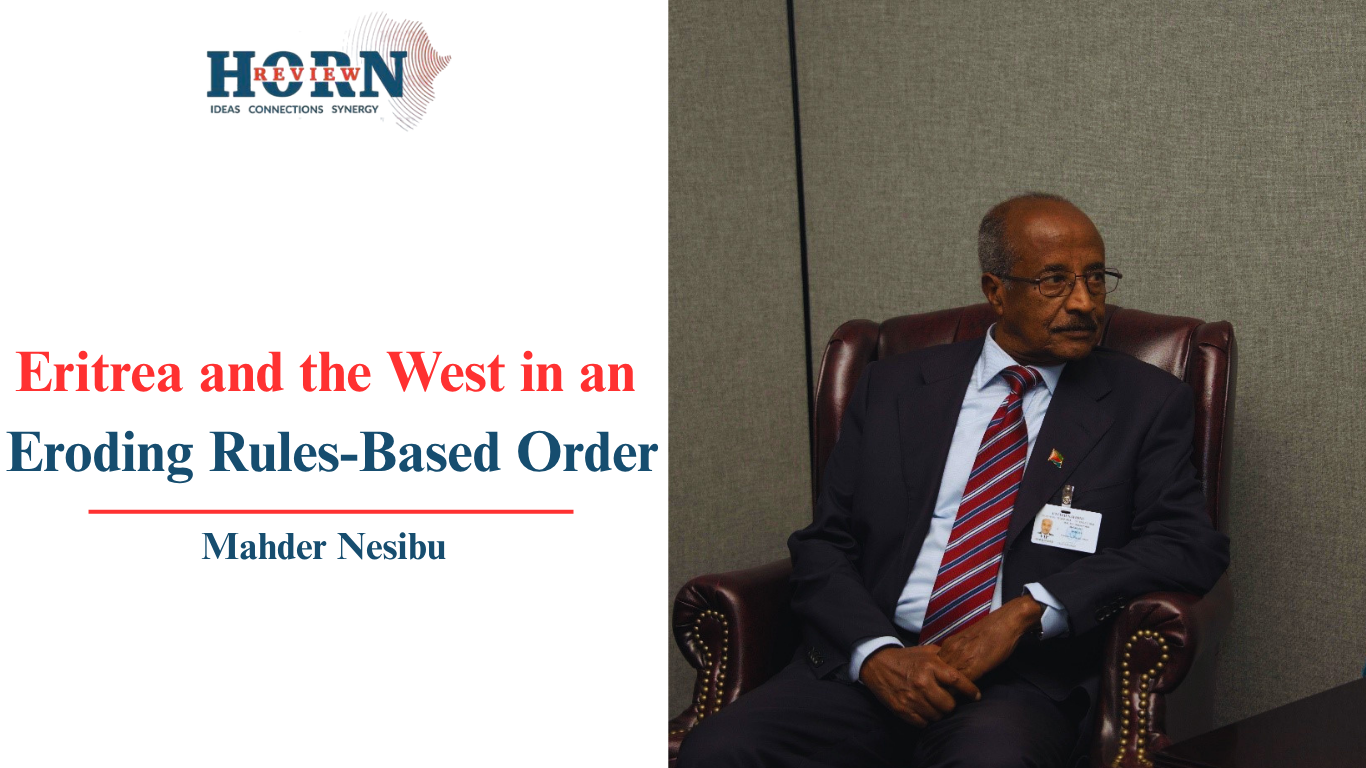
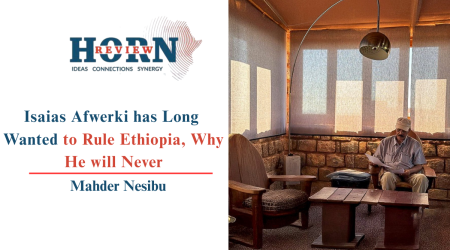
President Isaias Afwerki rarely misses an opportunity, in his local media interviews and public addresses, to offer a lengthy exposition of his reading of the current international system. Over the past few years, he has been describing an international system trending toward multipolarity, the gradual erosion of unchallenged American primacy and the redistribution of geopolitical weight among multiple competing powers.
The President, in his description of this phenomenon, appears optimistic. To him, the fall of the liberal world order, which he sees as the root of Eritrea’s ills, is something to be welcomed.
Isaias’ optimism is not unfounded.
The talk of multipolarity has encompassed most discussions of the international system across the globe, and Asmara has been among its most consistent voices. The world is indeed changing, and the rules-based order that dominated the world for a brief period following the collapse of the Soviet Union has been under strain for quite some time. For Isaias and Eritrea, the system that punished belligerency with crippling sanctions and isolation crumbling is more than good news.
Isaias is reaping the fruits of this collapse.
The changing world has brought many Westerners to the doorstep of Eritrea’s missions and to the country’s capital.
The Horn of Africa, the volatile sub-region home to Eritrea and its neighbours, is also experiencing deepening instability. And to the loss of the Western world, middle powers alongside China and Russia have gained considerable prominence in the foreign policies of regional states and non-state actors alike, leaving United States and Europe on the back foot.
This is what is partially at work in the diplomatic push of these states, and in part, in Eritrea’s own signals of willingness to engage with them.
The long list of middle powers competing for influence and economic gain has compounded Eritrea’s position alongside its neighbours. The immensely wealthy Gulf states have made strategic decisions to prioritise the Horn. Ports, minerals, farmland, and power projection have driven extensive investments and intensifying competition across the middle power space, a crowded arena of states of comparable weight competing for influence in more limited and vulnerable regions beyond their immediate neighbourhood. The rivalry among Gulf actors themselves, visible in the diverging alignments of Qatar, the UAE, and Saudi Arabia, has compounded that complexity further.
Eritrea’s approximately 1,200 kilometres of Red Sea coastline, running along one of the world’s most strategically consequential maritime corridors, has made it a focal point of that competition. The West, slower to register what middle powers identified some time ago, is now feeling the same incentive to engage.
Unlike the middle powers, who throughout the period of Eritrea’s isolation engaged with Asmara on straightforwardly strategic grounds, Europe operated within a framework of normative distance, maintaining formal relations while applying persistent pressure on human rights and political liberalisation. That posture is now giving way to something considerably more transactional.
Europe is highly dependent on the Red Sea waterway for its trade with Asia and the energy hubs of the Gulf. The Houthi campaign against commercial shipping, launched in late 2023 in response to the war in Gaza, forced the rerouting of vessels around the Cape of Good Hope at considerable cost and delay, exposing how vulnerable European trade is to developments along that corridor. The U.S.-Israeli war with Iran has sharpened that awareness further, bringing the strategic importance of Red Sea chokepoints into acute focus and drawing a direct line between Middle Eastern instability and European commerce.
From Sweden to Italy to Canada, diplomatic activity directed at Asmara has accelerated visibly. Italy concluded a broad bilateral cooperation agreement with Eritrea in July last year. Sweden’s Minister for Foreign Affairs, Maria Malmer Stenergard, conducted a working visit to Asmara in December, the first of its kind since 1993. The EU’s Special Representative for the Horn of Africa, Annette Weber, also conducted a recent visit. Joshua Tabah, Canada’s top diplomat for the region, held a meeting in April with President Isaias in Asmara.
European states may have concluded that isolating Eritrea has borne little fruit in terms of discouraging the regime in its repressive policies. Asmara has stood firm in its ways, and Europe, in the pursuit of strategic interests and to the detriment of human rights principles and the conditions of liberalisation, has conceded and is now pushing for a relationship.
The Swedish visit captures this dynamic most plainly. When Foreign Minister Malmer Stenergard arrived in Asmara, her counterpart, Foreign Minister Osman Saleh, made clear that the case of Dawit Isaak, the Swedish-Eritrean journalist held without charge or trial since 2001 and widely considered the world’s longest continuously detained journalist, was a secondary concern. The agenda, from Asmara’s perspective, was “about how we can develop the relationship between our countries.”
In Washington too, there are visible shifts.
The State Department indeed looks different, and the Trump administration’s foreign policy, in both conceptualisation and practice, is distinct in many ways.
The “trade not aid” doctrine, the shutdown of USAID, and the reduction of State Department staff reflect the administration’s rejection of what it considers futile and wasteful efforts to promote democratisation and press governments on human rights. The administration has signalled, both rhetorically and operationally, that it aims to secure the national interest whilst “avoiding passing judgment on authoritarians.”
Previous administrations operated within a different framework. Barack Obama and Joe Biden both oversaw the imposition of sanctions against Eritrea, first in connection with Asmara’s support for Al-Shabaab, and subsequently over its military conduct during the Tigray conflict. That era of conditionality-driven diplomacy appears to be, for now, over.
Trump’s diplomatic apparatus has also changed structurally. Much of the United States’ foreign policy is now conducted through Special Envoys and Senior Advisors, diminishing the role of the State Department and the institutional knowledge and depth that comes with it. Washington’s recent rapprochement efforts towards Eritrea may therefore have given little consideration to the history of American diplomacy toward Asmara, which has yielded few dividends for Washington’s interests.
Trump’s approach to the region in general, and his Senior Advisor for Africa, Massad Boulos, have been subject to criticism by United States foreign policy experts.
The “minerals for peace” framework, applied to the protracted dispute between Rwanda and the DRC in the Great Lakes region, has shown some dividends, though the fundamental fault lines preventing genuine peace and durable consensus continue to persist. Washington’s diplomacy appears to be much more unpredictable, and to some, short-sighted.
Washington’s peace effort in Sudan, a country engulfed in a complex and disastrous civil war, was prompted by a direct appeal from the Saudi Crown Prince to President Trump, and sustained by the administration’s appetite for peace agreements. The United States was a key actor behind the 2005 Comprehensive Peace Agreement, which ended a decades-long civil war. The current conflict has proven a different matter entirely. Juggling the diverging interests of its partners, several of whom back opposing warring parties, Washington has struggled to produce even a momentary humanitarian ceasefire. The Sudan file has revealed a Washington navigating a turbulent and complicated regional landscape, rather than one confidently projecting a leadership role.
Now the country is making another move in the Horn of Africa. The U.S.-Israeli military campaign against Iran has exposed the vulnerabilities of the Gulf region, and Iran’s demonstrated leverage over the Strait of Hormuz has shown its capacity to inflict economic and strategic costs on American interests through asymmetric means.
Washington had already reopened the Eritrea file before the Hormuz crisis deepened. Boulos met with Eritrean Foreign Minister Osman Saleh on the margins of the 80th session of the United Nations General Assembly in September last year, and subsequently held meetings with President Isaias Afwerki in Cairo, in talks facilitated by Egypt. Reports indicate that the lifting of sanctions in on the table. Eritrea’s strategic positioning along the Red Sea has coincided with Washington’s broader foreign policy recalibration. A regime aligned with American interests in the Horn of Africa and along the Red Sea is one worth engaging, and such engagement should yield dividends for those interests, however loosely defined they remain.
All in all, the weakening of the rules-based order means that the systems of pressure placed against the authoritarian regime of Isaias Afwerki are now loosening.
That spells trouble, more than most, for the people of Eritrea, who have been subject to repression for three decades, a period itself preceded by additional decades of civil war. As these states scramble for the goodwill of Asmara and lower the standards for engagement, giving ground to interests over principles, Eritreans see their hopes for democratisation and political freedom diminish. Indefinite national service has consigned an entire generation to open-ended military obligation, political repression has foreclosed civic life, and the diplomatic push now underway offers those conditions renewed protection from external scrutiny.
For the region also, things will likely fare worse. Since the lifting of United Nations sanctions in 2018, Eritrea has been involved in two major conflicts, first in Ethiopia, and now in Sudan. An emboldened Eritrea, to the detriment of the West’s stated strategy of engaging Asmara to produce net positives for themselves and the region, will likely move to deepen regional instability and complicate existing conflicts further. It is already doing so, and increased diplomatic standing will likely reinforce the destabilising foreign policy logic embedded within the Eritrean system.
Eritrea’s neighbour has already absorbed the lesson of the risks of engagement. After the 2018 rapprochement, Ethiopia invested significantly in normalising bilateral relations with Asmara, only to find that engagement produced, in relatively short order, Eritrea’s military intervention in Tigray and a subsequent deterioration of the relationship. Ethiopia now finds itself confronting a destabilising foreign policy from Asmara that continues to test its national security, a cautionary precedent that Western capitals, in their current rush toward Eritrea, appear prepared to set aside.
By Mahder Nesibu, Researcher, Horn Review