
30
Apr
Sudan’s Enduring War and the Limits of the Quad Process
The conflict in Sudan, often reduced to a collision between two recalcitrant generals, is more accurately understood as the terminal phase of a failed experiment in dual sovereignty. It is a crisis of biological rejection: a state that created an autonomous organ for its own protection only to find that organ has grown so large and predatory that it now seeks to consume the entire body. The “Quad” peace roadmap, unveiled in September 2025 by the United States, Saudi Arabia, the United Arab Emirates, and Egypt, attempted to treat this systemic collapse with the superficial balm of a calendar. By prescribing a three-month humanitarian truce followed by a nine-month transition to civilian rule, the roadmap assumed that Sudan remained a singular nation-state waiting for a bureaucratic reset.
However, as the regional shockwaves of the 2026 Iran-Israel war reverberate through the Red Sea, the Quad’s internal contradictions have been laid bare. The peace process is not merely stalled; it is being actively dismantled by the very powers tasked with its stewardship, as the existential threat of a broader Middle Eastern conflagration forces Gulf capitals to prioritize transactional survival over Sudanese stabilization.
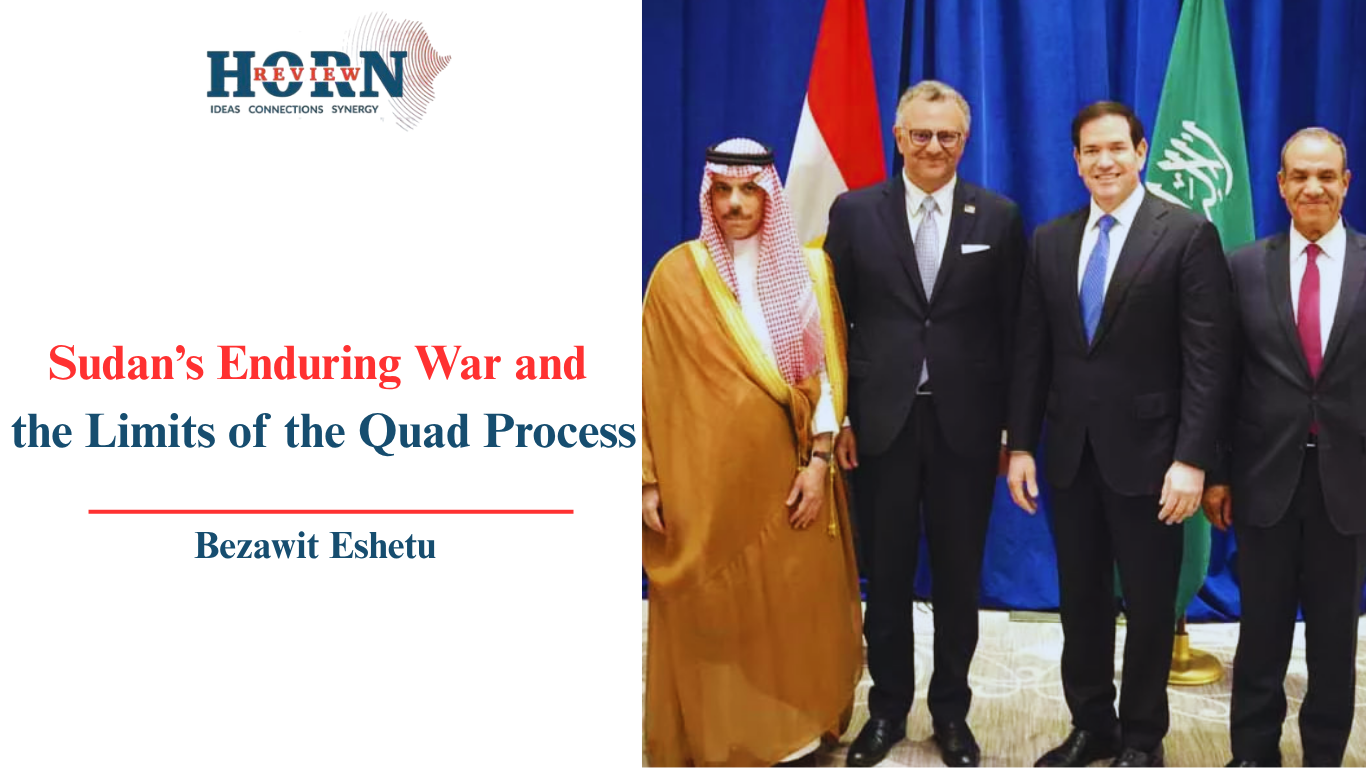
The Quad was never born from a shared vision for Sudan. It emerged as an improvised response to the October 2021 coup, after Washington recognized that sanctions and debt relief alone could not move a military elite that viewed civilian rule as a direct threat to its survival. Bringing Saudi Arabia, the UAE, and Egypt into the process was an attempt to work through the real gatekeepers of Sudan’s finance and regional security. In that sense, U.S. involvement was useful to Burhan less as a trusted partnership than as a source of cover, leverage, and international legitimacy. Even the Quad’s later September 2025 roadmap reflected that contradiction: an ambitious effort to force a humanitarian truce and political transition, but one that still struggled to win genuine buy-in from the warring sides.
For the Gulf capitals, the Quad has functioned less as a peace forum than as a mechanism for aligning competing interests. Each actor has approached Sudan through a different strategic lens, but the effect has been the same: a diplomacy of managed contradictions, in which public support for civilian transition sits uneasily beside private ties to armed patrons and wartime economies. The UAE in particular has been repeatedly linked, in reporting and investigations, to networks of RSF wealth and extraction, including gold-linked fortunes that have circulated through Dubai real estate. That is why the Quad has often looked less like a genuine architecture for peace than a table at which rival ambitions are quietly normalized.
To understand why this arrangement failed so quickly, one has to go back to Bashir’s coup-proofing strategy. His logic was simple: no single coercive institution should ever become powerful enough to challenge him. The RSF, which grew out of the Janjaweed and was formalized in 2013, was the product of that design. Bashir then deepened its autonomy by deploying both SAF and RSF units in Yemen under the Saudi-led coalition, strengthening the RSF’s finances, external ties, and political confidence. What emerged was not just a militia, but a parallel center of power: armed, funded, and institutionally insulated enough to survive Bashir’s fall in 2019 and later compete for the state itself.
The war that erupted in April 2023 was the collision of those two competing state projects. For the SAF, the conflict is a restorationist attempt to reclaim the monopoly of violence that defines a conventional state. For the RSF, it is a hostile takeover of Sudan’s sovereignty into a system of privatized assets, patronage, and extraction. External actors have not contained that struggle so much as amplified it. The clearest example was the cancellation of Sudan’s $6 billion Abu Amama port deal with the UAE in November 2024, after Port Sudan accused Abu Dhabi of backing the RSF. That decision showed how quickly commercial rivalry had become a proxy battlefield, and why the Quad’s language of civilian transition has repeatedly collided with the realities of war economy politics.
Egypt’s support for General Burhan and the Sudanese Armed Forces reflects more than a preference for military continuity over political transition. It is also shaped by a deeper strategic concern rooted in Nile water politics. Cairo reads Sudan through the lens of regional water security, especially in relation to the Grand Ethiopian Renaissance Dam and the broader dispute with Ethiopia. From that perspective, backing the SAF is not simply a bet on one armed actor over another; it is a way of preserving a centralized authority in Khartoum that can remain strategically aligned with Egypt on Nile-related issues. A fragmented Sudan, or one dominated by the RSF, would introduce a more uncertain and less predictable partner into an already fragile regional equation. Egypt’s interest therefore lies in an army-led Sudan that preserves enough state coherence to remain useful in long-term regional negotiations.
The wider Iran-Israel war has sharply altered the calculations of the Quad’s members. In the earlier phase of Sudan’s conflict, Gulf states viewed the country as a space for projecting power: a venue to secure ports, food corridors, and anti-Islamist influence. But the 2026 regional shock has turned those same capitals inward. As Iran and Israel exchange strikes that threaten energy markets and domestic infrastructure, the Quad members have become more defensive, risk-averse, and transactional. The focus has shifted away from transforming Sudan into a stable democracy and toward containing it as a manageable disorder. Saudi Arabia now sees the conflict primarily through the lens of Red Sea security and the prevention of Iranian encroachment. The restoration of ties between the SAF and Tehran in 2024, followed by the delivery of Iranian Mohajer-6 drones to the army, has deepened Riyadh’s anxiety and pushed it further toward prioritizing state continuity, even at the cost of tolerating a brutal military order.
This regional defensiveness is the poison inside the Quad roadmap. Although the roadmap speaks the language of civilian transition and unified political settlement, its sponsors continue to pursue divergent endgames. The UAE cannot afford a settlement that strips the RSF of its foothold on the African coast; Egypt cannot accept an RSF victory that would leave a powerful paramilitary authority on its southern frontier. As the Iran-Israel war heightens regional vulnerability, none of these actors is likely to spend the political capital needed to push its Sudanese allies toward compromise. The result is a drift toward either frozen conflict or de facto partition. By late 2025, that possibility had already begun to take shape, with the RSF establishing its “Government of Peace and Unity” in Darfur and Khartoum, alongside its own administrative structures and plans for a parallel currency. Sudan is no longer simply a country in civil war; it is becoming a geography of parallel governances, with the SAF entrenched in the north and east and the RSF dominant in the west and parts of the center.
One reason the Quad roadmap has struggled is that its leading members do not experience the war’s consequences in the same way as Sudan’s neighboring states. The United States, the UAE, and Saudi Arabia can absorb the conflict at a relative distance, even as they treat it as a strategic concern. Ethiopia, South Sudan, and Chad, by contrast, face the war’s direct spillovers: displacement, insecurity, border instability, and regional disruption. That asymmetry creates a classic collective action problem. Some actors are incentivized to preserve leverage and manage the conflict for their own purposes rather than resolve it for the public good. The result is a widening gap between the rhetoric of peace and the logic of power. For Gulf and Western states, Sudan remains a site of influence, security competition, and diplomatic positioning, while the immediate human and economic burden continues to fall on Sudanese civilians and neighboring countries.
The Quad’s insistence on “calendar peace,” meaning a settlement measured in months rather than in transformed incentives, is therefore a diplomatic illusion. It assumes the warring parties are fighting over the same state, when in fact they are fighting over whether the state should survive as a public bureaucracy or be broken into a privatized system of extraction. The RSF has demonstrated that it can perform many of the functions of statehood, including diplomacy, territorial control, resource management, and military coercion, without accepting the burdens of a social contract or a tax-paying public. This “venture state” model is inherently resistant to negotiation because its revenue streams are transnational and its survival does not depend on the welfare of Sudanese citizens. As long as gold continues to flow toward Dubai and arms continue to move across regional supply lines, the RSF has little incentive to submit to a centralized chain of command that would necessarily dilute its power.
That structural logic also explains why Washington’s sanctions on Islamist-linked figures within the SAF and senior RSF commanders have increasingly shown their limits. In the context of the regional crisis, they read less like a decisive instrument than like a leftover from a previous political moment. U.S. policy is now trapped between its desire for stability and the reality that its regional partners, especially Saudi Arabia and the UAE, are no longer operating within a single American framework. The Quad has become a divided structure, and the regional war has only deepened those divisions. Each member now calculates that a unified Sudan matters less than a Sudan that does not become a platform for Iranian influence or a source of regional contagion. If preserving that security requires the country’s permanent fragmentation, the Quad members appear increasingly prepared to accept it as the price of their own strategic insulation.
Seen from that angle, the Sudan war is no longer just a contest between two armed factions. It is unfolding inside a regional environment where external actors mediate the conflict while also sustaining rival forces, which makes any negotiated settlement far more fragile. Historical comparisons, including the Lebanese Civil War, are useful here because they show how peace processes weaken when outside powers both brokers talk and help keep the fighting alive. Alex de Waal’s concept of the “political marketplace” helps sharpen this point further, since it describes a system in which power is organized around patronage, coercion, and negotiated survival rather than stable institutions. The Quad’s effectiveness is limited in part because it does not fully incorporate neighboring states such as Ethiopia which is directly affected by spillover, displacement, and insecurity. A more durable settlement would therefore need broader regional inclusion and a clearer recognition of the states most exposed to the conflict’s consequences. Without that, the peace process risks remaining too narrow to produce a lasting political resolution.
The deepest tragedy of the Sudanese collapse is that the original sin of Bashir’s militarization created a structure perfectly suited for the twenty-first-century political marketplace. In this marketplace, sovereignty becomes a commodity to be traded rather than a duty to be upheld. The war is not happening because the state is weak; it is happening because there are two state-like powers occupying the same territory, both drawing on the legal and symbolic residue of the old order. The splitting of sovereignty is not a temporary breakdown but a durable replacement of the nation-state model. Sudan is becoming a blueprint for a new kind of “non-state state,” where a territory has a flag and a seat at the international table, but functions as a private security firm leased by foreign interests.
Thus, the failure of the Quad roadmap signals more than a diplomatic impasse; it represents the formal liquidation of the Sudanese nation-state in favor of a more manageable regional disorder. In the context of regional insecurity, including heightened tensions between Iran and Israel, Gulf governments may be prioritizing immediate security concerns and pragmatic arrangements over a comprehensive political transition in Sudan. As a result, external actors increasingly seem focused on containing instability and protecting strategic interests, rather than advancing a fully inclusive social contract. In this setting, the idea of a “venture state” can be understood less as an exception and more as a warning about what can happen when state institutions are weakened and public authority is fragmented. Sudan’s crisis may therefore be seen as part of a wider pattern in which sovereignty is constrained by competing external influences, local power centers, and economic interests, even as formal state symbols remain in place.
By Bezawit Eshetu, Researcher, Horn Review

RELATED
Posts
24
Aug
Will the New Saudi-SAF Supreme Council Strengthen or Weaken Peace Prospects?
The formalization of the Supreme Council for Strategic Coordination and...
24
Aug
Egypt and Yemen in Ethiopia’s Security Architecture
The conventional geographic definition of the Horn of Africa no...
23
Aug
Djibouti's Burden Sharing Appeal and Ethiopia's Path to Influence
Djibouti's public communications regarding the security of the Bab...
20
Aug
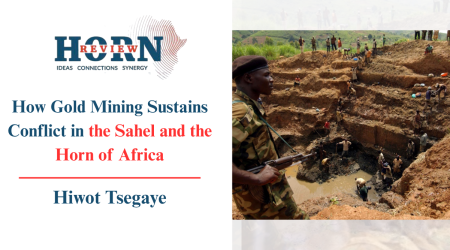
How Gold Mining Sustains Conflict in the Sahel and the Horn of Africa
Across a stretch of Africa running from northern Mali to...
19
Aug
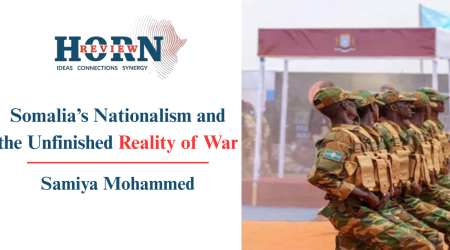
Somalia’s Nationalism and the Unfinished Reality of War
President Hassan Sheikh Mohamud's supervision of the Somali National...
18
Aug
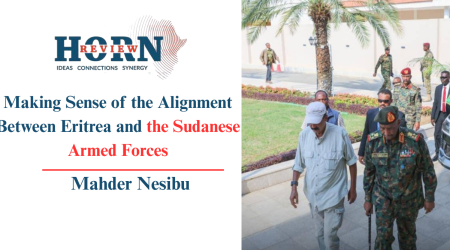
Making Sense of the Alignment Between Eritrea and the Sudanese Armed Forces
Among the alliances shaping the geopolitics of the Horn of...
17
Aug
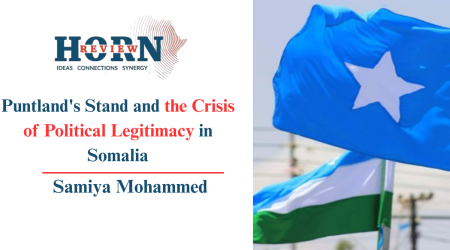
Puntland's Stand and the Crisis of Political Legitimacy in Somalia
The decision by Puntland to place its armed forces on...
17
Aug
The Warsheikh Facility and Somalia's Pattern of Asymmetric Agreements with Turkey
Turkey has commenced construction on a spaceport near Warsheikh...
15
Aug
Puntland's Red Sea Dividend and How Saudi Arabia's Maritime Is shaping Somali Military Recruitment
The security area of the Horn continues to evolve through layers of...
15
Aug
Egypt and the Mecca Pact: A State Without Room to Align
When Turkey, Saudi Arabia, and Pakistan signed a Nato-style collective-defence pact...