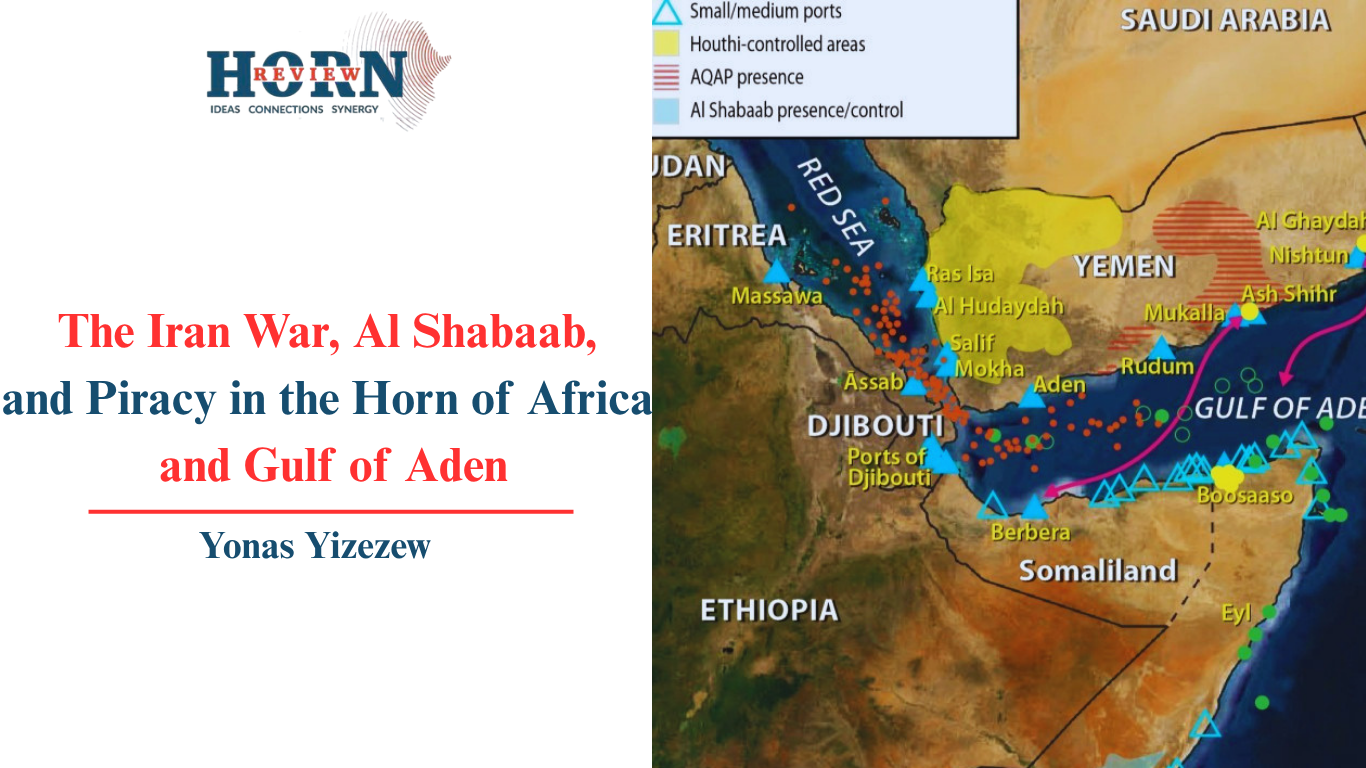
On April 26, 2026, the United Kingdom Maritime Trade Operations reported that unauthorized persons had seized a cargo vessel on northeast of Garacad on Somalia’s central coast. They forcibly redirected the ship into Somali territorial waters. Earlier than that, authorities had warned of a tanker boarded northeast of Mareeyo and dragged south into Somali waters. These twin hijackings, which occurred in close temporal proximity, signal a renewed resurgence in Somali piracy. They signal that the Gulf of Aden and the wider Horn of Africa have entered another period of heightened maritime insecurity. The incidents show symptoms of a broader regional dynamic. In this dynamic, the Iran-related war, Al Shabaab’s territorial and networked expansion, and the militarization of the Red Sea and Bab el Mandeb reinforce one another.
The Iran war has created ripple effects that reach far beyond the Middle East. Western and Gulf powers have redirected naval, intelligence, and air assets toward the Eastern Mediterranean and the northern Red Sea. There, Houthis, Iranian-backed networks, and other State and non-state actors have engaged in escalating confrontations. This realignment has reduced maritime patrols and airborne surveillance in the Gulf of Aden and the western Indian Ocean. It has created a security vacuum along the Somali coast and in the approaches to the Bab el Mandeb, where vessels now operate in a less predictable environment. The risk of piracy, armed robbery, and coordination with land-based networks has increased.
Somali piracy must be understood as both a criminal enterprise and a political-military instrument. Historical patterns show that spikes in piracy often follow periods of state collapse, regional conflict, and external distraction. The current resurgence fits this pattern as it unfolds within a Somali federal structure that has become increasingly fragile and contested. For instance, the March 2024 break between the Federal Government in Mogadishu and Puntland has further weakened state authority along the coast. Puntland withdrew from the federation in protest over constitutional reforms. In this fragmented landscape, local maritime networks operate with greater freedom. Some networks are clan-based while others link to criminal or insurgent groups. They exploit gaps between federal and regional jurisdictions.
Piracy today depends on sophisticated surveillance, information sharing, and logistical support from land-based networks. Somali pirates monitor vessel movements through open-source maritime tracking data, local informants, and sometimes collusion with officials or port-side actors. These actors can provide details on cargo value, ownership, and routing. The April 2026 hijackings suggest that the operations were deliberately targeted. They relied on detailed knowledge of shipping lanes and vessel schedules. When successful, such hijackings produce ransom payments worth millions of dollars. These funds have often been recycled into weapons procurement, local patronage, and support for armed groups operating inland.
Al Shabaab stands as one of the most significant beneficiaries of this evolving maritime-illicit ecosystem. The group has long maintained a presence along the Somali coast. It controls segments of the coastline, taxes maritime trade, and uses ports and anchorages as logistical nodes. Evidence based reports shows that Al Shabaab increasingly coordinates with pirates and other criminal networks. This coordination turns the Gulf of Aden into a gray space where terrorism, smuggling, and piracy intersect. The ransom earned from earlier hijackings, such as the MV Abdullah in April 2024, has reportedly financed Al Shabaab’s operations. These include recruitment, weapons procurement, and the maintenance of safe havens in remote areas. The April 2026 incidents represent potential revenue streams that can strengthen the operational capacity of an insurgency that already controls substantial territory in central and southern Somalia.
At the same time, Al Shabaab’s ties to the Houthis deepen the regional dimension of this threat. A 2025 UN Panel of Experts report documented increasing collaboration between the Houthis and Al Shabaab. This includes the transfer of drones, improvised explosive devices, and small arms munitions through maritime routes and land-based corridors particularly, the Gulf of Aden, the Horn of Africa, and at times networks linked to Saudi Arabia. The Houthis benefit from having a sympathetic actor on the opposite side of the Bab el Mandeb. Such an actor helps them project influence, test Western and regional responses, and secure alternative routes for logistics and intelligence. For Al Shabaab, the alliance provides access to more advanced weaponry and technical expertise. It enables the group to conduct more sophisticated attacks on Somali and regional targets while improving its ability to disrupt maritime traffic.
On the other hand, the US administration’s retreat from state-building efforts in Africa, despite kinetic operations, particularly in Somalia, has deepened these challenges. In parallel, the recent large-scale coordinated attacks by Al-Qaeda-aligned groups in Mali may also motivate Al Shabaab by showing the potential for bold advances against weakened governments.
This convergence of forces has transformed the Horn of Africa, the Bab el Mandeb, and the Red Sea from a primarily counterterrorism region into a proxy arena. Gulf and other middle powers invest heavily in ports, military bases, and security partnerships across the region. They do so mainly to secure access to the Red Sea and the wider area. These investments are driven by economic priorities, energy security needs, and growing rivalry among these actors seeking to expand their reach, secure access, and strengthen their security presence. Yet this same competition over maritime access and port infrastructure often sidelines long-term state-building and reconciliation efforts such as in Somalia. External actors focus more on securing alliances and access agreements than on building inclusive and accountable institutions.
The Somali Federal Government finds itself pulled between these external pressures and its own internal priorities. Its focus has shifted toward consolidating power among loyal elites and negotiating alliances with Gulf actors, where constitutional and electoral disputes have intensified at the same time. This shift has often come at the expense of coherent security sector reform and counterterrorism strategy. African Union-backed missions and bilateral Western partners continue to provide material and military support. However, their attention has been diluted by funding gaps, the Iran-related war, and other global flashpoints. This combination of internal fragmentation and external distraction has created a security gap. In that gap, Al Shabaab has expanded its territorial control, re-armed, and repositioned itself as a quasi-state actor. It governs territory, collects taxes, and provides basic services to populations who otherwise receive little from the state.
Climate change and resource scarcity further compound this dynamic. The Horn ranks among the most climate-vulnerable regions in Africa. Recurring droughts, erratic rainfall, and desertification undermine pastoral livelihoods and smallholder agriculture. As arable land and water grow scarcer, competition over resources intensifies. This sharpens inter-clan and inter-community tensions that Al Shabaab can exploit. Displacement, food insecurity, and dependence on humanitarian aid create conditions in which violence and recruitment flourish. These factors offer young men alternatives to economic marginality and social exclusion. In this context, piracy off the Somali coast extends beyond a criminal enterprise and reflects a broader crisis of governance, livelihoods, and territorial control that Al Shabaab seeks to exploit.
Furthermore, its coastal expansion combined with Houthi ties also raises the risk of connecting African jihadist networks with Red Sea militancy, posing broader threats to global shipping and humanitarian access.
External powers in the Horn focus increasingly on alliance building and access. At the same time, the region lacks the institutional capacity to coordinate a coherent maritime security strategy or a unified counterterrorism framework. The Gulf of Aden and the Bab el Mandeb were once managed mainly by international naval coalitions. They have now become sites where local actors, pirates, and terrorist networks operate in the shadows of larger state-level conflicts. This layered battlefield combines Houthi maritime attacks in the Red Sea, Somali piracy in the Gulf of Aden, and Al Shabaab’s territorial and networked operations inland. It creates a complex security environment that single-domain or single-actor approaches cannot resolve.
The connections run deep, as every increase in piracy, territorial gain by Al Shabaab, and escalation in the Horn and the Red Sea serves as both a symptom and a cause of the same underlying dynamics. Weak states, external meddlers, and violent networks continue to reshape security, trade, and politics across the region. These changes will outlast any single incident at sea.
By Yonas Yizezew, Researcher, Horn Review