
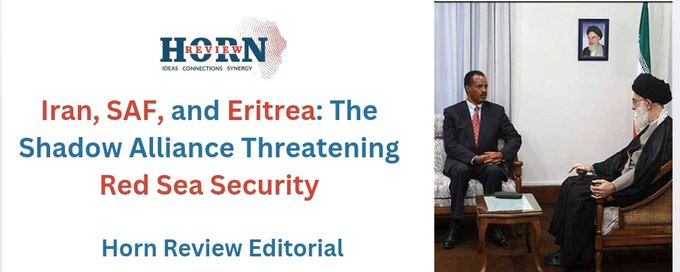
Iran, SAF, & Eritrea: The Shadow Alliance Threatening Red Sea Security
The intensifying confrontation between Iran and Gulf states, the ongoing war in Sudan, and the strategic contest along the Red Sea are converging into a complex theater of regional power dynamics. These developments reveal a web of alliances and transactional relationships that link Sudan’s conflict, Eritrea’s strategic coastline, Iran’s regional ambitions, and Egypt’s calculated geopolitical maneuvering. Recent decisions in Washington, including the designation of Sudanese Islamist formations associated with the Sudanese Armed Forces (SAF) as terrorist organizations, have brought these intersecting networks into sharp focus. Notably, the U.S. decision received explicit support from Saudi Arabia, with Saudi Foreign Minister Faisal bin Farhan reportedly endorsing the move in communications with Secretary of State Marco Rubio. This reflects growing Gulf concerns over Iran’s regional influence and the expansion of Islamist-aligned actors within Sudan’s conflict. SAF, led by Abdel Fattah al-Burhan, while ostensibly a national institution, its wartime alliances include Islamist formations historically tied to the Muslim Brotherhood, which have benefited from external patronage. The U.S. designation underscores the perceived transnational ideological and military links, including those with Iran. Iranian drones and other military technology reportedly transited through Eritrea before reaching Sudanese actors, demonstrating a regional corridor connecting Tehran to the battlefield in Sudan. Multiple witnesses and intelligence sources have confirmed that Iranian Mohajer-6 drones and Turkish TB2 systems reached Sudan via Asmara Airport in June 2025, highlighting Eritrea’s logistical role in facilitating Tehran’s operational reach.
Eritrea’s relationship with Iran is longstanding and deeply embedded. As early as May 20, 1998, Qassem Soleimani, then commander of Iran’s Quds Force, reportedly met with Eritrean President Isaias Afwerki, in the presence of Iranian Foreign Minister Manouchehr Mottaki – two weeks after the start of the 1998 Ethio-Eritrean war. The discussions focused on bolstering Eritrea’s military capabilities, including the construction of an ammunition factory, while providing Iran a strategic presence along the Bab el-Mandeb Strait. Afwerki’s subsequent visit to Tehran in May 2008 to meet President Mahmoud Ahmadinejad further cemented bilateral cooperation across security, industry, energy, and regional diplomacy. Following the meeting, Ahmadinejad publicly declared that “there is no limit to Iran-Eritrea ties.” Several agreements were signed covering trade, investment, and economic cooperation. Afwerki has also remarked in interviews that his affinity for Iran has historical roots: he recalled that the late Ayatollah Khomeini used to include Eritrea in his Friday prayers during the country’s struggle for secession from Ethiopia, a symbolic act that Afwerki describes as part of the foundation for Eritrea’s enduring diplomatic and political ties with Tehran that dates back to the early 1960s Eritrean Liberation Front (Jebha) movement that was initially formed in Cairo, Egypt. Jebha’s early leadership included Islamist figures such as Hamid Idris Awate, and the movement drew strong support from Muslim communities, particularly from the lowland regions of Eritrea – not only because many early leaders were Muslims educated or based in Arab states, but also for the movement received political and logistical support from largely Muslim and Arab countries such as Egypt, Sudan, Syria, Iraq, Iran, Libya and others. Its early social base was heavily Muslim lowland fighters until ideological and ethnic tensions emerged in the 1970s where the highland fighters and left-leaning cadres split from the ELF and formed Eritrean People’s Liberation Front (EPLF), which later became the dominant independence movement maintaining the ties with the aforementioned Arab and Gulf states, including Iran.
This historical connection has often been cited to explain Eritrea’s longstanding strategic alignment with Iran, blending ideology, pragmatism, and geopolitical calculus. Eritrea’s political alignment with Tehran soon extended into the diplomatic arena. Afwerki publicly defended Iran’s nuclear program, describing nuclear energy as Iran’s legal right and later stating that the program was “a source of pride.” Eritrean Foreign Minister Osman Saleh Mohammed echoed similar positions during meetings of the Non-Aligned Movement, formally supporting Iran’s enrichment rights. Eritrea’s geography also provides Iran with a strategic vantage point along the Red Sea. Eritrea’s coastline lies directly adjacent to the Bab el-Mandeb Strait, the maritime chokepoint linking the Red Sea with the Gulf of Aden and the global shipping routes that ultimately pass through the Suez Canal. A substantial portion of global trade flows through this corridor. Control or monitoring of this passage carries enormous geopolitical implications. The intelligence value of Eritrean territory is amplified by the concentration of foreign military installations across the water in Djibouti, including major bases operated by the United States Armed Forces and the French Armed Forces. From Eritrea’s coastline, surveillance assets could potentially observe naval deployments and maritime traffic throughout the southern Red Sea.
Throughout the late 2000s and early 2010s, reports suggested that Iranian vessels periodically called at Eritrean ports for logistical support. Eritrean territory was also alleged to have served as a conduit for covert weapons shipments destined for Iranian regional partners, including Palestinian groups and Yemen’s Houthi movement. Intelligence reports have indicated that some smuggling networks used coastal areas in Eritrea to offload weapons shipments before transporting them onward by small vessels across the Red Sea. During the same period, Eritrea faced international sanctions and strained relations with Western governments, conditions that further encouraged cooperation with alternative partners. Some reports suggested that Iranian networks intersected with Eritrea’s own regional relationships, including periods when Asmara was accused of supporting the Somali militant group Al-Shabaab. In 2008, Iran secured a military presence at the refurbished Soviet-era oil refinery in Assab, providing technical assistance and cash support. In 2009, Iran’s Export Development Bank transferred $35 million to Eritrea. Reports suggest that Eritrean ports, including Assab and Massawa, were used by Iran to facilitate covert arms shipments to Yemen and other regional actors. Satellite imagery and reporting indicate that Iranian-linked cargo aircraft, including Fars Air Qeshm 747s and Belarusian IL-62s, landed at Massawa as recently as November 2025, carrying drones, precision munitions, and technical personnel. Over time, Eritrea’s ports evolved into a hub for Iran’s regional operations, amplifying Tehran’s Red Sea projection beyond non-state actors such as the Houthis.
The maritime dimension of Iran’s engagement with Eritrea became particularly visible after 2016 when an Iranian vessel associated with the IRGC – the MV Saviz – established a long-term presence near Eritrean waters. The vessel functioned as a floating intelligence and logistics platform reportedly supporting Iranian regional operations. The ship was eventually sanctioned by the United States and damaged in 2021 before being replaced by another Iranian vessel performing a similar function, the MV Behshad. Although Eritrea severed diplomatic relations with Iran in 2016 following pressure from Gulf states after attacks on Saudi diplomatic missions in Tehran, the strategic logic of cooperation never fully disappeared. Eritrea simultaneously deepened relations with Gulf partners, including hosting a military facility operated by the United Arab Emirates Armed Forces at Assab beginning in 2015. When the UAE was forced by the Eritrean regime to withdraw from the base in 2021, however, a strategic vacuum emerged along Eritrea’s coastline. Recent developments suggest that Iran has re-established logistical access to Eritrean territory.
Satellite imagery and flight-tracking data in 2025 documented the arrival of heavy cargo aircraft linked to sanctioned Iranian logistics networks at Eritrea’s port city of Massawa. The aircraft included platforms associated with Iranian cargo operator Fars Air Qeshm, which has previously been sanctioned for transporting military equipment and drone systems. Analysts noted that such aircraft are capable of carrying disassembled unmanned aerial systems, precision munitions, and technical personnel. Witness accounts from the Sudan conflict have suggested that Iranian Mohajer-6 drones and other equipment may have transited through Eritrean territory before reaching Sudanese actors. If confirmed, such movements would place Eritrea at the center of a logistical corridor linking Iranian military technology to the Sudanese battlefield.
At the center of the regional alignment stands a strategic triangle linking Sudan, Egypt, and Eritrea. The Sudanese Armed Forces (SAF), led by Abdel Fattah al-Burhan, continue to consolidate power domestically while drawing on external support. Cairo, under President Abdel Fattah al-Sisi, has historically maintained close relations with Khartoum’s SAF, providing political backing, strategic guidance and at times, covert military interventions, particularly during periods of Sudanese instability. Eritrea, under President Isaias Afwerki, complements this alignment by offering mercenaries and geographic access along the Red Sea coast – most notably the ports of Assab and Massawa – which can serve as staging grounds, resupply nodes, and logistical hubs for allied operations.This SAF–Egypt–Eritrea configuration is further complicated by Iranian engagement in Eritrea. Through decades-long relationships, Tehran has developed port access, logistics corridors, and weapons transit capabilities in Eritrean territory, sometimes extending to Sudan via Asmara. While Eritrea’s cooperation with Iran appears pragmatic, it effectively positions Eritrean territory as a bridge between Iranian regional ambitions and the Red Sea Security.
Chronologically, the Iran–Eritrea relationship demonstrates both continuity and adaptation. Here are some of the key official engagements identified within the period of the last three decades.
- May 20, 1998 – Qassem Soleimani – Isayas Afwerki Meeting
- June 2007: Afwerki publicly endorses Iran’s nuclear energy rights (IRNA).
- Nov 2007: Eritrean FM Osman Saleh Mohammed formally backs Iran’s enrichment program at NAM Ministerial.
- May 2008: Afwerki meets Ahmadinejad; bilateral trade and investment agreements signed.
- July 2008: Afwerki highlights Eritrea’s pursuit of alternative partners, citing Iran.
- Oct 2008: MoU signed to boost scientific, educational, and cultural cooperation.
- Dec 2008: Iran granted exclusive control over the Assab refinery in exchange for upgrades; reports emerge of alleged Iranian military deployment at Assab.
- Apr 2009: Iran, Algeria, and Eritrea agree to expand cooperation.
- May 2009: Afwerki calls Iran’s nuclear program a source of pride; denies presence of Iranian bases but acknowledges Iranian “forces” at Assab.
- Nov 2009: Allegations surface of Iranian weapons transiting Eritrean coastal towns to the Houthis; UN monitoring reports 2009–2012 confirm Eritrea’s logistical cooperation with Iran.
- 2013–2015: Engagement declines under Rouhani due to JCPOA prioritization.
- 2015: UAE establishes military base at Assab; Eritrea pivots toward Gulf engagement.
- Jan 2016: Eritrea severs diplomatic ties with Iran under Gulf pressure.
- Late 2016: MV Saviz arrives off Dahlak Archipelago.
- 2016–2021: Saviz operates as an intelligence platform, supporting Houthi operations.
- 2018: Saviz sanctioned by the U.S. yet continues operations.
- Apr 2021: Saviz struck by limpet mine, towed to Bandar Abbas.
- 2021–2024: MV Behshad replaces Saviz, continuing operations off Eritrea.
- Feb 2021: UAE withdraws from Assab; strategic vacuum emerges.
- Jan 2024: Behshad displaced by U.S. pressure; relocates to Gulf of Aden.
- Apr 2024: Behshad returns to Bandar Abbas post-cyberattack.
- 2024: Iran regains access to Assab and Massawa ports; Eritrea expels UAE-linked companies.
- Nov 2025: Sanctioned Iranian flights land at Massawa; drones transferred to Eritrea via Assab/Massawa ports.
- Jun 2025: Iranian Mohajer-6 drones and TB2s routed through Asmara Airport to Sudan.
In contrast to Eritrea’s growing alignment with Iran in recent years, in addition to its strained relations with the US and the West, its relatively moderate earlier relationship with Israel has experienced a significant deterioration. Since formalizing diplomatic ties in 1993, Israel maintained a consistent diplomatic presence in Asmara, with nine successive ambassadors serving over nearly three decades. However, relations gradually cooled and effectively collapsed in 2020 following the departure of Ambassador Gadi Harpaz. Although Israel appointed Ishmael Khaldi as his successor that same year, the Eritrean government declined to grant him accreditation for more than two years without explanation. Consequently, Israel decided to close its embassy in Asmara in July 2022, leaving the diplomatic mission shuttered. Meanwhile, the Eritrean Embassy in Israel has remained open but has also operated without a full-ranking ambassador for several years. The mission is currently managed by a chargé d’affaires and a small diplomatic staff. Despite the absence of full diplomatic representation, the two states are widely believed to maintain limited and discreet security and intelligence contacts.
That noted, such key engagements between the Iranian and Eritrean regime intersects with broader strategic concerns for all western, gulf and horn stakeholders. The recent U.S. designation of Sudanese Islamist formations linked to the SAF as terrorist organizations underscores these interconnections and reflects a growing concern over the SAF’s ties to both Islamist networks and external powers, as well as the broader implications of this triangular regional alignment. The SAF’s operational reliance not only on Iran, but also the Egyptian and Eritrean regimes, coupled with mercenary provision, military intervention, logistical facilitation and political backing, makes the Red Sea corridor a focal point where geopolitical rivalry, maritime security, and conflict dynamics intersect.
By Horn Review Editorial

Leave a Reply Cancel reply
RELATED
Posts
15
Sep
What the UN’s Darfur Sanctions Rollover Reveals About the Next Phase of Sudan’s War
On paper, Resolution 2828 is a housekeeping measure. It...
14
Sep
Eritrea Can’t Secure the Red Sea. Here Is Why
When Saudi Arabia formed a coalition of states in...
14
Sep
Shadow Competition in the Horn, Saudi Training and Emirati Surveillance
The Horn is experiencing a shift in the character of...
14
Sep
Egypt's Rafale Rush Is What's Left After Washington Closed the Other Doors
Egypt is nearing a new deal with French company...
14
Sep
Why Has Ethiopia Become Egypt’s Exception on the Nile?
Egyptian officials have repeatedly made a revealing distinction about the...
14
Sep
The Houthi Advance and the Changing Strategic Geography of Bab el-Mandeb
The Red Sea crisis has largely been understood as a...
14
Sep
Egypt’s Diminished Regional Hegemony and the Structural Realities of the Saudi-Egyptian Axis
The geopolitics of the modern Middle East is frequently interpreted...
14
Sep
Wahhabism, Sunnism, and the Centralization of Saudi Political Authority
Saudi Arabia’s recent transformation is frequently presented as a movement...
12
Sep
Egypt’s Geopolitical Paradox on the Nile: Selective Partnerships as a Strategy of Containment
Egypt’s response to Ethiopia’s development and utilization of the Nile...

11
Sep
The Houthis at Bab el-Mandeb and the Stakes Ahead
The Houthis have completed their takeover of the Bab...
Comment (1)
[…] the 2000s, when it was isolated from the international community during the US-led War on Terror, it aligned itself with al-Bashir and his ally Iran, extending support to al-Shabaab, the terrorist group in Somalia, […]