
Ethiopian Americans Are Gaining Political Ground: Is Ethiopia’s Policy Keeping Up?
For Ethiopia, the diaspora represents both a political challenge and a largely underutilized strategic asset. Its influence extends from domestic political dynamics and armed movements to the political institutions and policymaking circles of its host countries. Its involvement in Ethiopian affairs has taken various forms, with sections of the diaspora, particularly opposition groups, seeking to influence domestic political developments while lobbying their host governments to exert pressure on Addis Ababa over issues ranging from human rights to broader governance concerns.
These efforts have also been directed at the United States, home to hundreds of thousands of Ethiopians in the diaspora. For many years, however, their attempts to influence Washington’s policy toward Ethiopia have had limited success, because the United States has continued to give greater weight to its security cooperation with Addis Ababa, especially in addressing terrorism and instability in the Horn of Africa.
In conceptual terms, the Ethiopian diaspora relatively fits Lyons’ notion of a “conflict-generated diaspora”, formed by people displaced by violence, conflict and political repression, whose ties to their homeland remain deeply shaped by memories of trauma and displacement. Because of this its influence extends beyond financial support to families and communities back home. Diaspora remittances can also sustain political or armed groups, while diaspora communities can shape political debates, influence party strategies and strengthen the legitimacy of political leaders. Conflict generated diasporas can therefore affect the course of conflicts through their financial resources, political networks and capacity to shape narratives, all of which can alter local conflict dynamics.
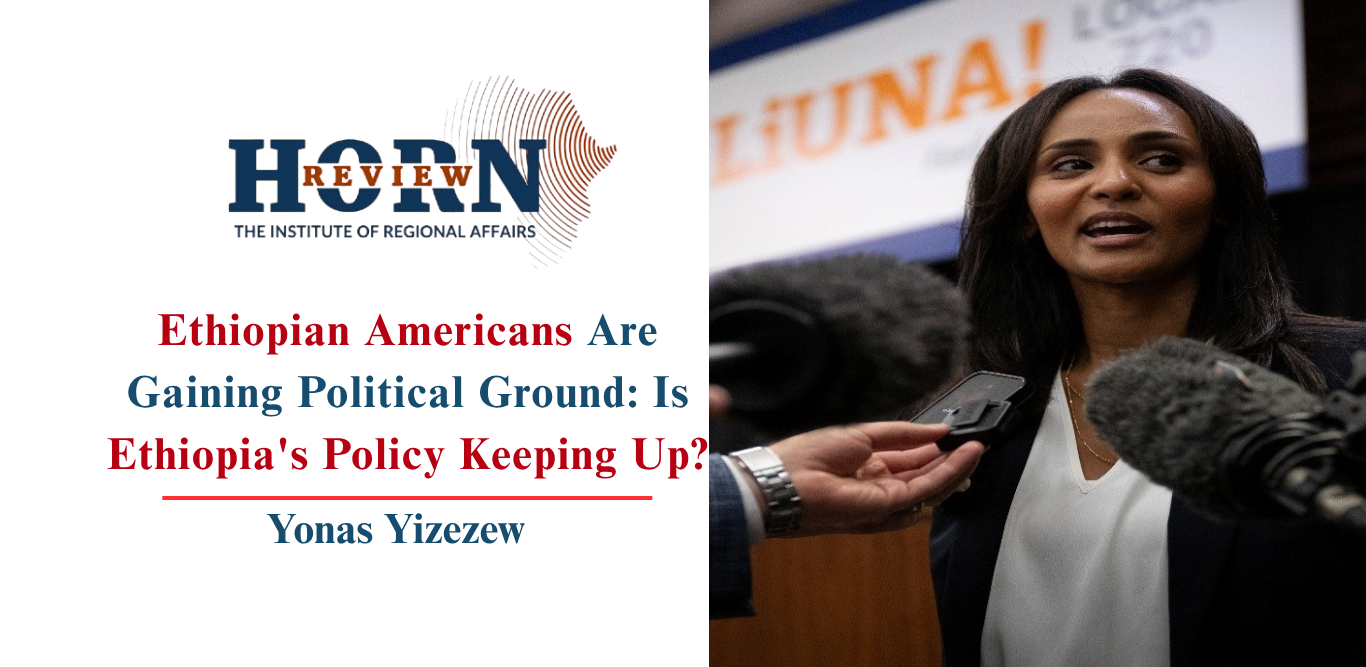
The effects of such a diaspora also extend to second and later generations. Although these generations did not experience the original conflicts directly, they may inherit their families’ memories, political grievances and emotional attachments to the homeland, and these inherited experiences can continue to shape their perceptions of Ethiopia and their engagement with its politics. The recent election of Ethiopian-born Melat Kiros to the US Congress illustrates how subsequent generations can retain political connections to their ancestral homeland. Despite having moved to the United States as an infant, Melat has maintained an attachment to her Tigrayan heritage and has publicly drawn on the experiences of conflict in northern Ethiopia in explaining her political activism. Her case illustrates how memories of homeland conflicts can be transmitted across generations and continue to shape political engagement in the countries where diaspora communities settle.
On the other hand, some young Ethiopian Americans have increasingly embraced a broader “Habesha” identity. They drew on Ethiopia’s historical heritage, cultural traditions and past achievements to strengthen their sense of connection to their ancestral homeland. A particularly relevant example is Illinois State Senator Mike Simmons, the son of an Ethiopian refugee and the first Ethiopian American to serve in the Illinois Senate. In March 2025, he formally recognized March 2 as Adwa Day, celebrating Ethiopia’s 1896 victory over Italian colonial forces. Describing himself as a “proud Habesha,” Simmons used his position in the Illinois legislature to recognize Ethiopia’s historical heritage and acknowledge the sizeable Ethiopian communities in his constituency.
Although the Ethiopian diaspora has achieved limited success in influencing US policy toward Ethiopia, its political influence and potential is should not be underestimated. The diaspora’s ability to mobilize, shape public debate and engage political representatives in their host countries can create opportunities to influence policy over time. In the US, Ethiopian diaspora groups organized demonstrations in various US cities, contacted members of Congress, submitted appeals to the State Department and sought to influence congressional discussions on Ethiopia.
The developments mentioned above show that the diaspora’s contribution to Ethiopia can extend well beyond remittances and financial investment. Its growing presence in political institutions abroad offers opportunities to strengthen Ethiopia’s international visibility, cultural diplomacy and access to foreign policymaking circles. The Ethiopian government should recognize this potential and approach the diaspora as a strategic partner, establishing sustained relationships with Ethiopian-origin politicians, professionals, academics and community leaders. Such engagement should not be limited to individuals already active in Ethiopian affairs. It should also identify and build relationships with emerging political figures and potential candidates of Ethiopian heritage across different states and levels of government in the United States, creating connections before they reach positions of greater political influence.
A broader engagement strategy could also help address the domestic consequences of diaspora involvement in Ethiopia’s conflicts. Financial contributions, political advocacy and media mobilization from abroad have in some cases supported actors engaged in domestic political and armed struggles. By addressing the grievances that encourage such involvement and by providing credible channels for political participation, the government could reduce the appeal of armed mobilization and limit the financial and political support available to insurgent movements. The 2005 general elections illustrate how significant this involvement can be, as they marked an important turning point in the diaspora’s direct role in domestic politics. Ethiopians living abroad supported opposition parties, raised funds, shaped political debates and helped build alliances among political groups, and some activists even returned to Ethiopia to take part directly in electoral politics.
Moreover, one of the principal challenges within the diaspora is its fragmentation along ethnic and identity-based lines. This fault line has been further deepened by successive Ethiopian governments’ failures to establish sustained and inclusive engagement with diaspora communities, often approaching their political activism with suspicion and viewing it as a challenge to domestic authority. This might make engagement difficult, particularly when government outreach is perceived as favoring one community or political constituency over another. The government must therefore adopt an inclusive and accommodating approach, recognizing the diversity of diaspora experiences and political positions. It should be prepared to engage with groups and individuals whose views differ from its own, including critics of government policy.
In 2024, the government launched a “back to your origins” initiative that invited second generation members of the diaspora from North America, Europe and elsewhere to visit Ethiopia and learn about their heritage, historical roots and identity. Initiatives of this kind remain important for strengthening relations between the government and diaspora communities, and they should be encouraged and institutionalized. More broadly, the government needs a coherent approach that moves beyond remittances and recognizes the diaspora’s political, economic and intellectual potential. This approach should include deliberate efforts to reach second and later generations, many of whom have limited direct ties to the country, and to strengthen their sense of belonging and engagement with Ethiopia.
Policy toward the diaspora in the United States should accordingly treat it as a strategic partner in development, public diplomacy, foreign policy advocacy, bilateral relations and the advancement of Ethiopia’s national interests. It should prioritize trust-building, rights expansion, targeted economic instruments, skills circuits, and constructive political engagement.
Translating these policy priorities into practice requires the government to engage with the diaspora through the existing community networks and institutions that shape its social and political activities. Ethiopian diaspora associations often begin by bringing people together around shared cultural, professional and community interests, but the networks they establish can also facilitate wider political mobilization. For example, Ethiopian community associations, religious institutions and professional networks in the United States provide spaces for social interaction, information exchange and collective organization. During periods of political crisis in Ethiopia, these established connections can help mobilize people for demonstrations, fundraising campaigns and advocacy initiatives.
An example is the American Ethiopian Public Affairs Committee (AEPAC), established in 2021 to organize Ethiopian Americans around advocacy for stronger US–Ethiopia relations. Through congressional engagement, political fundraising, voter mobilization and outreach to US policymakers, the organization demonstrates how diaspora networks can develop into structured platforms for influencing foreign policy and political debate. At the same time, engagement with various institutions requires careful consideration of their internal political dynamics to ensure that they do not become platforms for partisan competition, identity-based polarization or the mobilization of support for armed movements.
The 2026 US midterm elections provide a recent illustration of this political potential. The Trump administration faced a major electoral setback, with Democrats winning control of both the House of Representatives and the Senate. The elections also brought several politicians of African origin or heritage into elected office at both federal and state levels. One notable illustration is the growing political representation of Americans of Ethiopian heritage in the United States. Several individuals with Ethiopian roots have secured elected and appointed positions, including seats in legislative institutions, demonstrating the diaspora’s expanding presence in American political life.
The growing presence of Ethiopian-origin Americans in US political institutions is also reflected in the careers of Melat Kiros, Samra Brouk, Mike Simmons, Girmay Zahilay, Amsalu Kassaw, Oballa Oballa, Alexander Assefa, Yema T. Measho and Nina Ashenafi-Richardson. Their political trajectories span the US Congress, state legislatures, county government, municipal councils and the judiciary. Melat’s election to the US House of Representatives in Colorado in the recent election is particularly notable, while Samra retained her New York State Senate seat. Their representation, alongside the earlier political achievements of Simmons, Zahilay and others, illustrates the expanding institutional presence of Americans with Ethiopian roots. For the Ethiopian government, these developments reinforce the strategic importance of proactive engagement with both established and emerging Ethiopian-American political figures. Such outreach should seek to build relationships across the political spectrum, recognizing that these individuals may hold divergent views on Ethiopia’s domestic politics, foreign policy and bilateral relations. While some may become important partners in strengthening Ethiopia–US relations, others may adopt critical positions or advocate policies that challenge the government’s interests. A sustained and inclusive approach would help Ethiopia maintain channels of communication across these differing political orientations and avoid limiting its engagement to sympathetic voices.
Therefore, a government that broadens its engagement with its diaspora stands to benefit in several ways. First, it can address the grievances and political frustrations that armed insurgent groups may exploit to mobilize diaspora support, limiting their ability to secure financial resources, political backing and international legitimacy. Second, sustained engagement can help build trust, encourage diaspora investment and remittances, and channel the diaspora’s political, intellectual and professional resources towards national development. In due course, meaningful diaspora engagement can help transform a constituency often viewed through the lens of political opposition and conflict into a constructive partner in Ethiopia’s political stability, national development and international engagement.
By Yonas Yizezew, Researcher, Horn Review

RELATED
Posts
10
Nov
Reviving Pretoria and Algiers, Can the AU Resolve the Ethiopia-Eritrea Quagmire
The African Union (AU), through its Peace and Security Council...
7
Nov
Ethiopia Through Al-Burhan’s Lens: The Making of a Neighbor Turned Adversary
One of the defining characteristics of leadership in the Horn...
7
Nov
Ethiopia, Eritrea and the Politics of Strategic Depth
Eritrea remains a structural challenge to Ethiopia’s national security. The...
4
Nov
The Red Sea Chokehold: Why Maritime Access Is an Existential Question for Ethiopia
For a landlocked nation, maritime access is rarely a matter...
2
Nov
Ethiopia’s Maritime Diplomacy in a Contested Red Sea
On October 26, 2026, Addis Ababa hosted a gathering that...

29
Oct
Red Sea Security Cannot Be Left to a Few States
At the 12th Tana High-Level Forum on Security in Africa,...
29
Oct
Ethiopia’s Strategic Autonomy: Russian Su-35s, S-400 Air Defence and the Imperative of Hard Power
Prime Minister Abiy Ahmed’s announcement in Moscow on October...
29
Oct
Could Libya be a Decisive Frontier to Ethiopia's North-Africa Strategy?
Ethiopia’s renewed engagement with Libya is neither sentimental nor accidental...
29
Oct
How Is Washington Positioning Itself Amid Ethiopia’s Security Challenges?
Asked about the risk of war between Ethiopia and Eritrea,...
29
Oct
The Moyale Crisis and the TPLF Legacy
The eruption of violence in Moyale demands an analysis...