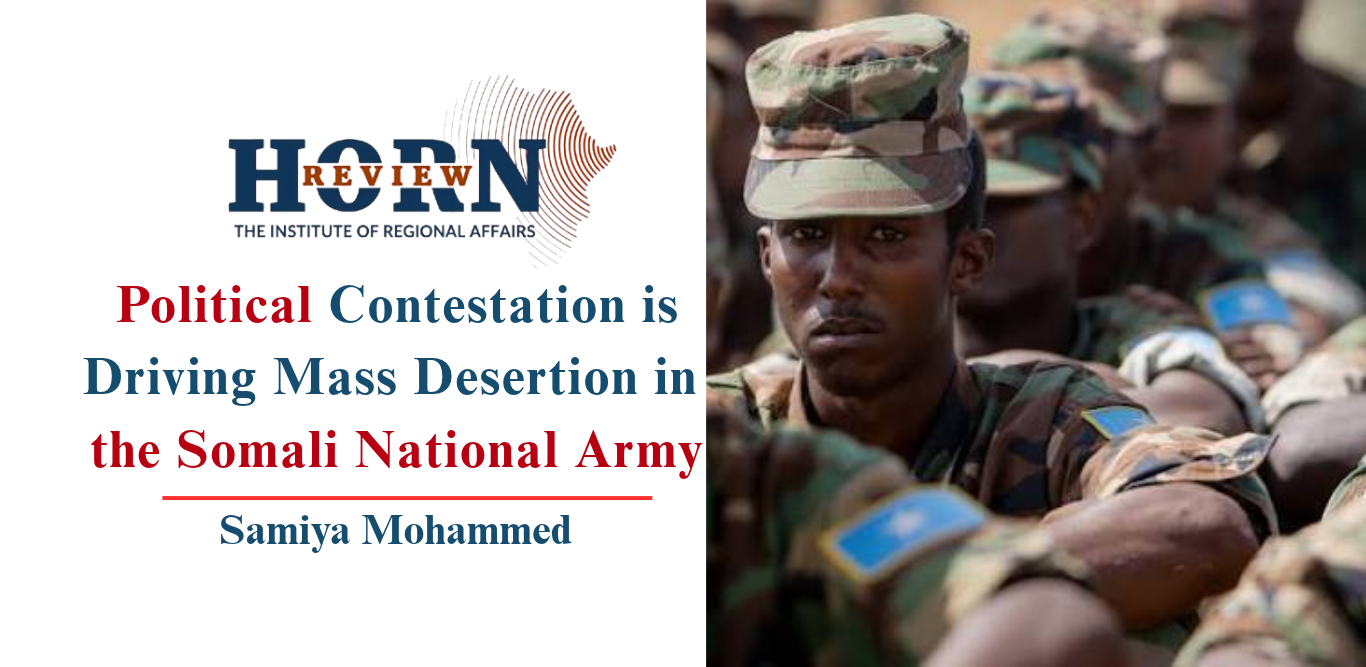
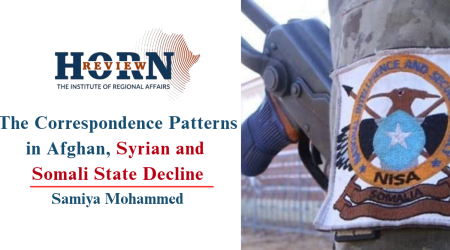
The desertions currently afflicting the Somali National Army following the call by Hawadle traditional leader Ugas Yusuf Ugas Hassan are not an aberration nor are they primarily the product of unpaid salaries or poor conditions of service. They are predictable fracture in a clan based political system with contradictions have been exposed by a convergence of specific political failures. The immediate trigger was the Ugas’s public declaration that there was no government to defend today his instruction to Hawadle men serving in the SNA to refuse deployment against the people of Hiiraan and his direction that they gather at his residence in Beledweyne with the stated intention of launching an offensive once sufficient numbers had assembled. But this call fell on receptive ground because of structural and political causes that had already eroded the willingness of soldiers to subordinate clan loyalty to national command with those being the persistence of clan identity as the organizing principle of the army, a broken power sharing understanding in Hirshabelle, a federal military deployment interpreted as clan aggression and a collapsing central legitimacy under President Hassan Sheikh Mohamud.
The foundational reality is that Somalia’s national army remains in functional terms with a confederation of clan recruited units. Recruitment has historically proceeded through clan networks commanders have exercised authority through clan lines and the loyalty for the individual soldier has never been fully transferred from the clan to the state. When the federal government is perceived to be moving against a soldier’s own territory or people the national chain of command becomes secondary. This is precisely that dissolved the Somali army in 1991 and the conditions that produced that collapse have never been structurally resolved.
The Ugas’s intervention did not create the loyalty conflict however it activated an existing one. Soldiers from the Hawadle clan were being asked to choose between a national institution whose legitimacy was contested and a clan authority whose claim on their allegiance was primary and immediate. In such a contest the outcome is determined by the actual incentive structure not by formal oaths or institutional affiliation.
The other driver is the collapse of the informal power sharing arrangement that underpinned Hirshabelle. The state was formed on an understanding however imprecisely codified that the presidency would involve rotation or at minimum a meaningful Hawadle share. The re election of Ali Gudlawe of the Abgaal clan in late October 2026 and the perception that President Hassan Sheikh Mohamud backed this outcome confirmed for Hawadle leaders the belief that a promise had been reneged upon. The vice president Yusuf Hagar Dabageed and other Hawadle political figures publicly accused the president of failing to honour a commitment to give the Hawadle the presidency this cycle. This was interpreted at the community level as evidence that the federal government had chosen sides in a clan competition and that the Hawadle were being systematically excluded from the structures of authority they had been promised. The re election deepened that sense of exclusion and converted a political disagreement into a legitimacy crisis for the state government and by extension for the federal government that was seen to be sustaining it.
The other driver is the federal military deployment that Hawadle leaders and the Ugas interpreted as an invasion by rival clans operating under government cover. The Hawadle Macawisley militias the clan fighters who had fought Al Shabaab with government support had already withdrawn from some fronts and taken control of Beledweyne pushing for a separate Hiiraan administration outside the Hirshabelle framework. The deployment of the Hananbure force to retake the town was framed by the Ugas not as a neutral restoration of federal authority but as an attack by rival clans using the government as a vehicle. This is the classic trigger for mass defection with soldiers will not reliably fight their own clansmen or their home region when ordered to do so particularly when the order is understood as serving the interests of a competing clan. The SNA soldiers from the Hawadle clan were not being asked to fight an abstract enemy they were being asked to take up arms against their own people in a dispute that their traditional leader had defined as existential. The withdrawal from active or recent anti Al Shabaab fronts following the earlier Macawisley pullback creates security gaps that Al Shabaab has historically exploited but the defecting soldiers were responding to a clan and political logic that overrode the counterinsurgency rationale.
The fourth driver is the crisis of central legitimacy stemming from the Supreme Court ruling in early November 2026 that President Hassan Sheikh Mohamud’s term had expired on 15 May 2026 that the parliamentary extensions were unlawful and that an electoral framework should be established within thirty days with elections within ninety days. The president had dismissed the chief justice and the court rejected that dismissal. This ruling provided opposition figures and regional actors with a legal and political basis to claim that there was no legitimate government to serve. The Ugas’s language that there was no government to defend today maps directly onto this judicial finding and the broader perception it reinforced. The pattern of federal interventions in other member states including Jubaland had already reinforced the view of Mogadishu as predatory rather than national in its orientation. When the central government’s own term is judicially determined to have expired, the claim that soldiers should sacrifice for the state becomes difficult to sustain particularly when the state is simultaneously perceived as an instrument of one clan faction against another.
These drivers are reinforced by secondary and enabling factors that shape the timing and scale of the desertions. The withdrawals are occurring from active or recently active anti Al-Shabaab fronts which means the defections have immediate security consequences. Chronic weak institutionalization means that even when salaries and conditions improve somewhat they rarely override clan solidarity when that solidarity is directly threatened. Discipline is thin when the political compact is contested and the army’s cohesion depends on a political settlement that is currently revealing. There is also a leverage that the Hawadle leadership is demonstrating that it can pull soldiers and militias out of federal structures and potentially use them offensively which is bargaining by other means. The federal response so far which a delegation to Beledweyne for talks and a call for dialogue from Hirshabelle’s president indicates awareness of the crisis but does not address its structural sources.
The importance of these events is that the soldiers are not abstractly disloyal. They are behaving rationally within the actual incentive structure of Somali politics where primary loyalty remains clan based, where informal power sharing deals are repeatedly broken, where federal military movements are interpreted through the lens of clan competition and where the central government’s legitimacy is contested on legal and political grounds. The SNA remains one contested political dispute away from further fracturing along clan lines and the current desertions are a demonstration of that structural vulnerability rather than an exception to an otherwise cohesive institution. Al Shabaab is the most consistent beneficiary of these cycles but the immediate cause of the desertions is not the group’s military pressure but it is the political fracture within the federal system and the clan based logic that the system has never transcended.
The Ugas’s call was the execution of a threat that Hawadle politicians had already made warning that SNA members from the clan would defect if Mogadishu attacked. The fact that the call produced the predicted result confirms that the underlying structure of loyalty and authority remains unchanged and that the national army cannot be sustained as a cohesive force while the political compact that underpins it remains broken.
By Samiya Mohammed, Researcher, Horn Review