To understand the tragedy consuming Sudan, observers often isolate the civil war into a domestic binary in which a paramilitary force fights a national army. Yet, treating the Sudanese Armed Forces (SAF) as an independent sovereign actor defending a unified republic is an analytical category error. Beneath the rhetoric of national defense, the SAF has regressed into a dependent client and a forward geopolitical instrument of the Egyptian state. By mapping the historical architecture of Egyptian military expansion onto contemporary hegemonic ambitions of Cairo, a stark reality emerges: the SAF is acting as Cairo’s proxy, actively weaponizing Sudan’s state collapse to escalate strategic tensions with Ethiopia and transform the Upper Nile into an open theater for Egyptian regional containment.
The structural foundation of this proxy relationship rests on two centuries of imperial entanglement in the Nile Valley. Egypt’s modern military was forged through its 1820 colonial conquest of Sudan under Viceroy Muhammad Ali Pasha, who extracted enslaved captives to build his Jihadiyya battalions and established Khartoum as an Egyptian garrison to pacify the Upper Nile. Following the 1898 reconquest and the 1899 Anglo-Egyptian Condominium Agreement, the administrative and logistical DNA of the future Sudanese Armed Forces was engineered through the Sudan Defence Force to police Sudan’s peripheries and guard downstream Nile infrastructure on Cairo’s behalf.
Even after formal independence, this colonial hierarchy was internalized within the barracks through Egyptian war colleges and the deliberate export of Nasserism. Throughout the post-independence decades, generations of Sudanese cadets from Jaafar Nimeiry to Abdel Fattah al-Burhan passed through Egypt’s Military Academy and the Nasser Higher Military Academy, absorbing Gamal Abdel Nasser’s Free Officers doctrine alongside conventional battlefield tactics. Guided by Egyptian instructors and joint military missions, Cairo transplanted its praetorian worldview directly into Khartoum’s command culture, conditioning Sudanese officers to dismiss parliamentary democracy as a threat to state order and to treat coups d’état as legitimate acts of national preservation. Consequently, when modern Egyptian and Sudanese officers coordinate today, they are not engaging in peer-to-peer diplomacy; they are operating within an unbroken two-hundred-year hierarchy in which Cairo’s military brass views Khartoum’s garrison state as a junior partner tasked with securing the southern reaches of the Nile basin.
This shared praetorian conditioning consistently manifests whenever Sudan’s rare experiments with civilian democracy threaten to steer Khartoum away from Cairo’s strategic orbit, prompting Egypt to work behind the scenes to undermine elected or transitional leaders and restore military rule. During Sadiq al-Mahdi’s democratically elected premiership in the late 1980s, Cairo grew increasingly alarmed by his independent diplomatic overtures toward Libya and Ethiopia, as well as his willingness to renegotiate the lopsided 1959 Nile Waters Agreement and pursue peace talks with southern rebels that threatened northern riverine hegemony. When Omar al-Bashir and his Islamist-backed officer corps overthrew Mahdi in June 1989, Hosni Mubarak’s regime immediately recognized the junta within days, rushing diplomatic support and intelligence backing to Khartoum under the miscalculation that Bashir was a Nasserist-style nationalist officer who would restore Egyptian-aligned military discipline.
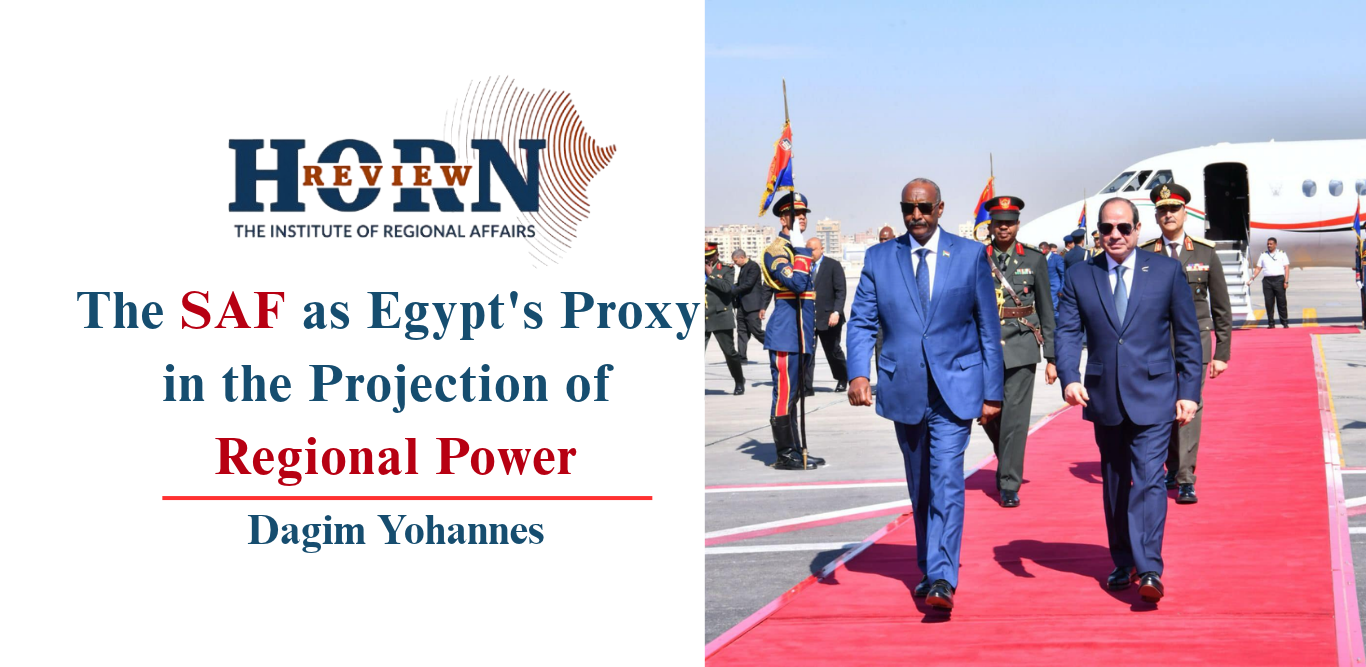
Three decades later, Cairo deployed the exact same playbook against Prime Minister Abdalla Hamdok’s transitional civilian government following the 2019 revolution. Because Hamdok’s technocratic cabinet sought to dismantle the military’s vast economic empire, normalize ties with international financial institutions, and adopt a pragmatic, conciliatory posture toward Ethiopia over the Grand Ethiopian Renaissance Dam, Abdel Fattah el-Sisi’s government actively cultivated Abdel Fattah al-Burhan behind closed doors. By hosting Burhan in Cairo, conducting high-profile joint military exercises on Sudanese soil, and signaling unambiguous diplomatic cover, Egypt emboldened the SAF high command to execute the October 2021 coup that toppled Hamdok, once again extinguishing Sudanese civilian sovereignty to ensure a compliant garrison remained in power on the Upper Nile.
This shared institutional heritage explains why Egypt relies so heavily on the SAF to secure three hard, unyielding material imperatives in the region. First and foremost is hydro-hegemon. Cairo views the Nile through an existential prism, recognizing that a stable, civilian-led democratic government in Khartoum would inherently threaten Egyptian water security because a sovereign Sudan has every economic incentive to integrate its power grid and agricultural planning with Addis Ababa. By keeping the SAF afloat, Cairo ensures that Khartoum remains locked into a hostile posture toward Ethiopia, aggressively vetoing independent Sudanese accommodations on water sharing. Second is praetorian solidarity and border containment. President Abdel Fattah el-Sisi’s regime views the region through the security lens of military-led authoritarian stability, and the rise of autonomous non-state actors like the Rapid Support Forces (RSF) terrifies Cairo, which fears the contagion of militia-driven fragmentation along its porous southern frontier. Third is the imperative to counterbalance rival Gulf influence, as funneling covert logistical and diplomatic support to Port Sudan allows Cairo to check the expansionist footprint of regional backers accused of fueling the RSF without triggering a catastrophic diplomatic rupture with wealthy Gulf patrons.
Because a proxy relationship under extreme duress requires material asymmetry rather than ideological uniformity, Cairo enforces this alignment through concrete operational levers. Stripped of its capital, industrial base, and sovereign tax revenue, the SAF survives only because Egypt provides its oxygen. Decades of joint training networks and coordination via Egypt’s General Intelligence Directorate mean that SAF operational planning is closely synchronized with northern intelligence assessments. This intelligence integration is reinforced by physical logistical lifelines running through Sudan’s Northern State, providing vital resupply, technical maintenance, and electronic warfare support. Indeed, the dramatic capture of Egyptian fighter jets and military personnel at Merowe Airbase at the outbreak of the war in April 2023 served as smoking-gun evidence of deep, pre-existing Egyptian military entrenchment inside sovereign Sudanese bases. On the international stage, Cairo simultaneously acts as the SAF’s diplomatic attorney, shielding Port Sudan from isolation, blocking peace frameworks that would dissolve the military establishment, and rigidly framing the generals as the sole legitimate embodiment of the Sudanese state. Even the apparent ideological contradiction of Cairo’s staunchly anti-Islamist regime propping up an army deeply intertwined with Sudan’s entrenched Islamist networks dissolves under structural pressure: preventing a militia state on its border and encircling Ethiopia matters far more to Cairo than ideological purity.
The most dangerous consequence of this clientelist capture is how the SAF is now being leveraged to drive a regional escalation with Ethiopia, directly serving Cairo’s broader anti-Addis Ababa containment strategy. Rather than focusing exclusively on internal pacification against the RSF, the SAF-led authority in Port Sudan has systematically escalated cross-border friction by advancing into disputed Mazega (Al-Fashaga) border territories while facilitating the forward deployment of Egyptian troops directly along Ethiopia’s western frontier a reality underscored in March 2026, when the Sudan Founding Alliance (TASIS) forces encircled SAF-authorized Egyptian battalion stationed near the Grand Ethiopian Renaissance Dam (GERD).
During their third bilateral consultative meeting in Cairo in early November 2026, Egyptian and Sudanese foreign and irrigation ministers not only invoked colonial-era water treaties to reject Ethiopia’s management of the completed GERD, but explicitly cited their bilateral Joint Defense Agreement to defend Khartoum’s institutional survival while jointly condemning Red Sea access for non-littoral states, a direct strike at Ethiopia’s core maritime and hydro-strategic interests. On the ground, leaked procurement documents exposed a covert Sudanese army weapons pipeline supplying TPLF-aligned forces with ammunition, tactical communications, and loitering munitions, enabling units such as “Army 70” to launch cross-border strikes on ENDF positions near Shererina from Sudanese soil. To mask this proxy mobilization, territorial encroachment, and forward Egyptian militarization, Port Sudan has resorted to fabricating false accusations, baselessly blaming Addis Ababa for cross-border drone strikes on Sudanese infrastructure while coordinating closely within an emerging Cairo-Asmara-Port Sudan encirclement axis.
Ultimately, the tragedy of the modern SAF is that even if it manages the war with RSF on the battlefield, it has already lost the war for national independence. By operating as a direct military proxy for Egypt subordinating its apparatus to Cairo’s imperial, hydro-hegemonic, and regional containment imperatives, the SAF has permanently transformed Sudan from a sovereign republic into a northern buffer zone and client state. In dragging the country into manufactured cross-border escalations and proxy insurgencies with Ethiopia, the generals in Port Sudan have proven unequivocally that their primary loyalty is not to the preservation of the Sudanese nation, but to the institutional survival of the barracks both those commanding a fractured Khartoum and those directing strategy from their masters in Cairo.
By Dagim Yohannes, Researcher, Horn Review