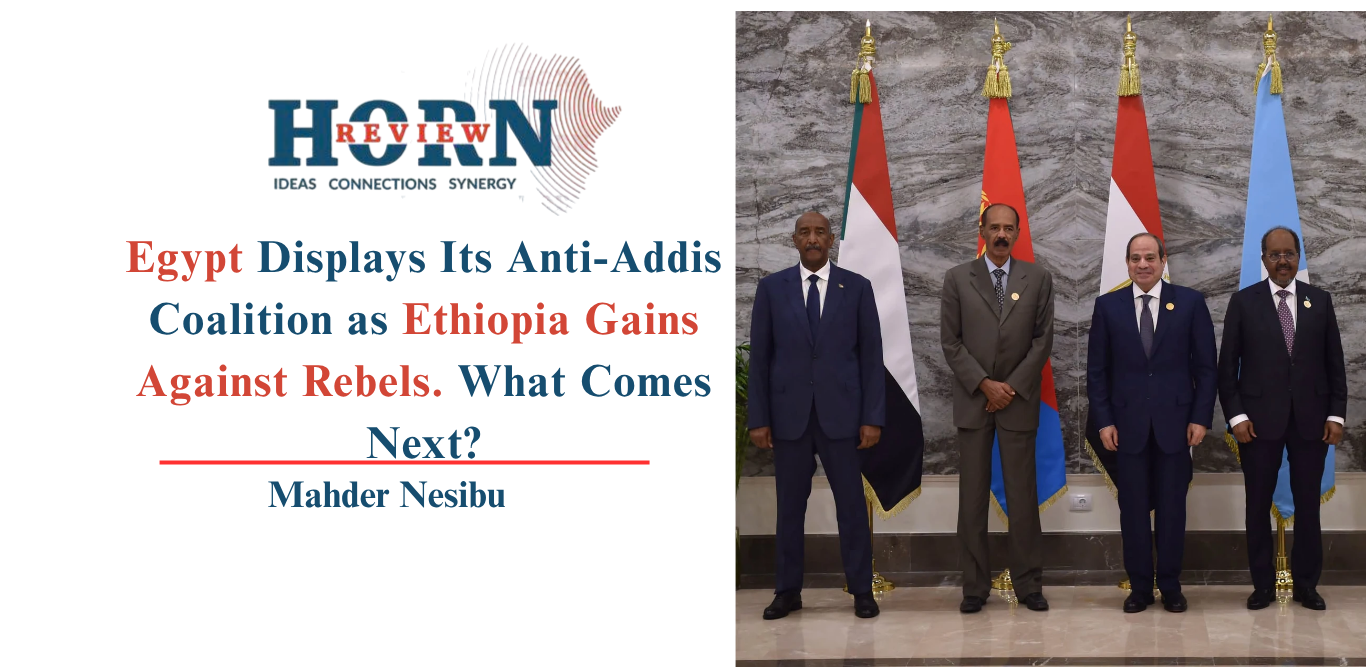
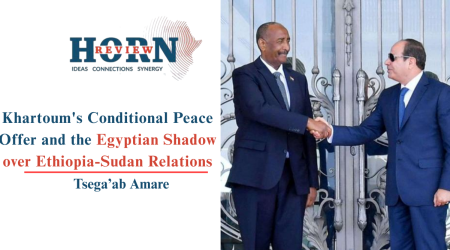
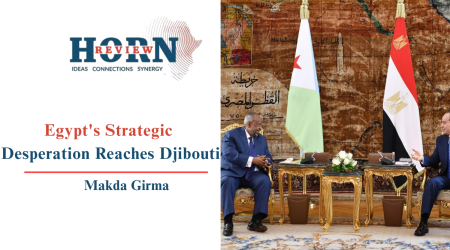
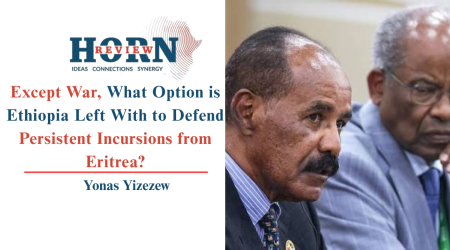
Egypt’s strategy of cultivating relationships around its chief rival in the Horn of Africa, Ethiopia, moved to the forefront this week as the city of el-Alamien hosted the heads of state of Eritrea and Somalia, alongside General Abdel Fattah al-Burhan, head of Sudan’s army, in a summit billed as one concerned for the security and stability of the region
The summit’s immediate catalyst was arguably the outbreak of fighting inside Ethiopia between the federal government and allied militias on one side, and a coalition of armed rebel groups spearheaded by the Tigray People’s Liberation Front on the other. The fighting began on 23 September, when the TPLF launched an offensive against federal positions in the neighbouring Amhara and Afar regions. Federal forces quickly reversed those gains, pushing into Tigray itself, and recent reporting indicates they have since taken Mekelle, the region’s capital.
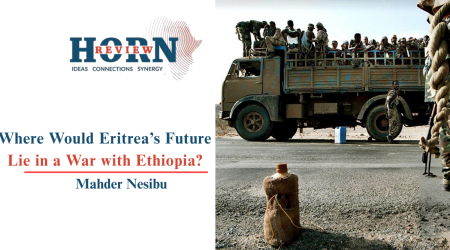
Alongside the TPLF’s advance came confirmation of the extent of Eritrean involvement. Ethiopian officials, including the president of the Afar region, say the Eritrean Defence Forces were directly engaged in the fighting on the side of the TPLF’s military wing, the Tigray Defence Forces. This comes as little surprise. Since the end of the previous Tigray conflict, largely fought among the same actors, Eritrea has moved into closer alignment with the TPLF and with a wider set of rebel groups inside Ethiopia, all of them, like Asmara itself, positioned against Ethiopia’s government.
The TPLF is one of several groups in this coalition, alongside Fano in Amhara, the Oromo Liberation Army in Oromia, and smaller factions such as the Afar Revolutionary Democratic Unity Front. The coalition formed only days before the fighting broke out, and it bears the heavy imprint of Asmara’s calculations and influence. Proxy warfare against Ethiopia has long been a hallmark of Eritrean foreign policy, and it has returned, it seems, with renewed vigour.
This proxy strategy is rooted in the breakdown of relations between Addis Ababa and Asmara following the Pretoria Agreement, which ended the previous Tigray conflict between the TPLF and the federal government. Dissatisfied with that outcome, Eritrea had already begun stepping back from Ethiopia. Relations worsened further when Addis Ababa made public its ambition to secure sovereign access to the Red Sea, a demand that reopened questions around Eritrea’s secession three decades ago. Ethiopia regards that secession as having left it landlocked through an unfair process, illegal under its own domestic law, that stripped it of the port of Assab, which had until then served Ethiopia exclusively.
Egypt is the overarching player in these Ethiopia-Eritrea dynamics, directing a broader strategy of encirclement in which Asmara serves as the most acute pressure point. The Sudanese Armed Forces and Mogadishu play complementary roles within that same strategy, but it is principally through Eritrea that Cairo exerts pressure on Addis Ababa.
The rivalry between Egypt and Ethiopia is arguably the overarching dynamic of Horn of Africa geopolitics today. The two countries have been at structural odds over the Nile for decades, if not longer, but tensions came fully to the surface once Ethiopia laid the foundation for the Grand Ethiopian Renaissance Dam in 2011, a project that fundamentally upended Egypt’s hegemonic position over the river basin. Cairo proved unable to deter Addis Ababa from building the dam, filling its reservoir, or completing it last September. Ethiopia now intends to build three further hydropower dams on the Nile, a prospect that has hardened Egyptian strategy toward undermining Ethiopia’s stability and cohesion, bringing Cairo into closer alignment with Eritrea.
How directly involved Cairo is in events on the ground remains unclear, though Ethiopian officials believe its role runs deep. Its involvement is certainly real, and it shows most clearly in a highly active relationship with Eritrea that has intensified over the past two years, including repeated visits between the two countries’ leaderships and a shared rhetoric of sovereignty and territorial integrity. That rhetoric, deployed extensively in the summit’s declaration, insists the Red Sea belongs exclusively to its littoral states, a pointed jab at Ethiopia’s pursuit of access to it.
Sudan, now in the fourth year of a destructive civil war, plays a strategic role for Cairo as well. The Sudanese Armed Forces, led by General al-Burhan, are fighting the Rapid Support Forces, a parallel military institution created by Sudan’s longtime dictator Omar al-Bashir. The current conflict is largely a power contest between al-Burhan and RSF leader Hamdan Dagalo, sustained on both sides by substantial external backing.
Egypt is one of al-Burhan’s principal external backers, alongside Eritrea. Beyond military support, including logistics and air strikes, Cairo has pushed hard for the SAF to be recognised as the legitimate representative of the Sudanese state, a status critical to its war against the RSF and to its ambitions of governing Sudan after any victory. Cairo has, in effect, already treated the SAF as Sudan’s government, but at a price. Egypt’s growing hold over the SAF has arguably cost it a relationship with Ethiopia, as the army reversed Sudan’s previously favourable view of the GERD and moved closer to Cairo’s position instead.
More consequentially, Sudan has become bogged down in its own hostilities with Ethiopia. Tensions built steadily, from a disputed border territory the Sudanese army moved to occupy militarily in 2020, to its backing of the TPLF during the Tigray conflict. Relations deteriorated further as the army began repeatedly accusing Ethiopia of backing its adversary, the RSF, a charge Addis Ababa denies. Sudan has meanwhile become a hub for Ethiopian rebel groups, serving now as a meeting point between the TPLF, which has fighters embedded with the SAF, and Eritrea, which has expanded its own presence on Sudanese territory through its support for al-Burhan’s forces, making Sudan another node in Eritrea’s broader proxy strategy.
Somalia’s role is considerably less defined. President Hassan Sheikh Mohamud attended the summit only days after meeting Ethiopian Prime Minister Abiy Ahmed, and he has, around the same time, voiced support for Ethiopia’s pursuit of sea access. Yet his government has simultaneously presided over the growth of Egyptian and Eritrean influence in Somalia, as Ethiopia’s own strategic depth there has declined. This tension connects to the question of Somaliland, a de facto state within Somali territory that has long sought international recognition, including from Ethiopia, which values it as a route to sea access. Somaliland has also pressed for recognition from Israel and the United States, with Israel extending that recognition last December.
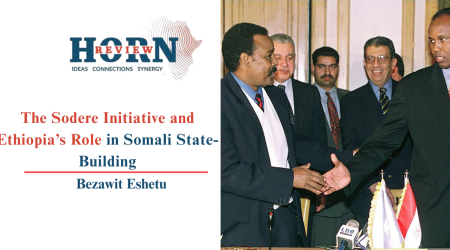
In response to a 2024 memorandum of understanding between Somaliland and Ethiopia, since shelved, Hassan Sheikh moved to curtail Ethiopia’s role in Somalia’s security architecture, including its counterterrorism operations against al-Shabaab and its place in the African Union peace mission, AUSSOM. In a first for the mission’s history, he instead admitted roughly a thousand Egyptian troops, effectively placing them on Ethiopia’s doorstep. The Somali president is indeed anxious about Somaliland’s sovereignty gaining further legitimacy, particularly following Israel’s recognition, and that anxiety has pushed him closer to Egypt, which has in turn backed Somalia’s claim over Somaliland in exchange for alignment.
All of this might suggest Ethiopia is on the back foot, with Egyptian pressure appearing to pay off. Yet the very developments that triggered the summit, the security crisis inside Ethiopia, suggest Addis Ababa is holding a stronger position against the coalition than that picture implies. Federal forces have reversed the TPLF’s offensive and continue to advance deep inside Tigray, exposing a stark imbalance of power between the coalition and the Ethiopian National Defence Force.
Ethiopia has also been quite assertive. In what appears to be a reaction to Eritrea’s and Egypt’s roles in backing the rebels, the country has recently expelled ten Eritrean diplomats and one Egyptian diplomat from Addis Ababa.
Ethiopia also retains powerful regional allies, among them the United Arab Emirates, Israel, and even Turkiye, all of which back, alongside other converging interests, its pursuit of Red Sea access.
In an implicit response to the summit and its declaration, Ethiopia’s foreign ministry issued a statement insisting the meeting changes little on the ground, neither on the Red Sea nor on the Nile, and reaffirming its intention to pursue its interests regardless.
What these positions will ultimately produce is difficult to predict. Egyptian strategy has historically delivered little, particularly its past efforts to deter the construction and completion of the GERD, however its more aggressive posture toward Ethiopia may yet pressure Addis Ababa into concessions on the Nile while pushing it further from the Red Sea. Yet as with the GERD, Addis Ababa may instead see the recent developments, including Eritrea’s direct involvement against its security, as an opportunity of its own, with a confrontation with Eritrea possibly leading to questions about Ethiopia’s outlet to the sea being revisited.
By Mahder Nesibu, Researcher, Horn Review