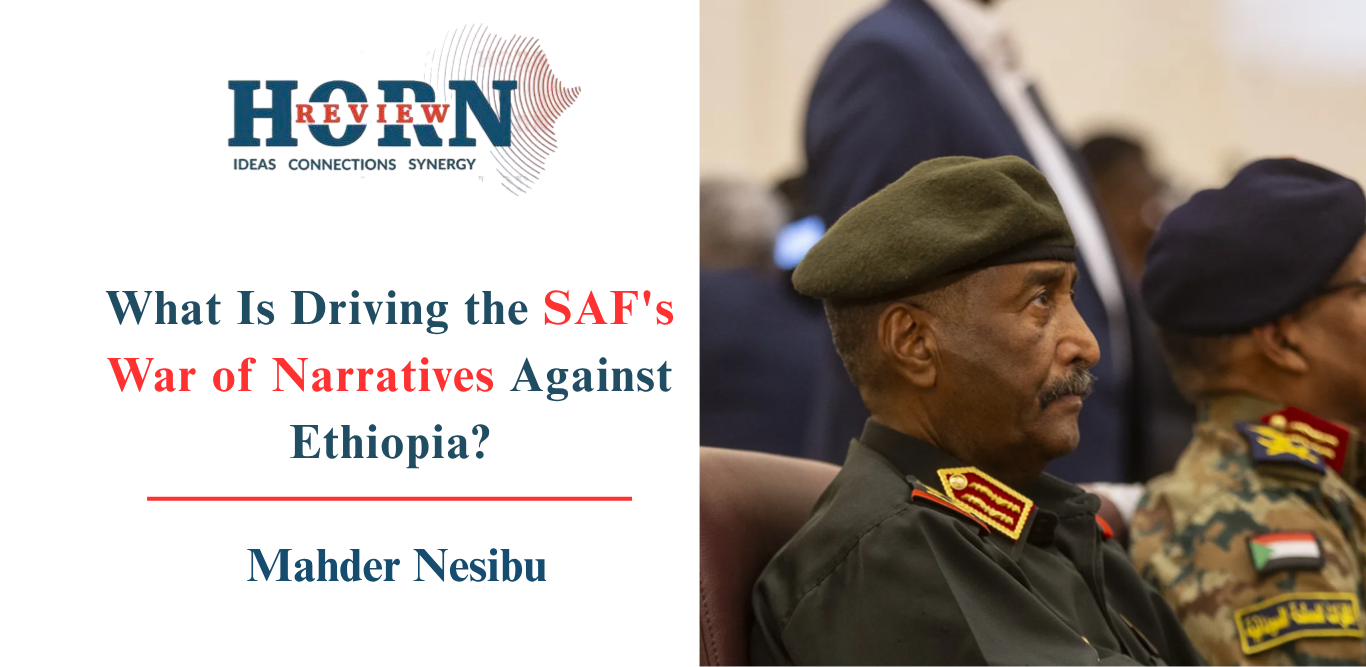
Unfounded claims linking Ethiopia to the Rapid Support Forces (RSF), one of the belligerents in Sudan’s civil war, are increasingly in circulation. The narrative is driven primarily by the Sudanese Armed Forces (SAF), the other side of the conflict. The Army has recently made repeated claims to have downed drones it says flew in from Ethiopian territory. In addition, open-source (OSINT) reporting has reinforced that narrative, with claims of Ethiopian support for the RSF along the border it shares with Sudan, in western Ethiopia.
This runs counter to the official position of the Ethiopian government, which has maintained neutrality, opting instead to remain committed to the civilian transition that ended decades of dictatorship, a dictatorship that had itself come to power through a military coup. The 2018-2019 revolution brought a coalition of civilian political actors, the Forces for Freedom and Change, to power, and set out a process for a transition to democracy, raising hopes for a democratic Sudan after decades in which the country had been plagued by coups and dictatorship since independence in 1956. Ethiopia was a central backer of that process, playing an important role in the agreements that gave structure to the revolution and built consensus among Sudan’s different political forces around a commitment to democratic transition.
However, Sudan’s military actors had clouded the process from the outset. Allied in overthrowing President Omar al-Bashir, the RSF’s Hemedti and the SAF’s General Abdel Fattah al-Burhan initially opted to share power with civilian actors in the transition, before later teaming up to sideline the civilian body entirely in 2021. This failed to bring the peace and stability many Sudanese observers had predicted at the time. A power struggle instead ensued between the two men, dragging Sudan into the total civil war of 2023, the conflict still gripping the country today.
The recent flare-up in accusations comes on the heels of a two-day meeting Addis Ababa hosted this August, bringing together Sudan’s anti-war civilian and political forces, including the Sumoud coalition led by former Prime Minister Abdalla Hamdok, the Popular Congress Party, the National Umma Party and a range of civil society, women’s and youth networks. The gathering rejected a political dialogue proposed by General al-Burhan, which participants saw as a move by the general to legitimise his army as Sudan’s state authority.
This in part explains the SAF’s antagonism towards Ethiopia and the motivations for the accusations. Addis Ababa continues to serve as the main hub where civilian actors, sidelined by General al-Burhan in his pursuit of state power, hold consultations. Beyond this, the Ethiopian government has refrained from extending support to either party, opting instead to call for dialogue and civilian-led rule as the only viable way forward.
For the Sudanese Armed Forces, one front in the war has been the battle for legitimacy. Since the 2021 coup alongside the RSF, and the subsequent fallout that triggered the civil war, the Army has pushed for recognition from neighbouring states and regional and continental bodies, namely the African Union and IGAD. For the Army, portraying itself as the custodian of the Sudanese state, while relegating Hemedti’s side to the status of a non-state actor, has been of serious importance. It has gained backing in this regard from other neighbouring states with stakes in the war, such as Egypt and Eritrea, both of which back its military on the ground. That has not been the case with Ethiopia.
This principle drove Ethiopia’s diplomatic push to initiate dialogue between the SAF and RSF leadership. As late as 2024, Ethiopia’s prime minister remained in direct engagement with the Sudan file, calling for a meeting with both belligerents while refraining from endorsing the SAF’s narrative of fighting the RSF. This was, in part, a driving factor behind Ethiopia’s diplomatic sidelining by the SAF, which has resulted in the current posture of minimal engagement from Addis Ababa, favouring support for civilian-led political processes instead.
Although Ethiopia’s refusal to extend legitimacy to the SAF, and its support for civilian bodies, partly explain the Army’s propaganda-driven accusations, dynamics on the ground have also given the SAF reasons to drag its neighbour into the conflict.
General al-Burhan is part of a broader set of alliances antagonistic towards the Ethiopian government. This includes, primarily, Egypt and Eritrea. His main backers within the immediate neighbourhood, Cairo and Asmara, are engaged in hostilities with Ethiopia, motivated by their own overlapping sets of interests. Eritrea’s antagonism is more acute, and overlaps directly with the SAF’s posture on the ground. General al-Burhan and Eritrea’s President Isaias have put their weight behind a spectrum of insurgencies, namely the Tigray People’s Liberation Front (TPLF) in Ethiopia’s Tigray region in the north, and Fano in Amhara. For Eritrea, these actors serve as proxies, challenging Ethiopia’s defence institutions and undermining the country’s security.
General al-Burhan, who hosts TPLF armed factions inside Sudan and deploys them on the battlefield, is complementing the position of his backers, who have an interest in challenging Ethiopia’s security and compounding its internal security dilemmas.
This was illustrated more recently on Ethiopia’s border with Sudan, where TPLF forces in Sudan, operating under the banner Army 70, crossed into Ethiopia and launched an offensive against Ethiopian positions in early August. Although there was fear of escalation into a broader conflict, reports the fighting stopped after the Ethiopian Defence Forces repelled the attack.
This, coupled with rhetoric from the SAF, makes the Sudan file increasingly consequential for Ethiopia. The country is under pressure to insert itself into the Sudanese war, either by reaching an accommodation with the SAF through diplomatic backing or military support, or by backing the RSF to counter the Army and its position against Ethiopia. However, the most viable strategy would likely be to maintain neutrality, call for dialogue with the warring parties, and back civilian political groups in the process. On security matters, Addis should maintain a defensive posture to prevent a spillover of the Sudan war into its own territory, while at the same time pressuring the SAF and its allies to cease their support for Ethiopian armed actors.
By Mahder Nesibu, Researcher, Horn Review