
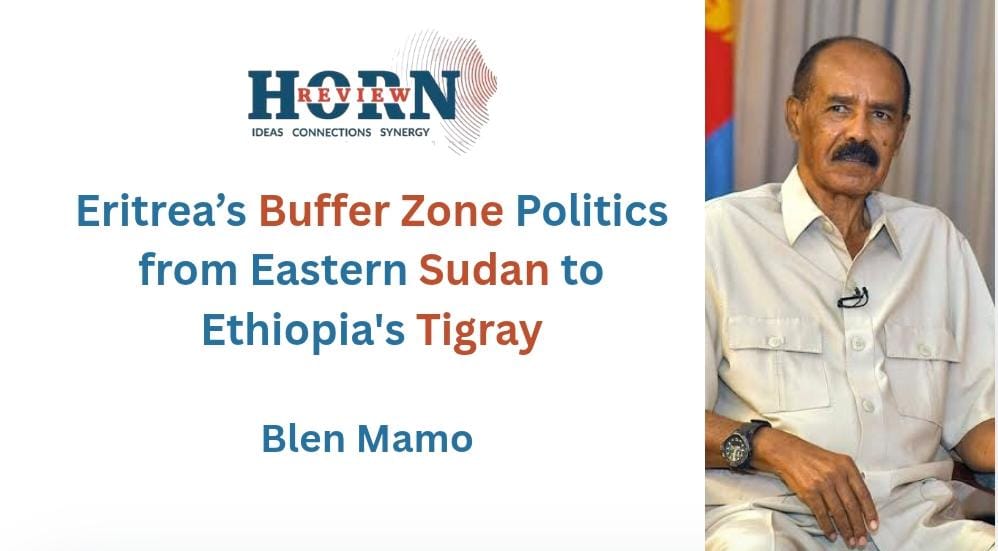
Eritrea’s Buffer Zone Politics from Eastern Sudan to Ethiopia’s Tigray
The most consequential development in the Horn of Africa may not be taking place in any of its capitals. It is unfolding instead across a chain of borderlands stretching from the Red Sea through Kassala and further eastern Sudan to South and south-eastern to Ethiopia’s Tigray: spaces formally divided by international frontiers but increasingly connected by militias, military camps, ethnic networks, displaced armed forces and the strategic ambitions of states.
Eritrea sits at the centre of this emerging geography. The evidence accumulating in eastern Sudan suggests that Asmara is once again doing what it has done, in different forms, for decades: aggressively extending its security frontier beyond its own territory. The training and organization of Sudanese armed groups inside Eritrea, particularly among cross-border constituencies with social and ethnic ties to the country, is more than an intervention in Sudan’s civil war. It reflects a deeper doctrine of strategic depth. The objective is not necessarily territorial expansion, nor the establishment of a formal Eritrean sphere of sovereignty. It is the construction of political and military environments beyond Eritrea’s borders in which hostile forces cannot easily consolidate. Eastern Sudan is therefore becoming something more than a rear theatre in the war between the Sudanese Armed Forces and the Rapid Support Forces. It is being transformed into a buffer for Eritrea.
The historical logic is unmistakable. Eritrea’s borders have never functioned as the clean geopolitical lines imagined in conventional maps. The communities straddling the Eritrea-Sudan frontier, among them Beni Amer, Beja and Rashaida networks, have long moved through a political geography that predates the modern states claiming authority over them. Trade, kinship, pastoral routes and armed mobilization have created forms of social continuity that states have repeatedly attempted to weaponize. The Eritrean regime itself once depended on Sudanese territory during its secessionist struggle. Sudan later became a source of threats to the new Eritrean state. Asmara responded by cultivating Sudanese opposition networks in the East. The lesson absorbed by the Eritrean state was simple: borderland populations are not merely populations. In the right geopolitical circumstances, they can become strategic instruments.
This is the context in which Eritrea’s reported training and organization of eastern Sudanese armed formations, while simultaneously fighting alongside the Sudanese Armed Forces, should be understood. The underlying logic is not ideological. Isayas Afeworki does not require partners to share a common political doctrine. He wants them to contribute to a security environment favourable to his regime. Eritrea therefore builds relationships with militaries, tribal militias, political movements and insurgent networks that might otherwise have little in common. What binds such arrangements together is not solidarity, rather utility. For Afeworki, a network distributed through borderland societies, armed formations and military relationships is considered durable though its foundations are not entirely institutional. It lives inside the political and military landscape surrounding him.
In eastern Sudan, this process is now intersecting with a much larger regional crisis. The Sudanese war has weakened central authority while militarizing the country’s peripheries. For the Eritrean regime, the resulting disorder is simultaneously dangerous and advantageous. It is dangerous because a hostile force capable of consolidating control over Sudan’s eastern frontier could expose Eritrea’s western border to new threats. Yet it is advantageous because the fragmentation created opportunities for influence. A militarily weak central state cannot monopolize the political loyalties of its frontier populations. External actors can step into the resulting gaps. Asmara appears to be doing precisely that. But Sudan is only one half of the emerging picture. The more important question may lie to Eritrea’s south.
Ethiopia’s Tigray has returned to the centre of the Horn’s geopolitical crisis. The formal end of the 2020–2022 war did not resolve the strategic conditions that produced it. It merely suspended a conflict whose political geography had become far more complicated than the original confrontation between the Ethiopian federal government and the TPLF hardliners. Eritrea emerged from the war with a deep security interest in preventing the restoration of a hostile strategic order along its southern border, including the TPLF itself. Addis Ababa, meanwhile, emerged with an unresolved relationship with both the Eritrean regime and the splinter TPLF faction. The result is a region in which no actor, except the Ethiopian Federal Government, has been committed to or fully reconciled with the political settlement that formally ended the war.
The postwar problem for Eritrea is particularly acute. The Pretoria Agreement established a political framework centred on Addis Ababa and the TPLF authorities. Eritrea was not a party to the agreement despite having played a major military role in the conflict. This produced a paradox. Eritrea had participated in the destruction of the prewar regional order but had little formal role in constructing the peace that followed it. For a state such as Eritrea and most importantly for Isayas Afeworki, exclusion from a political settlement is not necessarily the same as exclusion from the political space. The current instability inside Ethiopia’s Tigray and part of Amhara offers Asmara alternative means of influence. Political fragmentation, rivalry within the TPLF and the remilitarization of certain armed networks beyond the direct control of Addis Ababa all create an environment in which Eritrea’s strategic importance can re-emerge.
The emerging relationship between hardline elements of the TPLF military apparatus, Eritrean forces and the Sudanese Armed Forces is especially significant. Recent reporting on Army 70 and the fighting around Kurmuk suggests that the boundaries between the Sudanese and Ethiopian theatres are becoming increasingly porous. Armed actors once separated by national conflicts are now operating within a shared strategic environment. This is where the idea of an Eritrean buffer zone becomes analytically powerful. Eritrea may no longer be thinking of Eastern Sudan and Northern Ethiopia as separate security theatres. Instead, the emerging frontier could be understood as a single strategic space. In Kassala, Kumurk, the Blue Nile State, Zalambesa, Tserona, Humera, Bure, Badme, al-Fashaga, Afar and so forth – the Eritrean frontier, the TPLF militias and the Sudanese military rear are increasingly connected through overlapping conflicts and relationships. A development in one space can alter the military balance in another. A Sudanese militia trained in Eritrea affects the security environment near Ethiopia’s western frontier. TPLF forces operating from Sudan are participants in Sudan’s civil war while simultaneously remaining part of Ethiopia’s unresolved internal conflict. Eritrean soldiers move from one theatre into another without the strategic logic changing. The frontier itself is becoming a political actor.
This may also explain why comparisons with Ethiopia’s approach to Somalia are useful, although the relevant parallel is not the sponsorship of armed groups or a conventional proxy-war model. Ethiopia has long sought to contain al-Shabaab not only through direct military operations but by building close political and security relationships with Somali federal member states and regional administrations along its frontier. This approach has operated with the knowledge and consent of the Somali Federal Government and within formal bilateral and multilateral security arrangements, rather than as a unilateral attempt to penetrate or destabilize Somali territory. Ethiopia’s military and security role has been grounded in cooperation with Mogadishu, including through agreements between the two governments and its participation in internationally mandated regional security frameworks. By supporting the security capacity and political consolidation of aligned borderland administrations, Addis Ababa has effectively pushed its security perimeter beyond its formal border, creating a layered buffer between Ethiopia and al-Shabaab-controlled or contested territory. The underlying logic is that a stable, aligned and security-capable borderland is itself a strategic asset: the more effectively neighbouring administrations govern and secure their territory, the less space exists for transnational threats to approach Ethiopia’s frontier. Ethiopia seeks strategic depth by shaping the political and security environment beyond the state’s legal borders through cooperation with the internationally recognized norms and frameworks of state consent and collective regional security.
Eritrea’s emerging model, however, appears more dependent on violation of the principles of state sovereignty, territorial integrity, non-intervention as it continues to pursue influence through militarized networks and politically fragmented borderlands. It is neither mechanically reproducing an Ethiopian model, nor supporting simplistic claims about the direct creation or control of groups such as al-Shabaab. The analogy is structural. The Eritrean regime has repeatedly sought to influence its national security environments by penetrating the political ecology of neighbouring territories. Militias, clans, insurgents, dissidents and regional administrations become extensions of state strategy without necessarily becoming obedient proxies. The most effective proxy for Isayas Afeworki is often not one that takes orders. It is one whose own interests happen to converge with those of its sponsor.
Asmara does not need to govern eastern Sudan. Nor does it need to occupy Ethiopia’s Tigray, Amhara or Afar. It may not even need to exercise direct command over the armed formations with which it maintains relationships. What it requires is a political environment in which no consolidated hostile power can easily establish itself along Eritrea’s western or southern approaches. This produces what might be called a doctrine of networked strategic depth. Traditional buffer zones are territorial. One state controls territory between itself and a potential adversary. The boundaries of Eritrea’s emerging buffer are rather defined not by formal sovereignty but by the reach of influence through armed networks. For Eritrea, a cross-border community trained on its soil is more strategically useful than a strip of formally controlled territory. A sympathetic military formation in eastern Sudan or Northern Ethiopia provides earlier warning, local intelligence and political leverage. A relationship with TPLF hardliners and Fano militia armed networks prevents the reconstitution of a unified hostile military frontier from its South. A Sudanese military partner provides depth against threats emerging from the west. Each relationship, taken separately, appears tactical. Together, they begin to resemble architecture.
The strategic implications for Ethiopia are profound. Ethiopia increasingly confronts instability across several frontiers at once. The unresolved crisis in the North can not be underestimated. Sudan’s war has created a volatile western frontier. At the same time, Addis Ababa’s tensions with Eritrea have re-emerged as a central fault line in the regional balance. In this environment, the militarization of eastern Sudan cannot be treated as a purely Sudanese problem. Nor can developments inside Tigray be treated solely as an Ethiopian domestic crisis. The spaces are beginning to interact.
The most important emerging configuration may therefore be the triangle linking Eritrea, the Sudanese Armed Forces and TPLF armed networks. The relationship does not necessarily constitute a formal alliance as has been frequently exaggerated into a coherent regional bloc. It is rather a tactical interaction with tailored calculations or miscalculations. But the convergence is significant because it creates the possibility of a strategic rear beyond Ethiopia’s immediate control. Sudanese territory provides sanctuary, logistics and depth. Eritrea provides military infrastructure and a secure state base. TPLF forces provide political and military capacity inside Ethiopia.
This is a qualitatively different kind of threat from a conventional bilateral dispute. It is an ecosystem of chaos and crisis, with no single command centre to defeat. And at the helm of this ecosystem lies the Egyptian establishment that seeks to export internal crises and contain Ethiopian regional ambitions through strategic encirclement and suffocation of the Ethiopian state. Egypt, however, appears to be having difficulty distinguishing strategic depth from strategic overextension. The paradox is that this strategy can create the very instability it is designed to manage. Beyond the inevitable resurfacing of hostility between TPLF, Fano, SAF and the Eritrean regime, once Ethiopia defines security in terms of foreign threats that must be neutralized within and beyond its borders, the frontier of national security can move indefinitely outward. The geography of insecurity has no natural endpoint.
Blen Mamo, Executive Director, Horn Review

Leave a Reply Cancel reply
RELATED
Posts
17
Oct
Russia’s Mediation Offer Between Ethiopia and Eritrea
Russia’s decision to offer a platform for contacts between Ethiopia...
15
Oct
The Aswan Dam and Ethiopia’s Longstanding Rejection of Egypt’s Nile Veto
On 29 May 1956, before construction of the Aswan High...
15
Oct
Why Somalia’s Hedge between Ethiopia and Egypt Cannot Last
The public position articulated by Somalia’s Deputy Foreign Minister Hassan...
15
Oct
Ethiopia Somaliland Defence Ties and the Practice of Keeping the Door Ajar
The recent meeting between Brigadier General Nimcaan at the...
15
Oct
Ethiopia’s Right to Self-Defence and the Strategic Fallacy of Symmetrical De-escalation
The growing calls for de-escalation to the Ethiopia–Eritrea crisis risks...
12
Oct
Ethiopia or Eritrea, Who Is the Aggressor?
Eritrea has answered, in kind, a letter that Ethiopia...
9
Oct
Eritrea’s Post-Pretoria Strategy and the Escalation in Ethiopia
Our latest report examines Eritrea’s post-Pretoria trajectory and how selective...
8
Oct
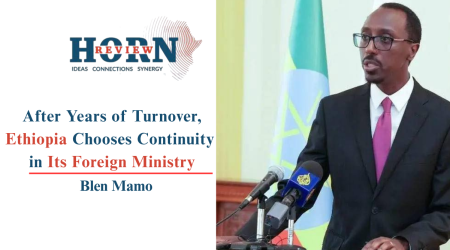
After Years of Turnover, Ethiopia Chooses Continuity in Its Foreign Ministry
Abiy Ahmed’s decision to retain Gedion Timothewos as foreign minister...
8
Oct
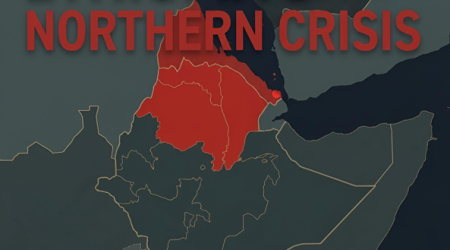
Ethiopia’s Northern Crisis: Actors, Interests and the Anatomy of Escalation
Our latest report, examines the renewed conflict in northern Ethiopia...
7
Oct
“Decaffeinated Sovereignty”: Eritrea’s One-Way Street with Ethiopia
There is a peculiar contradiction at the heart of Eritrea’s...
Comment (1)
[…] be a reaction to the speed at which the rebel offensive collapsed and the ENDF made gains. With its buffer zone collapsing, Asmara has likely resorted to direct intervention in support of the rebels, primarily […]