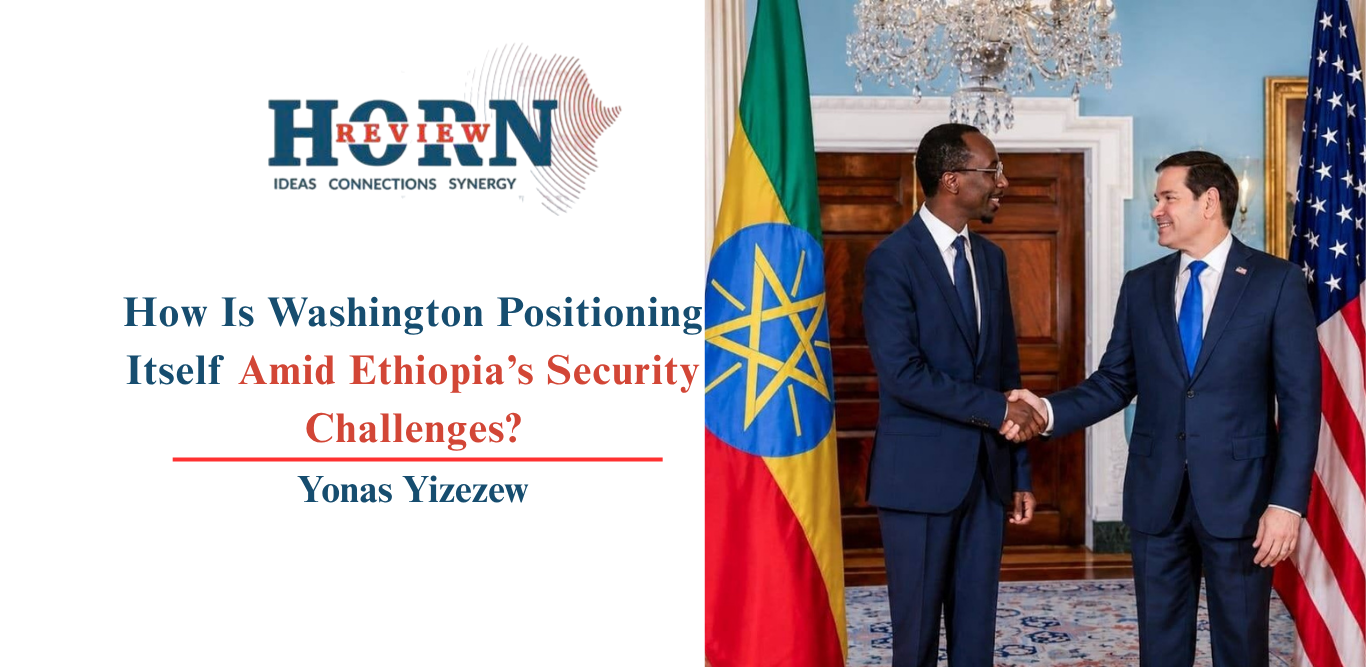
Asked about the risk of war between Ethiopia and Eritrea, Rubio said that “separatists” had attacked inside Ethiopia, that Ethiopia had responded and that troops were now “surging on both sides of the border.” He warned that this could become “a broader conflict” and “pull in other countries.” He also described the reported attacks by the “separatists” as terrorist attacks, while urging Ethiopia to respond “wise[ly] and measured[ly].” In his call with Prime Minister Abiy Ahmed days ago, he had framed the situation far more conventionally. He called for de-escalation by all sides, dialogue under the 2018 Ethiopia-Eritrea peace framework, respect for sovereignty and territorial integrity and an end to cross-border incursions. The timing coincides with the escalating confrontation between the federal government and the TPLF, as well as rising tensions between Ethiopia and Eritrea.
By framing their activities in terms of separatism and terrorism, Washington moved beyond its earlier emphasis on conflict management toward a more explicit political distinction between the Ethiopian government and those challenging its authority. It marked a notable change in American public characterization of the conflict in Ethiopia since the northern conflict. At the same time, the United States indicated that it was gradually reopening diplomatic channels with Eritrea, so that it would have enough standing to speak to both sides and ease tensions.
The shift in Washington’s public messaging was also reflected in its response to the TPLF months ago. In his September statement following the TPLF’s seizure of airports in Mekelle, Axum and Shire and the outbreak of renewed fighting, U.S. Ambassador Ervin Massinga said the TPLF leadership had made the “poor decision to launch a large-scale offensive.” He accused it of engaging in an “unwinnable fight,” criticized its rejection of AU-sponsored dialogue, and warned that the United States could impose further sanctions. Earlier in June, the State Department also imposed targeted visa restrictions on TPLF officials it accused of ‘undermining resolution to the crisis in Tigray.
The terrorism label Rubio has framed could strengthen the Ethiopian government’s hand. Ethiopia’s parliament had itself listed the TPLF as a terrorist group during the northern conflict in 2021, and formally lifted the designation only when it removed the group from the national list as part of implementing the Pretoria peace agreement. For the alliance, designation and isolation could also become a means of fracturing the coalition, particularly if followed by targeted sanctions, in addition to their unresolved tensions and lack of clarity surrounding the relationships among its constituent groups.
The timing of US measures reinforces this interpretation. Washington lifted restrictions on defense exports to Ethiopia in February, followed by the termination of the sanctions regime established under Executive Order 14046 on September. The latter brought an end to the associated sanctions and removed the designated individuals and entities from the U.S. sanctions list, signaling a broader adjustment in American policy toward both Ethiopia and Eritrea.
These moves are consistent with a long-standing American strategic interest in a stable Ethiopia capable of contributing to regional security, an objective explicitly articulated in the State Department’s 2023 country strategy. Although the current administration’s approach differs in important respects from that of its predecessor, the underlying strategic interest remains relevant to understanding Washington’s calculations in the Horn of Africa.
Meanwhile, as Washington recalibrates its approach to the Horn of Africa in response to shifting strategic priorities, it has moved to reopen relations with Eritrea including through sanctions relief and renewed diplomatic contact. The timing has become particularly significant as the risk of direct confrontation between Ethiopia and Eritrea has intensified, placing Washington’s engagement with Asmara within a much more consequential regional security context. Rubio’s subsequent remarks made clear that the administration views these channels as necessary to preserve its ability to engage both sides and potentially mediate the dispute.
The recent developments and Rubio’s words suggest that Washington might appear to be pursuing four overlapping objectives. It wants to prevent a wider interstate war that could draw in additional actors and disrupt Red Sea shipping. Simultaneously, taken from Rubio’s words, it seems to back Ethiopia’s territorial integrity and its right to counter armed challenges framed as separatism or terrorism. On the other hand, it wants to keep just enough engagement with Eritrea for communication and Red Sea positioning. And it wants to protect and expand commercial footholds that reward a functional Ethiopian center. Washington’s approach reflects an effort to manage the immediate risks of escalation while preserving strategic flexibility in a region where its interests increasingly overlap and sometimes conflict.
However, given Eritrea’s longstanding pattern of regional behavior, the expectation that diplomatic outreach alone can moderate its conduct remains difficult to sustain. The effectiveness of Washington’s approach will ultimately depend on whether renewed engagement can translate into concrete changes in Asmara’s regional calculations, particularly its role in Ethiopia’s internal conflict and its willingness to reduce the risk of interstate escalation. Besides, the diplomatic reset comes amid intensified concerns over Eritrea’s role in Ethiopia’s internal conflict, with sanctions relief coinciding with the formation of the Alliance for Survival and reports of Eritrean forces advancing tens of kilometers into Ethiopian territory, raising risks of interstate confrontation. However, rather than steering Asmara away from a proxy strategy, American engagement appears to have changed very little. Contacts between American and Eritrean officials have continued even as Eritrea’s backing for the TPLF and the broader rebel coalition has become more visible.
Eritrea’s public narrative sits uneasily with its conduct on the ground. Asmara appears to be employing a victimhood narrative to portray Eritrea as the aggrieved party, attribute the escalating confrontation to Ethiopia and divert international scrutiny from its own conduct. Sophia Tesfamariam’s recent diplomatic outreach appears consistent with this effort to shape international perceptions in Eritrea’s favor. Meanwhile, Eritrean forces remain on Ethiopian territory, it continues to support armed proxies inside Ethiopia and its actions appear consistent with an effort to establish strategic depth through a buffer along the frontier. This pattern is difficult to reconcile with a purely defensive posture or Asmara’s portrayal of Eritrea as the aggrieved party. It also raises questions about the central assumption underlying Washington’s approach in that diplomatic engagement can moderate Eritrea’s behavior despite evidence and behavior pointing in the opposite direction. Rubio’s characterization of the attackers as separatists, coupled with Eritrea’s support for these forces, could complicate Asmara’s efforts to sustain its victimhood narrative. The contradiction between portraying Eritrea as the aggrieved party and supporting armed groups challenging its federal authority would undermine Eritrea’s effort to present itself as the victim.
For a state that has long approached regional politics through strategic suspicion, confrontation and the cultivation of leverage through neighboring conflicts, renewed diplomatic standing may not necessarily translate into restraint. It also has the risk to simply give Eritrea more room to pursue its regional objectives. Washington’s interest in Eritrea is shaped by the strategic importance of the Bab el-Mandeb and the vulnerability of Red Sea shipping. Even so, Isaias Afwerki’s longstanding skepticism toward Washington reinforced by years of hostility, accusations and Eritrea’s adversarial posture toward US regional policy, raises serious questions about whether renewed diplomatic engagement can overcome the mistrust that has long defined their relationship.
Additionally, Asmara has kept closer ties with Iran has shown little enthusiasm for confronting the Houthis and was absent from the Saudi-led coalition formed to counter them. Engagement may give Washington a diplomatic channel to Asmara, but Eritrea’s unpredictable regional posture raises the risk that renewed American recognition could embolden its leadership without securing any meaningful restraint. Rubio’s repeated emphasis on preventing a conflict that “could ultimately pull in other countries” is both a warning and an acknowledgment of regional entanglement. A purely bilateral containment strategy risks underestimating how actions in one theater alter the cost-benefit calculations in another. Washington’s renewed engagement could create an opening to press Eritrea toward restraint and reduce the risk of interstate conflict. Whether that opportunity produces a more stable relationship will depend on whether diplomatic access is accompanied by credible pressure and measurable changes in Asmara’s conduct.
By Yonas Yizezew, Researcher, Horn Review