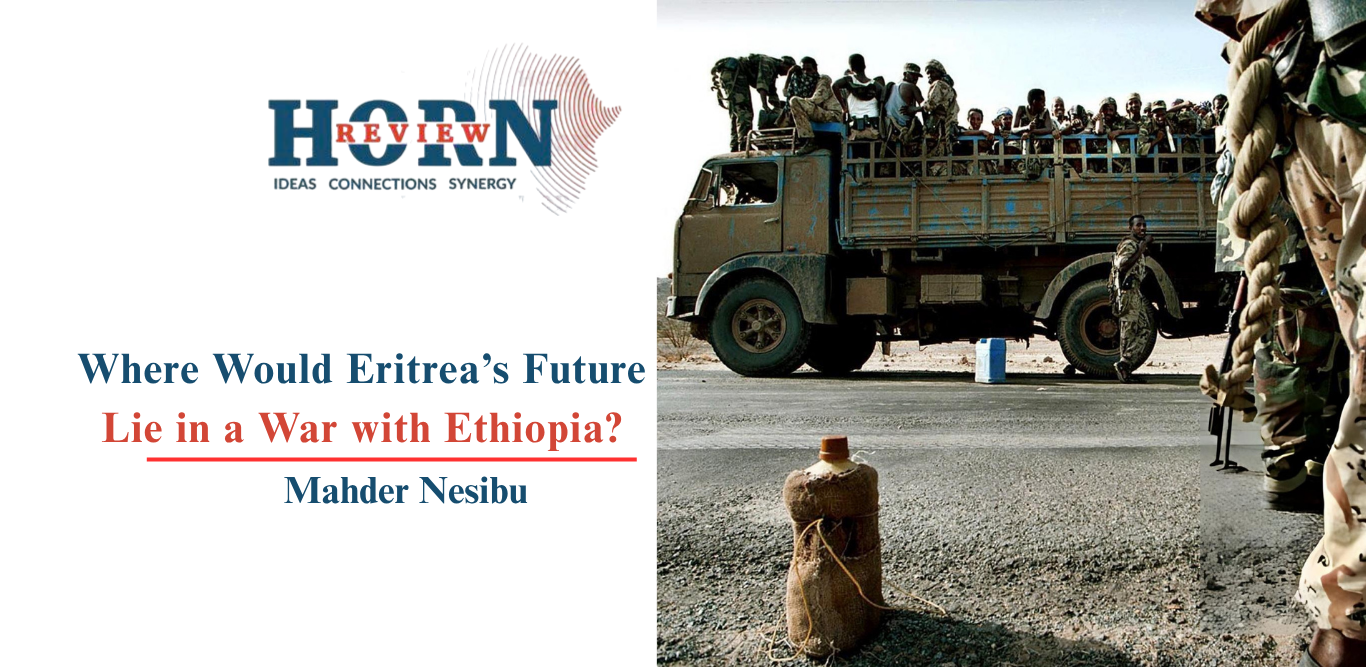
After a succession of escalations, the armies of Ethiopia and Eritrea now stand face to face, and a direct confrontation that has been years in the making has become a real possibility. Such a war would pit two mismatched neighbours against each other in what promises to be a consequential contest. Ethiopia, the larger and better resourced of the two, fields a force that has been substantially strengthened, notably through its rapid and sophisticated integration of drones into combat. It may find itself facing a tough but brittle Eritrean army, backed by a garrison-state system able to pool the country’s resources, human ones included, however hollowed out they may be. Eritrea stands at a marked disadvantage, if not at risk of outright defeat, in an all-out war. The future of Eritrea itself, a state moulded around and resting on Isaias Afwerki and his ruling circle, is now open to speculation.
The dynamics that brought the two armies face to face trace back to the spectacular failure of a strategy the Eritrean leadership had spent years assembling. As frictions between Asmara and Addis Ababa grew following the cessation of the conflict in northern Ethiopia in 2022, Eritrea turned to proxies to destabilise the Ethiopian security landscape, an asymmetric strategy it has used for decades to offset its more powerful neighbour. It began with the Tigray People’s Liberation Front (TPLF), previously its adversary in that conflict, and went on to cultivate relationships across the country, including with the Fano insurgency in Amhara. It also reactivated proxies in which it had previously invested, such as the Afar-based Afar Revolutionary Democratic Unity Front (ARDUF).
These insurgent groups came together on 20 September and, chiefly through TPLF forces, launched an offensive against military positions only three days later. The offensive was reversed quickly. The Ethiopian National Defence Force (ENDF), with capabilities revitalised in large part by the build-up that followed the previous conflict, turned the tide and made gains against the TPLF, pushing the remnants of the group’s fighting force into the countryside as it took the major roads and the cities along them. By mid-October these included Mekelle and cities near the Eritrean border such as Adwa and Shire.
For Eritrea, the failure meant the collapse of the buffer-zone strategy on which it had counted. Under that design, Tigray, through the TPLF, would serve as an arena where Asmara could exercise strategic depth while reaching the other rebel groups inside Ethiopia more concretely, in turn standing capable of deepening the country’s insecurity. Eritrea had invested heavily in the rebels. The Ethiopian military later revealed that the TPLF had sourced a formidable quantity of weapons systems, drone technology included, through its connection with Eritrea.
The Eritrean Defence Forces (EDF) entered Tigray themselves as the TPLF lines broke down, only to become targets in turn. The ENDF used drones to strike EDF positions inside the region and along the border, forcing a retreat behind Eritrea’s lines.
The present situation poses a direct question to the leadership in Addis Ababa. By largely dismantling Eritrea’s proxy strategy on the ground and pushing back the Eritrean army, the ENDF has formally exercised the country’s right to self-defence. In addition, Addis Ababa’s stated position remains that war with Eritrea should be avoided. Yet the nature of the regime in Asmara, its inherent antagonism toward Ethiopia and the permanent threat it poses to the country may lead Addis Ababa to judge it necessary to confront the Eritrean army and leadership in full. It could do so through conventional war, or by targeting the small circle at the regime’s core, an operation that would, if carried out, render the state apparatus dysfunctional.
Addis Ababa could also use the moment to address the question of access to the sea, which has ranked among the foremost items, if not the foremost, on the country’s national interest agenda for the past three years, since its diplomatic push became prominent. The strategic question itself dates back to Eritrea’s secession from Ethiopia, an arrangement that left the country landlocked. Ethiopia has set its sights on the port city of Assab, in the east along the Ethiopia-Eritrea border, which it could capture comparatively easily, at least in comparison to the mountainous terrain surrounding Asmara, and then present its case for legitimate sovereignty over the port – which holds historical and legal weight on its own – to the international community.
Whatever specific interests the Ethiopian government may have set for itself in regard to Eritrea, and even if war remains only a possibility, direct fighting would place the future of President Isaias Afwerki’s regime, already a black box, open to speculation. Three outcomes can be anticipated, all of which exclude victory for Asmara, a highly unlikely result.
The first would see the Eritrean People’s Liberation Front (EPLF), the rebel root of the current Eritrean regime, meet a fate similar to that of the TPLF. Like the TPLF, the EPLF traces its origins to an insurgency against the Ethiopian state. The TPLF has resorted to guerrilla warfare reminiscent of its roots in the 1970s, and the EPLF could follow a similar path, in which the collapse of the state gives way to a weakened EPLF fighting against Ethiopia or against whatever Eritrean structure succeeds it.
The second would see the removal of the current leadership, President Isaias included, and the emergence from within the regime of a new set of leaders prepared to reach some form of compromise with Addis Ababa. That compromise would address Ethiopia’s national security and Eritrea’s role in it, as well as the question of securing access to the sea, with concessions that ultimately satisfy Addis Ababa. It could open a new chapter in Ethiopia-Eritrea relations, at the risk of preserving Isaias Afwerki’s system of governance, which has produced the state Eritrea is in today.
The third would rest on the means Addis Ababa has of influencing Eritrea’s future directly. It has been giving refuge to an array of political movements that seek, in one form or another, to free Eritrea from the grip of Isaias and the EPLF, and the current cohort of the Eritrean opposition offers a pool from which a new leadership could be drawn. One is the Eritrean Blue Revolution Front (EBRF), a largely diaspora-based movement with a large following that is also active in Addis Ababa, where many Eritrean refugees reside. The group presents itself as committed to opening up Eritrea and as friendly toward Addis Ababa and its interests. Installing it in place of the EPLF could allow Ethiopia to secure its interests over the long term and to project power in and through Eritrea, in turn strengthening its position in the Horn of Africa and the Red Sea basin.
Yet the trajectory of a confrontation could also produce outcomes far more problematic than those outlined. The last time Ethiopia and Eritrea fought an all-out war, in 1998, the destruction was substantial. The fighting was brutal, and the rationale for the war remains peculiar and unconvincing to this day. It could be argued that Asmara dragged the two countries into a full-scale war over a claim to border territories, a dispute, however, that negotiation could have resolved. Ethiopia nonetheless broke the Eritrean defences after much struggle and came close to capturing Asmara itself, before withdrawing and signing a peace deal in 2000 that it considered a poor reflection of realities on the ground, particularly a border demarcation decision that favoured the Eritrean claim, at least in Addis Ababa’s view.
History leaves Ethiopia facing a dilemma over how to approach the regime in Eritrea, which has posed a national security threat to Ethiopia since Eritrea emerged as a state and, in its origins as an insurgency fighting the Ethiopian army, as far back as the 1960s.
By Mahder Nesibu, Researcher, Horn Review