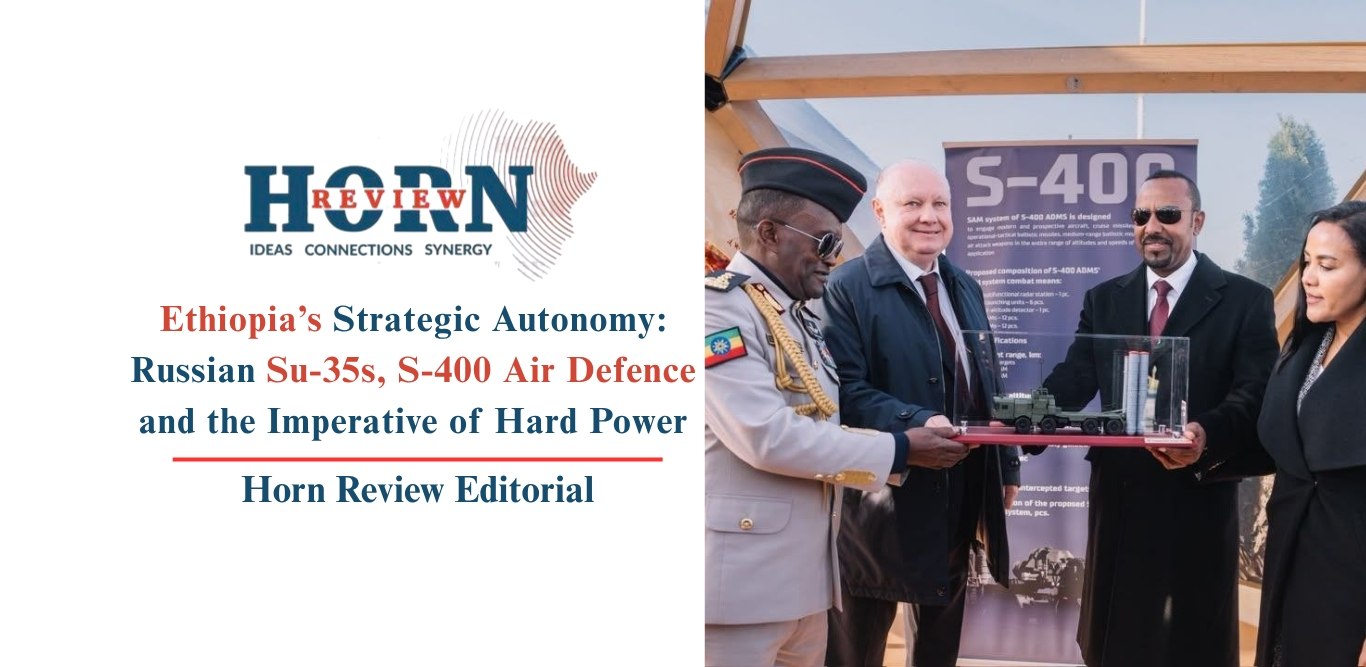
Prime Minister Abiy Ahmed’s announcement in Moscow on October 28 that Ethiopia had acquired 12 Russian Su-35 fighter aircraft and planned to procure four batteries of the S-400 air-defence system marks a significant development in the country’s defence modernization. Abiy said the aircraft had arrived a year ahead of schedule, crediting Russian President Vladimir Putin’s support. Russia’s state-owned arms exporter, Rosoboronexport, confirmed to Reuters that the initial delivery comprised two Su-35s. The acquisition signals Ethiopia’s determination to strengthen its military capabilities as part of its pursuit of strategic autonomy.
Since 2018, strategic autonomy has emerged as a central pillar of Ethiopia’s state-building project, linking political sovereignty with economic self-reliance, technological development and the capacity to defend national interests. The acquisition of advanced Russian fighter aircraft and the planned procurement of S-400 air-defence systems translate this ambition into the military domain. They reflect Ethiopia’s effort to strengthen its capacity to protect its airspace, deter potential threats and preserve freedom of action in an increasingly competitive regional environment.
The significance of these acquisitions extends beyond the equipment itself. The Su-35 expands Ethiopia’s combat aviation capabilities, while the planned S-400 procurement would add an advanced air-defence capability. Together, these systems represent an investment in the hard-power dimension of strategic autonomy: the ability to safeguard national interests through military capabilities rather than relying on diplomatic assurances alone. Ethiopia’s longstanding air-force tradition provides an institutional foundation for this modernization, while the new platforms expand the technological reach of its armed forces.
The procurement also reflects Ethiopia’s effort to diversify its strategic partnerships. By acquiring advanced Russian military systems, Addis Ababa is broadening its defence relationships and accessing technologies that remain beyond the immediate reach of domestic production. This aligns with a strategic-autonomy framework in which external partnerships serve national priorities without determining them. Foreign procurement thus becomes an instrument of national strategy, expanding the range of capabilities available to the state while reinforcing its pursuit of independent decision-making.
This military modernization complements Ethiopia’s efforts to develop a domestic defence-industrial base. Initiatives such as SkyWin Aeronautics Industries and the Homicho Ammunition Engineering Complex reflect the government’s drive to expand indigenous production and technical capacity. Although these institutions operate at different technological levels from advanced combat aviation, they form part of the same broader undertaking: reducing critical dependencies and building a stronger domestic foundation for national defence.
Ethiopia’s approach combines the acquisition of advanced foreign military systems with the development of domestic defence capabilities. Foreign procurement provides access to technologies that remain beyond immediate domestic production, while the expansion of the defence-industrial base supports the longer-term objective of reducing external dependencies. Both form part of Ethiopia’s pursuit of strategic autonomy: strengthening national defence capabilities and resisting external coercion while preserving the freedom to determine its own strategic priorities. In doing so, Ethiopia is translating sovereignty from a political principle into a material national ambition.
By Horn Review Editorial