Eritrea remains a structural challenge to Ethiopia’s national security. The present relationship between the two countries is defined by escalating tensions, in which Asmara, consistent with its broader and long-standing calculation that a stable Ethiopia constitutes a threat, has cultivated alliances with Ethiopia’s diverse rebel groups in order to weaken Addis Ababa. What shape the Ethiopian response to that threat should take has been a matter of debate. Addis Ababa has taken steps to counter the rebels themselves, while Eritrea’s broader antagonism remains unaddressed, a question of considerable sensitivity and complexity because it belongs to the realm of interstate dynamics. Nonetheless, Ethiopia possesses an array of options for dealing with the Eritrean threat, one being the establishment of strategic depth of its own.
In Tigray, Ethiopia’s northern region, Eritrea’s proxy penetration of Ethiopia’s security space has centred on the Tigray People’s Liberation Front (TPLF), which has thus far been the most prominent and capable of the rebel groups inside Ethiopia. Before a counteroffensive by the Ethiopian National Defence Force (ENDF) forced it into a crushing retreat to Tigray’s countryside, the TPLF had served as the linchpin of Eritrea’s buffer-zone strategy. The shared border between Tigray and Eritrea allowed the relationship between the PFDJ/EPLF (Eritrea’s ruling regime) and the TPLF to develop, and the regime to invest in the Tigrayan front, effectively establishing strategic depth inside Ethiopia.
The TPLF is one element among several in Eritrea’s strategy. The Ethiopia-Eritrea border extends beyond Tigray and cuts through the homeland of the Afar people, and Eritrea has also exploited the politics of Ethiopia’s Afar region to its apparent advantage. A smaller but long-standing rebel group, the Afar Revolutionary Democratic Unity Front (ARDUF), which has regarded Addis Ababa as an adversary, saw its leadership travel to Eritrea in 2025, where it reorganised the front. Ahead of the TPLF offensive of 23 September, the ARDUF became part of a broader alliance of rebels and joined the fighting itself, primarily in Ethiopia’s Afar region.
The rebel alliance, formalised as the “Alliance for Survival”, was at least in part engineered by Asmara, whose reach extends beyond the TPLF and the ARDUF to the rebels of the Amhara and Oromia regions, which, alongside the TPLF, make up the coalition’s three core members.
Where the Ethiopia-Eritrea border served as the bridge for Eritrea’s strategic depth in Tigray, reaching the Amhara region and the Fano rebellion, specifically the grouping under the Amhara Fano National Movement (AFNM), and by extension the Oromo Liberation Army (OLA) in Oromia, has been orchestrated by distinct means. In addition to the links among the rebels themselves (such as between the AFNM and the TPLF), Asmara has found its previously established relationships, formed as host to Ethiopian rebels under the previous Ethiopian administration, useful. It comes as no surprise that Asmara is able to reach the OLA leadership, a group that had maintained a prolonged presence in Eritrea, and some figures within the AFNM, including its leader, Zemene Kassie, who has a history with the Eritrean regime from his time in the Ginbot 7 rebel group.
More concretely, Eritrea has been able to reach the AFNM materially through the strategic exploitation of Sudan and the instability produced by its civil war. Through its broad involvement in Sudan’s war, Eritrea has hosted meetings between the rebels and its representatives and even supplied logistics directly to the AFNM, as multiple reports have revealed.
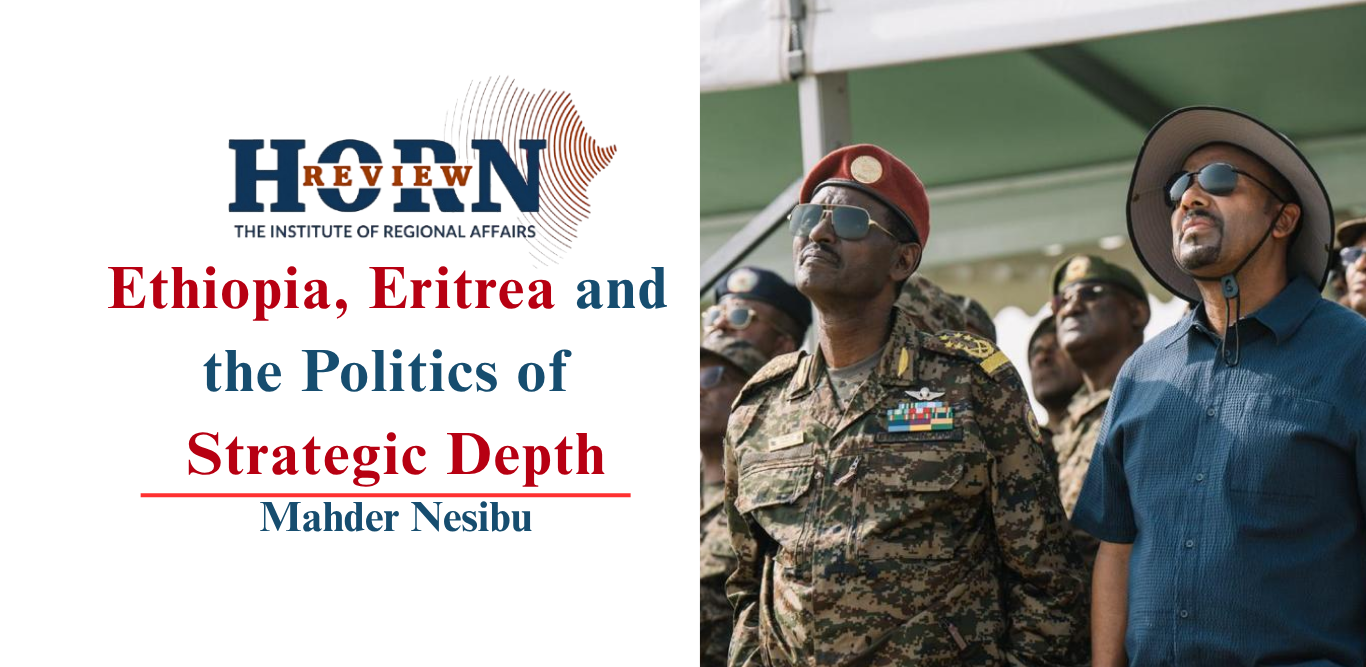
Since late September, the dynamics on the ground between Ethiopia and Eritrea and its proxies have shifted radically. They reveal that the Eritrean buffer zone has been largely degraded, if not wholly dismantled. Ethiopian forces now maintain a steady presence on the Ethiopian side of the border with Eritrea, and the rebels, even if not permanently neutralised, have weakened in their ability to tie down the Ethiopian security establishment, which enjoys a marked asymmetry in capacity relative to Eritrea’s limited military prowess.
The Eritrean threat nonetheless persists. The “Alliance for Survival” still maintains its goal of overthrowing the government in Addis Ababa and destabilising Ethiopia, albeit with more modest capacity than it originally intended. More structurally, the PFDJ’s enduring strategic thought, which Ethiopia’s foreign minister has described as equating Ethiopia’s instability and state weakness with Eritrea’s own security and longevity, will ensure Asmara remains a permanent dilemma for the Ethiopian security establishment.
To meet that challenge, Addis Ababa has a range of options to consider, which could take the form of a direct offensive against Asmara itself, such as targeting the apparatus of the regime so as to render it incapable of implementing its strategy, while avoiding an all-out confrontation, which would foment complex dynamics in turn.
It could also establish a degree of strategic depth that would constrain Asmara’s ability to threaten Ethiopia’s national security.
For one, the option of a military approach to establishing such depth, which would mean the creation of a buffer zone inside Eritrea itself, remains available and falls under the rationale of self-defence granted to Ethiopia by international law. This rationale rests on two major considerations. The first is that the Eritrean Defence Forces (EDF) displayed their appetite for direct confrontation during the proxies’ September offensive. As Eritrea’s buffer zone in Tigray broke down, EDF personnel made deep incursions into the region (having already established a presence in border towns), as recorded by various reports and asserted by Addis Ababa itself. Although they were pushed back quickly, the incursion proved that the possibility of direct EDF attacks on Ethiopian forces remains high.
The second is the TPLF factor in this threat. Although the ENDF has largely re-established its positions along Ethiopia’s border, it may face the Front from Eritrean territory as well as from the Tigrayan countryside. Such a threat is plausible given Eritrea’s past willingness to open its territory to Ethiopian rebels and the TPLF’s own receding fighting capability inside Tigray, which makes the prospect of the group using Eritrea as a safe haven and a launchpad for its fight against the Ethiopian government more likely.
Broader forms of strategic depth vis-à-vis the Eritrean regime could also enter Ethiopia’s defence calculus.
One strategy employed by the PFDJ leadership has been a diplomatic and media push to recast Eritrea’s military posture as defensive while portraying Ethiopia as harbouring aggressive intent. This has been visible in the diplomatic offensive by its senior envoys, including the Eritrean foreign minister, directed at the United Nations, the African Union and several Western capitals, which has characterised Ethiopia’s interests, particularly in the Red Sea, as “expansionist” and invoked international law and narratives of sovereignty. Eritrea’s media campaign has followed the same trajectory. Concealing Eritrea’s proxy mobilisation and direct incursions, it has pushed narratives of Ethiopian aggression to undermine Ethiopia’s standing amongst the international community.
Addis Ababa has ground to gain on the diplomatic front. It has already made its position clear to the United Nations and through bilateral channels. Beyond asserting its defensive position, it could go further to lay bare the hostile strategy within Asmara’s rationale, and to expose its role in the formation of the rebel coalition.
The logic of strategic depth, which should also be comprehensive in addressing Eritrea’s various avenues of projection, such as its influence over Sudan and its activities there, is likely the way forward. The fundamental posture of the Eritrean regime, and its hostility toward a stable and secure Ethiopia, remain a central threat to Ethiopia’s national security, one broader in scope than the rapidly shifting dynamics on the ground.
By Mahder Nesibu, Researcher, Horn Review