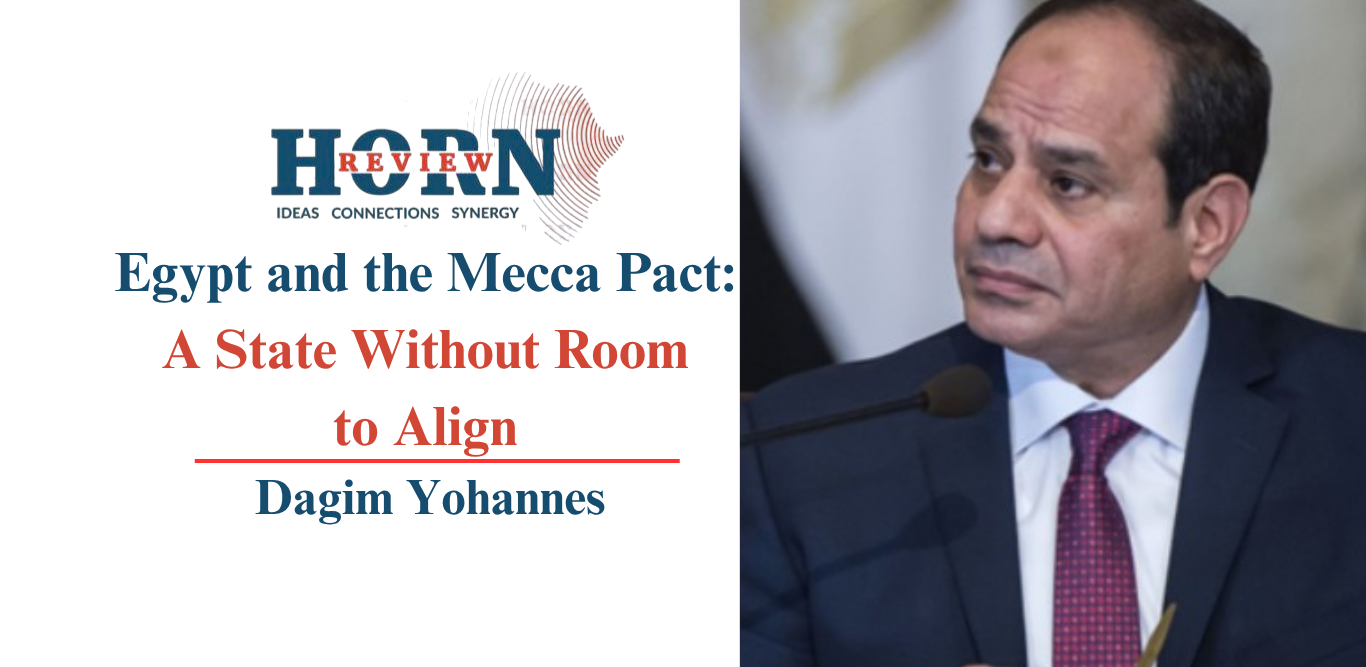
When Turkey, Saudi Arabia, and Pakistan signed a Nato-style collective-defence pact in Mecca this month, the absence that mattered was Egypt. Cairo was not a bystander to this treaty; it was the party Ankara most wanted at the table, formally proposed for inclusion, and structurally aligned with the other three on Gaza mediation, counter-Muslim Brotherhood politics, and African-file cooperation. The instinct across mainstream commentary, which frames the Mecca pact as a bold show of “middle-power autonomy” and strategic self-reliance will be to read Egypt’s refusal as hedging, a calculated wait-and-see typical of Cairo’s foreign policy caution. That reading drastically understates what has actually happened. Egypt did not choose to stay out. It no longer has the room to choose to go in.
The logic is a tradeoff between two opposite risks, and Cairo is caught on both sides of it at once. Commit to the pact and Egypt risks being pulled into a confrontation it never chose, one triggered by someone else’s conflict and defined by someone else’s enemies. Decline it and Egypt risks losing the backing of a patron it cannot function without. Most states facing this kind of tradeoff can at least resolve it in one direction and hold that position until conditions change. Egypt cannot, because it is not managing one version of this problem but two simultaneously, on opposite sides of the region, and neither can be settled without inflaming the other.
Turkish officials envisioned a trilateral treaty and widened it specifically to capture Egypt, whose military weight and existing coordination with Turkey, Qatar, and Saudi Arabia on Gaza and African security made it a natural fourth pillar. Egyptian officials have not been absent from the underlying architecture. Cairo has sat inside the informal Regional Four consultations for months, and its foreign minister was photographed alongside his Turkish, Pakistani, and Saudi counterparts in Cairo in June. The distinction Egypt drew was narrow and precise: participate in the dialogue, decline the binding collective-defence commitment. That is the standard move of a state trying to capture a patron’s reassurance without accepting the exposure that comes with it. Dialogue signals alignment to Riyadh and Ankara without triggering the automatic-commitment clause that would make Cairo answerable for a conflict it did not choose.
The confrontation risk runs through Israel. Egypt is not merely diplomatically correct with Israel; it is treaty-bound to it, and it borders it. Former Israeli Prime Minister Naftali Bennett’s public framing of the emerging Turkey-Saudi-Pakistan axis as a hostile Sunni bloc was not incidental noise. It set the terms under which any Egyptian signature would be read in Tel Aviv and Washington, not as regional solidarity but as confrontation. Cairo has spent four decades building its regional utility around being the indispensable, non-threatening interlocutor between the Arab world and Israel, most visibly through its Gaza mediation role. A collective-defence signature, under a treaty explicitly triggered by an attack on any member, hands Cairo a binding commitment whose activating event it does not control and whose consequences it cannot contain.
The patron-loss risk is where the problem stops being singular and becomes two-sided. Egypt’s economy has been kept solvent since 2024 largely by a single transaction, the $35 billion Ras El Hekma development deal with Abu Dhabi’s ADQ, the largest foreign direct investment in Egyptian history, layered on top of roughly $163 billion in external debt. Egypt deployed Rafale fighter jets in May in response to Iranian strikes against the UAE, a level of direct military commitment it has extended to no other partner in the current alignment. Joining the Mecca pact risks the loss of Abu Dhabi’s support, whose capital Egypt cannot replace. But the risk cuts deeper still: the UAE sits on the other side of a quiet but real alignment with Israel. Any Egyptian move that visibly distances Cairo from Abu Dhabi risks being read in both capitals as a step toward confrontation with that axis, an outcome Egypt has spent four decades carefully avoiding. Declining the pact visibly, while the other signatories deepen their coordination, risks the loss of Riyadh’s support instead. Sources close to the signing describe Saudi officials already viewing Egypt as unreliable; three Saudi sources familiar with the discussions indicate that Riyadh actively opposed Egypt’s inclusion, driven by growing frustration with President Abdel Fattah el-Sisi’s government and a belief that Egypt no longer offers the strategic or military value it once did. One former senior adviser put it bluntly: Egypt “takes and takes with no return.” That assessment reflects specific grievances, Cairo’s limited role in the Yemen war, its perceived subordination to Abu Dhabi amid the Saudi–UAE rift, and the asymmetry of military support Egypt extended to the UAE during Iranian strikes while offering no equivalent to Saudi Arabia. Ordinarily a state in this position can at least manage the risk by choosing which patron to reassure. Egypt cannot choose, because Riyadh and Abu Dhabi are themselves diverging, and reassuring one now reads as abandoning the other, and, in the UAE’s case, as risking friction with the Israeli relationship that underpins much of Abu Dhabi’s current regional posture.
That divergence is the mechanism, not background colour. Riyadh and Abu Dhabi have split sharply through 2026, from the UAE’s abrupt OPEC withdrawal to disputes over Yemen, Sudan, and Syria, to the point that Cairo has had to step in as an emergency mediator between the two. Normally a state facing this kind of squeeze can pick a fixed position and hold it until conditions change. Egypt cannot hold a position, because the ground itself is moving under it. Every signal that satisfies Saudi Arabia’s expectation of solidarity erodes the UAE relationship funding Egypt’s currency stability, and the reverse holds equally. Non-alignment stops being a chosen equilibrium and becomes the only position that does not immediately cost Cairo one of its two Gulf patrons, even though, as Saudi Arabia’s souring view demonstrates, it costs Cairo credibility with both over time.
Compare Pakistan, which signed without hesitation. Islamabad carries no Israel treaty to generate confrontation risk, no Emirati investment position to generate a competing patron-loss risk, and it brings a nuclear deterrent that gives Riyadh and Ankara reason to want its signature regardless of what Pakistan asks in return. Egypt has the inverse profile on every axis: exposure to Israel, exposure to a fracturing Gulf on two fronts, and no comparable asset that would let either patron tolerate friction with Cairo the way both tolerate none with Islamabad. For Pakistan the tradeoff barely exists. For Egypt it is layered three deep, which is why the two states arrived at opposite decisions from a nominally similar invitation.
This is the pattern this publication has tracked since the Ras El Hekma deal reshaped Cairo’s fiscal position: Egyptian statecraft substituting collateral for autonomy. While other middle powers flex newly found strategic leverage through multilateral pacts, Cairo is constrained by a solvency deficit. The Octagon military buildout, the Somalia deployment, and the Gaza mediation role all function less as expressions of independent strategic will than as assets pledged against continued Gulf and Western tolerance of a state that cannot otherwise service its own debt. The Mecca abstention is the diplomatic expression of the same underlying condition. A state with slack, fiscal or strategic, can absorb some confrontation risk in exchange for allied reassurance. A state without slack has to minimize that risk categorically, because it has no reserve capacity to manage the fallout if the gamble goes wrong. Egypt’s abstention is not caution or temporary hesitation in the ordinary sense. It is the tradeoff being resolved entirely toward avoiding confrontation, because the other side of the ledger no longer has a safe direction to lean.
Turkish Foreign Minister Hakan Fidan’s public framing;, that Egypt’s absence is merely a matter of unresolved “technical issues” and that Cairo will join in due time, should be read as diplomatic face-saving rather than accurate forecasting. Structural constraints, not procedural delays, dictated this decision. Nothing about the Saudi-UAE rift, Cairo’s fragile debt profile, or Egypt’s financial exposure to the UAE is on a resolution timeline that would allow Fidan’s prediction to hold. The more useful question for regional planners is not whether Egypt eventually signs, but what a state squeezed on three sides at once does instead. The answer is more of what Cairo has already been doing: mediation roles that generate leverage without commitment, military deployments that are transactional rather than allied, and public statements that other capitals are left to interpret generously because contradicting them costs nothing and clarifying them costs everything.
The institutional implication for actors dealing with Cairo is to stop treating Egyptian non-alignment as a negotiating position that can be moved with better terms. A state in Egypt’s position shifts only when the balance of confrontation risk and patron-loss risk itself shifts, not when a partner simply asks harder. Ankara’s two-year effort to secure Egyptian participation failed because persuasion was never the binding variable. Any future attempt to bring Cairo into a formal bloc will fail on the same terms unless it changes the underlying calculus directly, either by offering Egypt a financial alternative to its UAE dependency that lowers the cost of Gulf friction, or by resolving the Saudi-UAE rift that currently makes every Egyptian signal costly in one direction or the other. Absent either, Egypt’s regional posture will keep reading as ambiguity when it is in fact a squeeze with no stable exit available to the state trying to manage it.
By Dagim Yohannes, Researcher, Horn Review