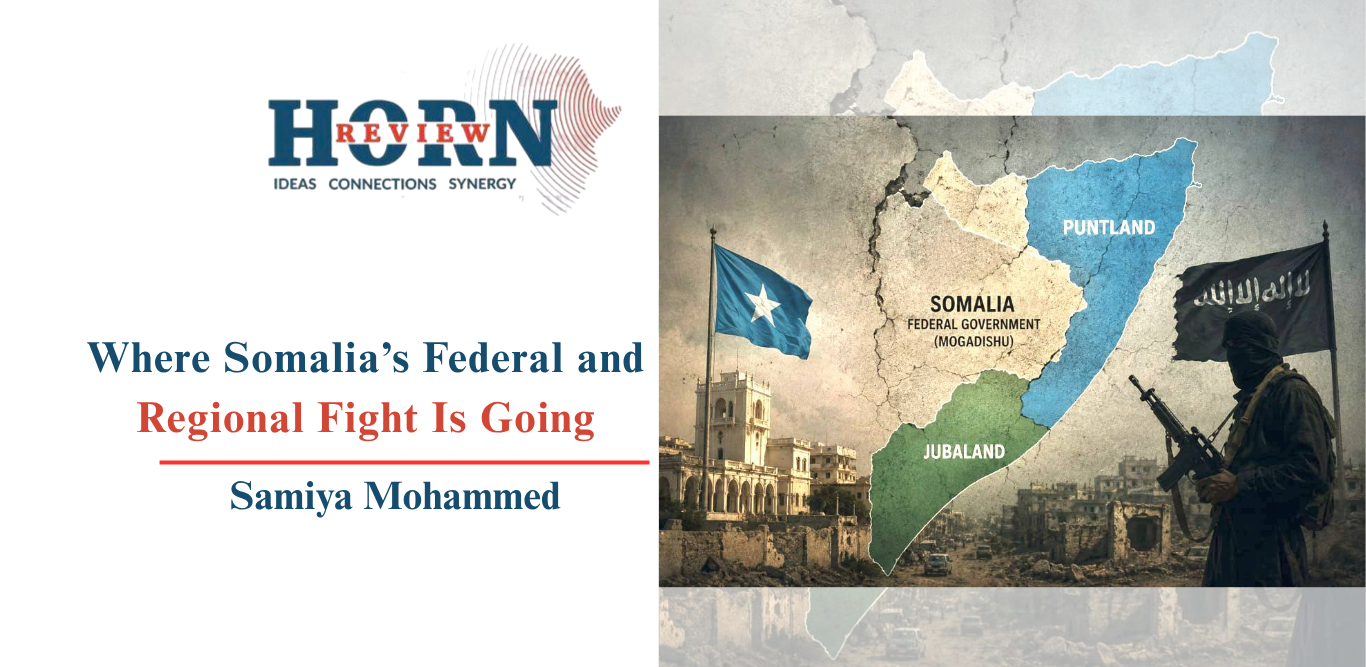
The 2012 federal settlement was less a constitutional order than a negotiated compact among parties whose cooperation was indispensable to the reconstitution of a Somali state and its logic rested on a reciprocal exchange with Mogadishu would retain the international seat, the ports and the aid pipeline while the member states would preserve their own forces, their own revenue and substantial influence over how power in the capital was assembled and transferred. The arrangement was imperfect yet it possessed a virtue that no subsequent arrangement has recovered namely that it was accepted however by the actors capable of making it function. Puntland and Jubaland remained inside the process precisely because the bargain conferred sufficient autonomy for self protection while allowing them to share in the international recognition that attached to a unified Somali state which is why the settlement’s durability depended not on its legal elegance but on the consent of those whose cooperation it required.
That bargain has since been rewritten unilaterally when the Hassan Sheikh government extended the presidential term from four years to five and deferred elections to 2027 without the agreement of Puntland and Jubaland. His original mandate expired on 15 May 2026 and the government characterizes the period that followed as a transition while its opponents characterize it more simply as the tenure of a president whose term has ended. That disagreement is not a debating point but the fault line along which the entire federal project is now splitting because once the two sides cannot agree on who legitimately holds power in Mogadishu, they cannot agree on anything that derives from it like elections, security coordination, revenue sharing or the command of the national army and every subsequent dispute becomes a contest over legitimacy rather than a disagreement over policy.
South West has become the clearest case of force replacing politics. In March the national army entered Baidoa, removed Abdiaziz Laftagareen and installed Aden Madobe. The removal was not the product of a state assembly vote or an agreed reconciliation. It was a military action against a sitting regional president carried out by forces that are supposed to be shared national assets. Since then Laftagareen’s men have struck the city three times. The significance of this is that the national army is now fighting Somalis not only Al-Shabaab. A force built with international money and trained for counterinsurgency is being used to settle a political dispute inside a member state and every clash it fights in Baidoa is a clash it is not fighting against the insurgency that still controls large parts of the country.
Baidoa today is held by the federally backed administration, which remains on high alert with Laftagareen’s forces still outside the city and there is no political settlement only an installed administration and an unresolved armed dispute waiting for the next round. That is not a stable outcome but a frozen confrontation that can be reheated at any moment and it has already demonstrated to every other regional leader what happens when Mogadishu decides a member state’s leadership is a problem, the army arrives, the president is removed and a replacement is installed. Whatever legal arguments are offered for the action, the political lesson is unmistakable and it has shaped regional states since because most now operate on the assumption that the same sequence could be applied to them and that their own forces and not the national army are the only reliable guarantee of their political survival.
Puntland’s response Under Said Deni has locked federal forces out of its territory, seized bases aligned with Mogadishu and in a letter to the United Nations on 13 September warned that it may cut ties for good. Puntland already runs its own security forces, its own ports and its own operations against ISIS and piracy. It does not depend on Mogadishu and What it took from the 2012 bargain was recognition and a seat at the table and not protection. When the table stopped producing acceptable outcomes, Puntland began behaving as a separate authority in practice while deferring the formal declaration. Its separation talk remains a threat more than a proclamation but the substance of separation is already visible with separate forces, separate foreign engagements, separate security priorities and no shared electoral framework with the capital.
Jubaland follows the same pattern with In Gedo fighting has hit Beledxaawo and Doolow. On 8 October the Doolow commissioner said the district would follow Ethiopian security orders until a real Somali government exists. That statement deserves to be read carefully because a district commissioner is a local official within the federal system and he publicly declared that his district would look to a foreign capital rather than Mogadishu for its security. This is the break moving below the level of the state. When districts begin choosing external actors over the national government, the problem is no longer a dispute between Mogadishu and a regional administration. It is the erosion of the state’s authority at its most local level and it is difficult to reverse because the district has already found an alternative.
The opposition has consolidated around the Somali Future Council which brings together Puntland, Jubaland and former presidents and prime ministers. Mogadishu says talks are open. The other side says the president’s term is already over. Those two positions cannot be reconciled by dialogue alone because one side is negotiating about the future and the other is disputing the legitimacy of the present. Talks have not stopped the guns. The fighting in Baidoa, Gedo and elsewhere has continued while channels remain nominally open which suggests that neither side believes the other is negotiating in good faith or that the talks can deliver what force has so far failed to deliver.
The position therefore not a stalemate in the ordinary sense however it is a fragmentation. Baidoa is held by a federally backed administration with its rival’s forces outside and no political settlement in sight. Puntland and Jubaland are outside the federal process in practice not just in rhetoric. Galmudug and Hirshabelle remain weaker and more dependent on Mogadishu but their dependence is not evidence that the system works. It is evidence that they have fewer options and weak partners are not the same as consenting ones. Meanwhile Al Shabaab still holds large parts of the south and center has gained ground in places such as Hiraan and Middle Shabelle and continues to cut local deals. The political war helps it and every federal soldier deployed to Baidoa or Gedo is a soldier unavailable for operations against the insurgency and every regional force that turns its attention to defending itself against Mogadishu is a force that is not clearing Al Shabaab from the areas it controls.
The 2027 elections are the government’s plan but they are not agreed by the states that matter. A vote that Mogadishu runs alone will not be accepted in Puntland or Jubaland and it is unlikely to be accepted in the districts that have already begun looking elsewhere for security. An election held without the participation of the major regional administrations would not produce a nationally legitimate government. It would produce a government that Puntland and Jubaland treat as another unilateral act by the capital, no different in kind from the term extension itself. The consequence would be a further entrenchment of separate authority and possibly a formal rupture that the current threat of separation has so far avoided.
This is not a federation under strain and it is two or three authorities that no longer accept each other’s rules, operating alongside an insurgency that fills the gaps between them. Mogadishu can seize a city and install a president. It cannot make Puntland obey, it cannot finish Jubaland and it cannot hold the countryside against Al Shabaab while its army is used for politics. Each Baidoa clash is a net loss for the state because the state’s coercive capacity is being spent on Somalis rather than on the insurgency and because the political cost of that spending is paid by every region that watches and draws conclusions about its own future.The base case is not a dramatic collapse but a slow and grinding deterioration. No election in 2027 that all sides accept and Puntland remaining de facto separate while avoiding a formal declaration. Jubaland following the same path with a more fragile internal security environment
A clean reset would require concessions Mogadishu has not offered and regions have not been given reason to trust with reopening the 2012 bargain in a form the member states believe is binding, restoring an agreed electoral timetable and returning the national army to a role that does not include removing regional presidents. None of that is currently on the table and absent such a reset force has produced resistance rather than a country. The fight is therefore not heading toward resolution but toward a longer and more fragmented conflict in which the authority of the center shrinks to what its soldiers can hold while the regions consolidate what they have already decided they can no longer entrust to Mogadishu.
By Samiya Mohammed, Researcher, Horn Review