Analysis of instability in the Horn of Africa and its relationship with the Middle East frequently focuses on visible political disputes like Ports, borders, diplomatic recognition, sovereignty claims and security alignments that dominate policy discussions and media coverage. However an assessment requires distinguishing between the visible apparatus of competition and the underlying condition that gives that competition its intensity and persistence. That structural condition is water and more specifically the control of the rivers that carry it. Water is the core and Everything else is apparatus. Disputes over ports and recognition, diplomatic expulsions, military cooperation agreements and competing declarations are political instruments through which states seek or block leverage over a condition defined by geography. This condition cannot be altered by negotiation alone and Understanding this distinction is essential for any serious path of the region.
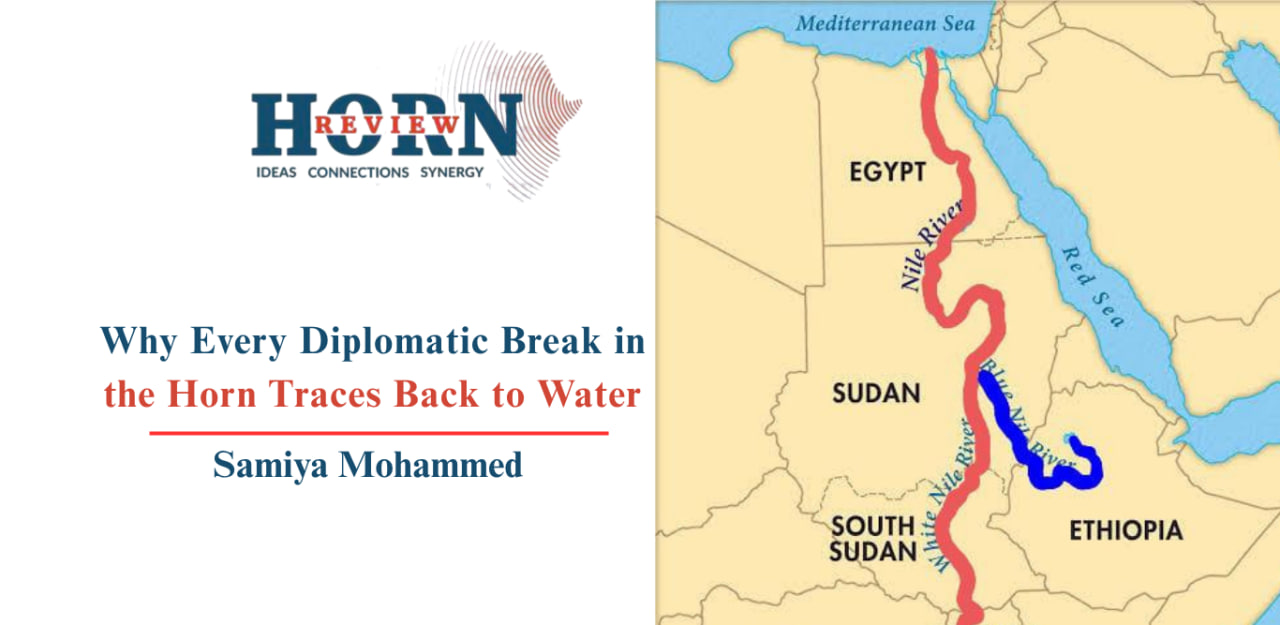
Water is the foundational condition that shapes the constraints and opportunities of every state in the region. The Nile River system is the clearest example. Upstream states possess the geographical advantage of controlling the flow. Where water is scarce its distribution becomes a matter of existential importance. Where water is abundant but unevenly distributed, the potential for leverage and pressure becomes a permanent feature of regional politics.
A dispute over a port is not just a dispute over a port. It is a dispute over access to supply chains linked to water dependent economies. A disagreement over diplomatic recognition is not just a legal or political question however it is a question of which actors will be empowered to shape the rules that govern shared resources. A security alignment is not just a military arrangement. It is a mechanism for projecting leverage over territories and infrastructure connected to water and water enabled development. Water multiplies the stakes of ordinary disputes and narrows the room for compromise. It does not need to be the declared cause of any single incident to be the underlying force that makes those incidents difficult to resolve.
Ethiopia’s use of its highland waters for electricity generation and productive capacity is an ordinary exercise of internal development. The construction of infrastructure within a state’s own territory to harness natural resources for the benefit of its population is a standard component of economic development. It is not in itself an act of aggression or a violation of international norms. The criticism that Ethiopia’s development constitutes the origin of the problem misidentifies the source of tension. The source of tension is the geographical asymmetry of the Nile system and the unequal dependencies it creates. Ethiopia’s development decisions are responses to that geography. They are not the geography itself. However the appropriate response to those is not to treat every additional infrastructure step as illegitimate however it is to pursue confidence building measures around shared systems. The task is technical management not political confrontation. The error in much of the current discourse is the conflation of a legitimate development priority with an existential threat. That conflation serves political purposes but it does not serve the long term interests of any state in the region.
An analytical distinction must be made between legitimate dependence and the assertion of a veto over upstream development inside another state’s territory. Dependence does not confer the right to block development within the borders of another sovereign state. The framing of every additional infrastructure step as illegitimate externalizes the problem. It substitutes regional pressure for durable shared rules. It treats geography as a grievance rather than a condition to be managed.
The current alignment of Egypt and Sudan with other actors in the region reflects this externalization. Their strategy has emphasized the construction of external fronts that treat upstream infrastructure as inherently illegitimate. This approach does not produce a sustainable management framework. It substitutes confrontation for cooperation and narrows the space for compromise. The question is whether this approach serves the long term interests of downstream states. The evidence suggests it does not.
When it comes to Somalia and Eritrea, their claims of sovereignty and security concern do not justify treating Ethiopian development capacity as an automatic threat to be blocked through coordinated exclusion. This is the analytical error in the current alignment. It converts self interested positioning into offensive instruments. It treats Ethiopian development as a threat to be constrained rather than a geographical fact to be managed through technical agreements.
Somalia’s position is further complicated by its internal fragmentation and its selective external alignments. These factors amplify friction without producing workable management frameworks. The challenge for Somalia is to distinguish between genuine security needs and participation in external fronts that serve the interests of other actors. The same applies to Eritrea. Sovereignty is not strengthened by participation in coordinated exclusion. It is strengthened by the construction of predictable, transparent and mutually beneficial relationships with all neighbours. The alignments that have emerged in recent years illustrate the conversion of geography into coordinated external pressure. The El Alamein declaration of October 4, 2026, involving Egypt, Eritrea, Sudan, and Somalia is a clear example.
Concurrent steps reinforce this pattern. Reciprocal diplomat expulsions between Ethiopia and Egypt, the Ethiopia-Eritrea diplomatic break with mutual accusations of support for opposing forces and Egyptian military and security cooperation with Somalia all form part of a coordinated apparatus. These moves bundle Nile objections, Red Sea exclusivity and territorial claims into a single external front. The criticism is that this alignment treats Ethiopian development capacity itself as the threat to be constrained rather than a geographical fact to be managed through technical agreements. Accusations of interference in internal conflicts further instrumentalize security crises as additional leverage. The apparatus is the reframing of a logistics need into a territorial or existential threat that justifies broader alignment.
External actors including Gulf States and other powers with interests in the Red Sea and the Horn of Africa play a role in this configuration. States with severe freshwater limits watch developments in the Horn because instability affects ports, shipping and supply chains. Their engagement can be commercial or security driven and it is not inherently problematic. However when external engagement systematically reinforces the Alamein style front on Nile and Red Sea exclusivity, it operates as additional leverage in the wider contest over regional influence tied to water and development. This occurs without corresponding responsibility for the constraints faced by all parties. Their engagement can reinforce zero sum dynamics without contributing to durable management frameworks.
Interstate wars fought solely to seize or control water have been rare. Research on transboundary rivers including work associated with Aaron T. Wolf and others shows that cooperation, negotiation, and agreements are more common than full scale warfare. Shared rivers create mutual vulnerabilities. Conflict imposes costs on all sides. Water is difficult to seize and transport at scale. Long term management requires sustained cooperation rather than military occupation. The rarity of open water wars does not make water geopolitically unimportant. Competition more often takes indirect forms. Diplomatic pressure, infrastructure disputes, alliance building, bargaining over projects and fights over the rules that govern shared resources are the visible manifestations of water related competition. These methods produce substantial consequences without a conventional war declared over water. The greater danger is not inevitable war but the slow narrowing of political compromise.
Water is one of the central structural forces shaping the Horn of Africa and its relationship with the Middle East. It influences development priorities, exposes unequal dependencies and elevates the importance of infrastructure, diplomacy and partnerships. Water remains the structural force that shapes priorities, exposes unequal dependence and raises the cost of every other dispute. Current alignments around the Nile and the Red Sea are the visible apparatus. They do not independently start every confrontation but they make those confrontations harder to isolate and more severe. The region’s current path is defined by the conversion of a geographical condition into a political confrontation. Water is the core. The apparatus is the set of political instruments through which states pursue or block leverage over that core. Geography distributes the advantage and the vulnerability. Politics decides whether the result is technical management or prolonged confrontation.
By Samiya Mohammed, Researcher, Horn Review