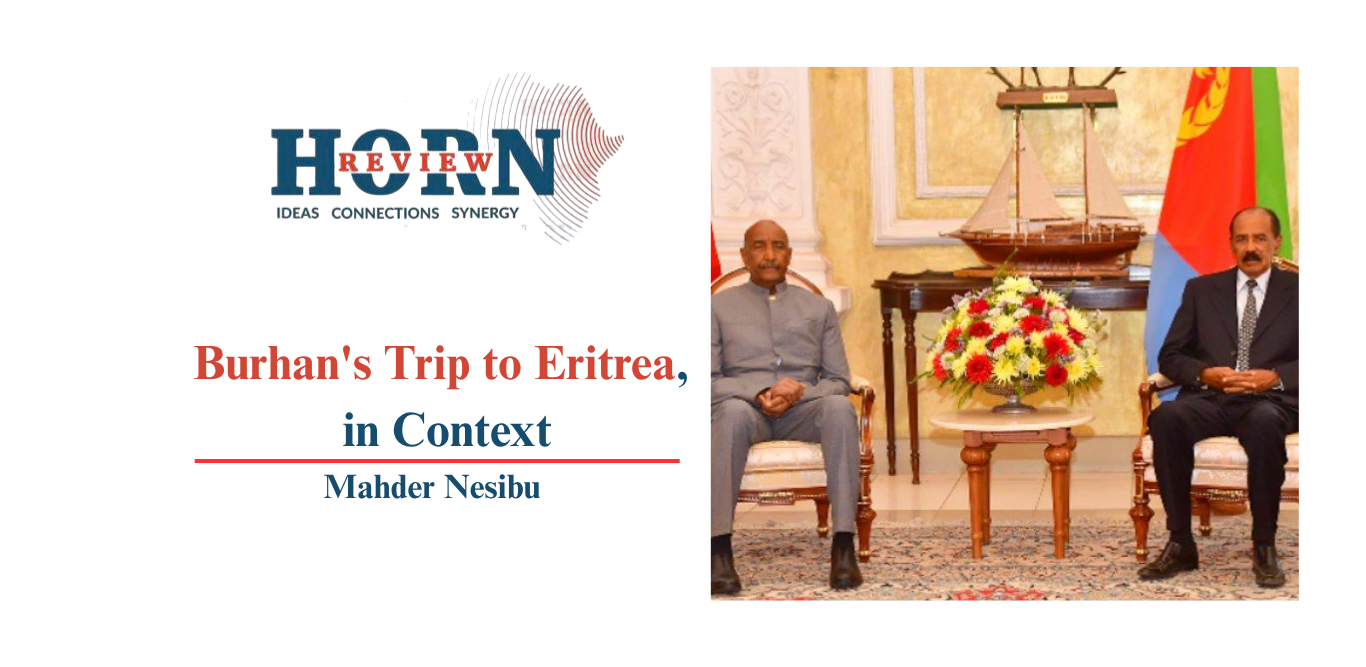
In a show of increasing alignment, the head of the Sudanese Armed Forces (SAF), General Abdel Fattah al-Burhan, travelled to Asmara to meet one of his increasingly significant backers in the army’s civil war against the Rapid Support Forces (RSF), Eritrea’s President Isaias Afwerki.
This is a continuation of meetings held by senior leadership from both sides, and follows one made by Isaias Afwerki, who travelled by road to Port Sudan to meet the general in November last year. This round of visit by Burhan was brief, compared to the one he made in April 2025, when he thanked Isaias for the support Asmara had provided the army, a month after its forces pushed the Rapid Support Forces out of the capital, Khartoum.
Similar to the April visit, this one follows a victory by the Sudanese Armed Forces and forces aligned with it, which took the strategic town of Kurmuk from the RSF and its ally the Sudan People’s Liberation Movement-North earlier this month.
The Sudanese Armed Forces, in its asymmetrical fight with the RSF, has come to rely over the course of the war on an array of external patrons, including Eritrea. Although Asmara does not possess the financial, logistical, and diplomatic capability of the SAF’s other backers, namely Saudi Arabia, Egypt, and Turkiye, Isaias Afwerki has moved to put the country’s weight behind the army’s war effort in critical areas — primarily through the mobilization of cross-border communities in eastern Sudan, over which Eritrea has maintained strong influence in order to shape successive Sudanese regimes. In addition, Eritrea has put its own army into the war, establishing training bases inside Sudan to train SAF and aligned forces, and involving its own troops in the fighting.
More critically for the region, it is increasingly serving as a node between the armed personnel of the Tigray People’s Liberation Front (TPLF) and the SAF, a role it has made growing use of, particularly in eastern Sudan.
The gains against the backdrop of which General Burhan made his visit, the capture of Kurmuk, had involved not only the various local armed groups operating under the SAF’s umbrella, but troops from the Eritrean Defence Forces (EDF) and Army 70, a major contingent of the TPLF’s armed apparatus long stranded in eastern Sudan after being cut off from Tigray during the Tigray conflict between 2020 and 2022. Although a significant number of these forces were killed during the fight for Kurmuk, including most of Army 70’s leadership and a number of Eritrean troops, Burhan’s visit is a display of the strong reliance his forces maintain on Isaias Afwerki and his support, indicating that the president’s reach is strengthening as the war grinds on.
Yet far from helping Sudan reach a peaceful settlement, the president’s own rationale for supporting the Sudanese Armed Forces makes his deepening involvement not only an obstacle to peace, but a risk for regional destabilization across the Horn of Africa.
The alignment between the SAF and Asmara is highly transactional and fluid. Just three years ago, as Eritrea was at odds with the TPLF, the party with a firm hold on Tigray, Ethiopia’s northern region bordering Eritrea, and ostensibly on good terms with the Ethiopian government in Addis Ababa, Isaias had been at odds with General al-Burhan and the army, owing to the SAF’s antagonistic position toward Ethiopia and its backing of the TPLF. Many had speculated, rather, that the president might throw his weight behind General Hemedti, the leader of the Rapid Support Forces.
However, true to the unpredictable nature of Horn of Africa alliances, Isaias Afwerki subsequently had a falling-out with Ethiopia over the terms on which the Tigray conflict was concluded, a conflict his troops had taken part in, and made the strategic decision to align with the SAF instead.
This, as the current pattern of alliances stands, places Eritrea in a constellation of regional powers backing the army, such as Egypt, which, in tune with the president, is antagonistic toward Ethiopia. It also flipped the relationship Eritrea had with the TPLF and the array of insurgencies present in Ethiopia; another constellation, dubbed Tsimdo, which Asmara heads as part of its antagonism toward its southern neighbour.
The gains at Kurmuk sit alongside a development that, as reported, might result in a ceasefire and an eventual peace process in Sudan. The United States, which had been working through Massad Boulos, Senior Advisor for Arab and African Affairs, to bring about a ceasefire, has reported progress toward one after heavy delays caused by reservations from General Burhan and the RSF. Washington has been working through the Quad, which consists of the major powers with stakes in the war.
This would present a significant setback to President Isaias and his regional calculations. For one, the army’s continued fight has allowed Asmara, as well as Cairo, to use their support as leverage against the SAF to sustain its antagonism toward Ethiopia — a strategy of critical importance, as Sudan shares a vast border with the country, one that runs along its most volatile regions, including the internally disputed territories of Welkait and Humera, as well as Amhara and Benishangul-Gumuz, both grappling with insurgencies in some form.
Sudan’s embroilment in war has allowed Eritrea to develop a coordination amongst these insurgents, including ones from Oromia; reportedly holding meetings with the groups with the consent and participation of the army’s representatives, as well as enabling the movement of arms supplies from Eritrea to the armed groups.
Although the gains at Kurmuk showed the depth of reach that Eritrea, and its constellation of forces in the region, has in Sudan, a ceasefire deal would jeopardize the rationale behind Eritrea’s involvement, which is increased instability across Ethiopia’s borders and a strengthening of the Tsimdo alignment.
Ethiopia would likely have been a major item on the agenda in the meeting between President Isaias and General Burhan. Earlier this month, Ethiopia’s Prime Minister, Abiy Ahmed, openly addressed the anti-Ethiopia alignment in a parliamentary session, stating that it posed no threat to Ethiopian sovereignty. The Ethiopian defence apparatus indeed seems confident in the threat level these forces pose, as it has maintained limited engagement with the insurgencies in Amhara and Oromia and has not yet taken military measures against the TPLF, despite escalatory moves that appear to be war preparations.
By Mahder Nesibu, Researcher, Horn Review


Comment (1)
[…] mobilization in Sudan is now better documented than a single capture claim. A unit known as Army 70, a major contingent of the TPLF’s armed apparatus that was stranded in eastern Sudan after […]