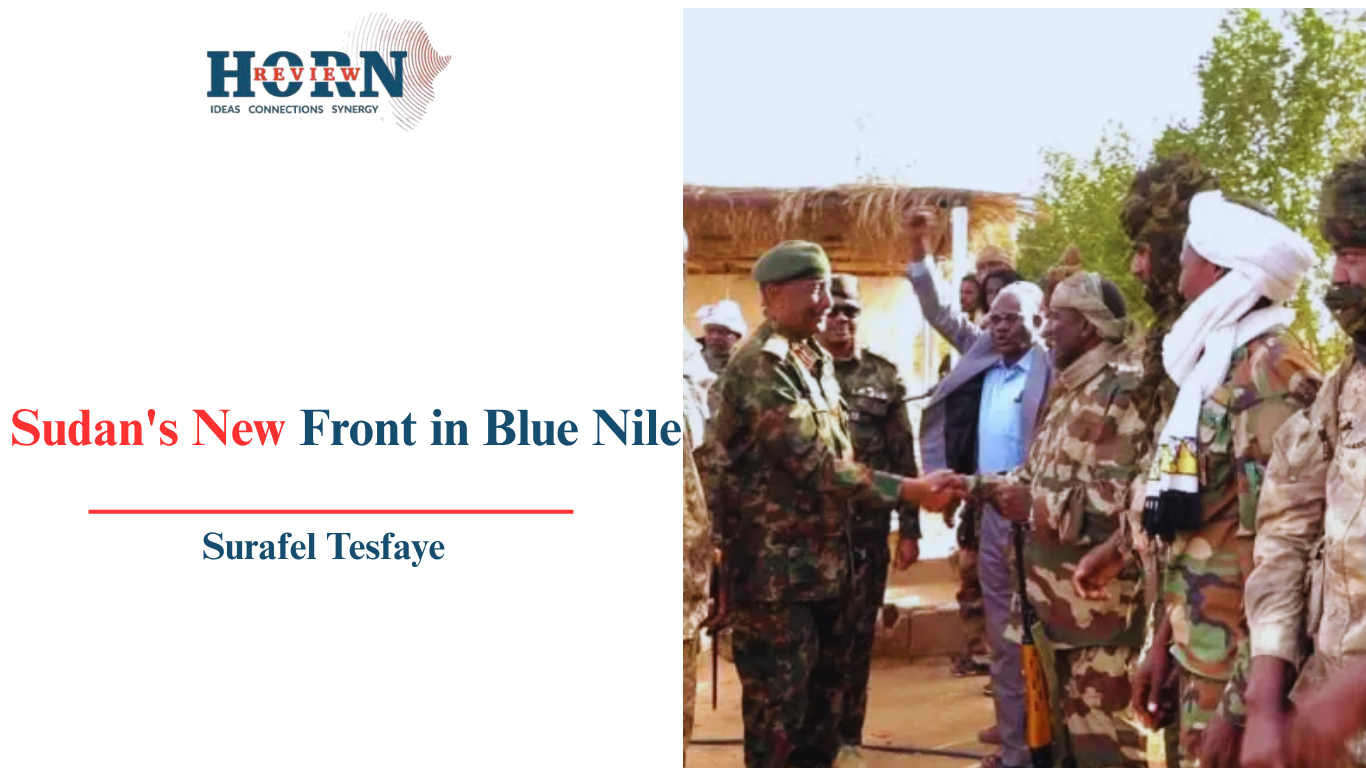
As of early May 2026, the Rapid Support Forces and the Sudan People’s Liberation Movement-North, led by Abdelaziz al-Hilu, have launched a significant campaign in Blue Nile State. In late March, the joint forces captured the strategic border town of Kurmuk and surrounding areas. By mid-April, pro-RSF sources reported control over the Al-Keili area, approximately ninety miles south of the regional capital, Ed Damazin. Severe clashes have occurred around Sali, a town on the main highway leading to the capital. While the Sudanese Armed Forces claimed to have repelled attacks there as of April 29, the overall trend shows the RSF-SPLM alliance pushing northward. The escalation has already displaced over 73,000 people, most of whom have sought refuge in and around Ed Damazin. The SAF’s 4th Infantry Division, based in the capital and commanded by Major General Ismail al-Tayeb Hussein, has reinforced its positions south of the city.
That is the military picture. However, the real turning point in Blue Nile is not just about territory. It is about men switching sides.
In April 2026, two high-ranking generals defected in opposite directions. Major General Al-Hassan Adam Al-Hassan, the second-in-command of the SPLM-N (Agar faction), left the SAF-allied wing and joined the Sudan Founding Alliance, known as TASIS, which is aligned with the RSF and the SPLM-N (al-Hilu faction). He is now active in the Blue Nile region, leading the offensive alongside Joseph Toka, a senior SPLM-N commander operating from Yabus. His move gives the RSF-SPLM alliance critical local military expertise and legitimacy in the southern corridor.
The other defector is Major General Al-Nour Ahmed Adam, better known as “Al-Qubba.” He is a founding member of the RSF and one of its highest-ranking field commanders. Before his defection, he controlled the Kutum locality in North Darfur, and he was a key leader in the siege and capture of El Fasher in October 2025. However, he was passed over for the appointment of military governor of North Darfur in favor of Gedo Ibn Shouk, a relative of Hemedti. He also opposed RSF attacks on Mistereiha, the stronghold of tribal leader Musa Hilal, with whom he shares deep tribal ties. Therefore, he fled North Darfur with a significant force estimated at between 47 and over 130 combat vehicles and joined the SAF in northern Sudan. The RSF sentenced him to death in absentia. General Abdel Fattah al-Burhan received him personally in Dongola and gifted him his own vehicle.
These two defections are mirror images. Al-Hassan, a lifelong rebel against the Khartoum center, has joined the RSF the very militia created to crush rebels like him. Al-Qubba, a founding father of that militia, has joined the SAF the army he spent decades fighting alongside the Janjaweed to undermine. They have swapped sides, but they remain standing on opposite ends of the same historical fault line.
To understand this, you have to go back to the early 2000s in Darfur. Al-Burhan served as a senior military intelligence officer and regional commander in Central Darfur. During that same period, Al-Qubba emerged as a key leader in the Border Guards and Arab militias under Musa Hilal. The SAF, led by officers like Burhan, provided the logistical and intelligence brain, while militia commanders like Al-Qubba provided the muscle on the ground. They were effectively coworkers in the same counter-insurgency campaign for nearly two decades. That is why Burhan welcomed Al-Qubba so easily. He is not a stranger; he is an old hand from the Janjaweed machine.
Al-Hassan, by contrast, was on the receiving end of that violence. He spent decades fighting against the system Al-Qubba defended. His ideology centers on secularism and the removal of Islamist influence from state institutions. He justifies his defection by accusing the SAF of being a tool for Islamists to dominate the peripheries like Blue Nile. By joining the RSF and the TASIS alliance, he is betting that Hemedti is the only force strong enough to dismantle the Khartoum center once and for all.
Nevertheless, here is the deeper problem that both defections expose. Critics frequently argue that both General Burhan and Hemedti are primarily motivated by personal power and survival rather than a clear ideological roadmap for Sudan’s future. They are not leading a unified national movement. They are governing small warlords who have no real ideological alliance with their stated visions. That is why major and minor defections occur repeatedly in Sudan. Alliances are opportunistic, not principled.
Consider the high-profile defection of RSF commander Abu Aqla Keikal to the SAF in late 2024. That move was driven more by tactical shifts and local pressures than a change in core belief. Keikal did not suddenly embrace the SAF’s ideology. He saw an opening and took it. The same logic applies to Al-Qubba and Al-Hassan. Neither man switched sides because he had a revelation. They switched because their personal interests were no longer being served by their former patrons.
This is what might be called the Post-Bashir Paradox. When a war goes on this long and becomes this decentralized, a peace treaty signed between two men at the top becomes a paper tiger. It looks powerful, but it has no teeth on the ground. Because even if Burhan and Hemedti agreed to stop fighting tomorrow, the small warlords under them would not necessarily submit. In addition, here is the brutal truth that the international community does not want to accept: even as the United States, the European Union, and the African Union keep trying to impose a civilian government and slap sanctions on the two generals, nothing will change. A civilian government in Khartoum would have no army loyal to it, no police force, no tax base, and no way to enforce its laws beyond the capital’s few safe neighborhoods. Sanctions on Burhan and Hemedti have already been tried; they only make the generals dig in deeper.
Here is why the small warlords won’t just submit. First, the mercenary market. In a normal army, soldiers follow orders because of a chain of command. In Sudan right now, many units follow commanders like Al-Qubba or Al-Hassan because those men provide the food, the ammunition, and the tribal protection. If Burhan signs a deal that says Al-Qubba must give up his weapons, Al-Qubba loses his leverage. Why would he submit to a civilian government that might put him on trial for past war crimes? For him, staying armed is staying alive.
Second, the economic veto. Small warlords in the Blue Nile or Darfur now control local economies. They tax the markets, control the gold mines, and run the smuggling routes. A civilian government would want to centralize the economy and collect taxes. To a local commander, peace and civilian rule look like a pay cut. They can veto any peace deal simply by firing a few shots and keeping the region a conflict zone to keep the central government out.
Third, the ghost of the old regime. Many middle-level officers in the SAF are Islamists from the Bashir era who hate the idea of a civilian government. On the other side, many RSF commanders are tribal hardliners who fear that a civilian government will favor the Nile Valley elites. Even if the two big bosses agree, the colonel-level and major-level officers can sabotage the deal. They can launch rogue attacks to provoke the other side, making it look like the peace deal has failed until it actually does.
Fourth, fragmented territory. Because the country is already physically split with the RSF in the west and south and the SAF in the north and east the reality on the ground has already changed. A civilian government sitting in Khartoum cannot easily tell a commander in Kurmuk, on the Ethiopian border, what to do. Without a massive international peacekeeping army, which does not exist yet, there is no way to force these local guys to submit.
So who is winning the war as of May 2026? Neither. The country is moving toward a de facto partition. The SAF has reclaimed much of central Sudan and Khartoum over the last year, consolidating power in the north and east. The RSF and SPLM-N dominate Darfur and are currently on the offensive in Blue Nile, having seized Kurmuk and Al-Kaili. The defection of Al-Hassan gives the RSF a bridgehead into the southeast. The defection of Al-Qubba gives the SAF a knife into the RSF’s western command. Both sides have gained intelligence and local credibility, but neither has gained a knockout blow.
Instead of one big war between red and green, Sudan is becoming a checkerboard. One square is controlled by an RSF defector. The next is controlled by a tribal militia. The next is a neutral zone run by a local committee. In Realpolitik terms, Sudan is no longer a single state. It is a broken mirror. You can try to glue the two biggest pieces back together, but the cracks are still there, and the small shards have their own sharp edges.
The continuous swapping of generals creates a market of loyalties where no side can decisively win, but both can prevent the other from governing. This ensures that even if a ceasefire is signed at the top level, local warlords and defectors will likely continue fighting for control of regional resources. Sudan is facing a long war of attrition, and the Blue Nile is just its newest front line. The international community can mediate, threaten, and sanction all it wants. But until the small warlords see a better deal in peace than in war, the guns will keep firing.
By Surafel Tesfaye, Researcher, Horn Review