For nearly two decades, Somalia was treated primarily as a stabilization file a fragile state requiring counterterror assistance, peacekeeping structures, and externally managed security support. That framework is now steadily giving way to a different reality. Somalia is no longer viewed only through the lens of Al-Shabaab or state fragility; it is increasingly situated within the wider power competition shaping the Red Sea and the Horn of Africa. As regional alignments shift, security assistance to Mogadishu is becoming part of a broader geopolitical equation, where timing, type of equipment, and the identity of donors matter as much as the stated counterterror objectives.
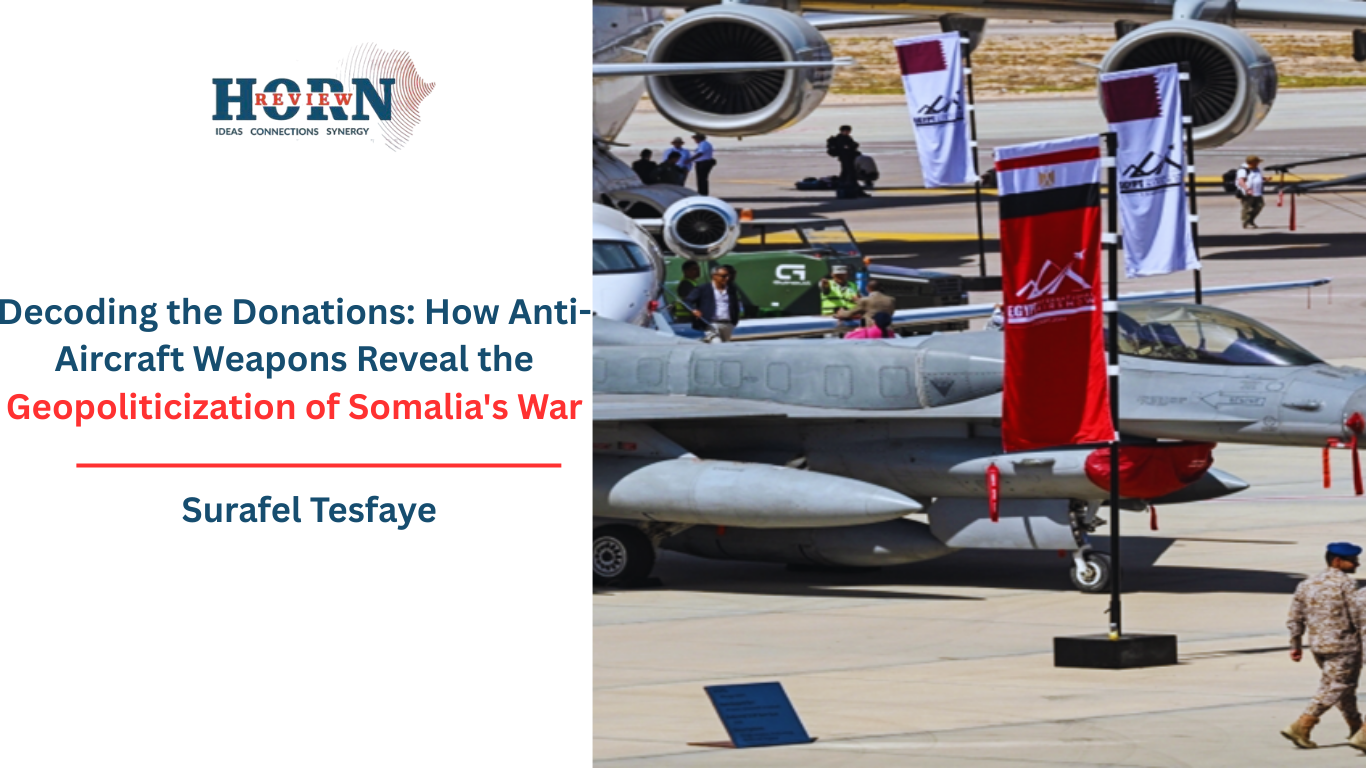
Egypt’s renewed presence in Somalia illustrates this transition. Cairo was involved in Somalia during the international stabilization efforts of the 1990s, but its engagement then receded for decades. Its recent return, therefore, is not merely the continuation of a long-running mission but a re-entry at a moment of heightened regional tension. This timing is central. Egypt’s renewed military role and arms donations appear less like routine stabilization support and more like a political move to secure national interests in a changing regional order. The form of support reinforces this interpretation. Strengthening Somalia’s capabilities is not inherently problematic; any sovereign state has the right to develop its defense capacity. The question is what specific capabilities are prioritized and what that choice signals.
Anti-aircraft weaponry is designed, in conventional military logic, to counter aerial threats. Al-Shabaab, however, is a guerrilla movement. It operates through hit-and-run tactics, improvised explosive devices, and deep local infiltration. It does not possess aircraft. Military specialists widely agree that defeating such an adversary depends on “boots on the ground,” human intelligence networks, community penetration, and highly mobile counter-insurgency units. In that context, heavy air defense systems have limited relevance to the immediate insurgent threat. Their logical purpose is to deter or prepare for a scenario involving a state actor with air capabilities not a ground-based guerrilla force. This is why the nature of Egypt’s contribution is widely read as oriented toward broader strategic contingencies rather than the day-to-day realities of counter-insurgency.
Timing reinforces this perception. If the recent surge in military support were driven solely by the need to defeat Al-Shabaab, similar levels of assistance could have been delivered during earlier periods of intense fighting. The most obvious window was the “Total War” campaign known as the Macawiisleylaunched by President Hassan Sheikh Mohamud in 2022–2023, when the Somali government mobilized clan forces and regional administrations in an unprecedented push against the insurgency. Yet the most politically significant and heavier packages arrived later, in a period marked by visible military signaling elsewhere in the region, including Ethiopia’s air force modernization display during its 90th-anniversary air show. The synchronization of new support with this broader regional moment suggests that geopolitical deterrence considerations are operating alongside, and at times above, pure counterterror logic.
This does not mean Somalia has no need for technological upgrades or stronger defenses. The country is rebuilding its armed forces after decades of collapse. However, the implication of certain donations can differ from their formal justification. Support framed under a stabilization or counterterror banner but centered on systems tailored for state-level deterrence inevitably reflects the donor’s strategic calculations. In this sense, Egypt’s approach appears aligned with protecting its own regional interests including Red Sea and Suez-linked security concerns while also signaling in the evolving balance involving Ethiopia and other Horn actors.
Turkey’s role provides a contrast. Ankara undeniably has political and strategic interests in Somalia, but the nature of its military engagement has largely matched counter-insurgency needs. Turkey has spent more than a decade building an institutional presence through the TURKSOM base, training Somali units such as the Gorgor commandos, and emphasizing mobility, intelligence, and drones. Platforms like the Bayraktar TB2 have proven effective in surveillance and precision strikes against non-state actors who hide within civilian terrain. This focus on manpower development and adaptable tools corresponds more directly to the operational requirements of fighting a guerrilla movement. Turkey’s involvement can therefore be understood as both strategic and functionally consistent with the stated counterterror mission.
The broader picture is that Somalia is becoming embedded in a regional security architecture where multiple external actors pursue overlapping but distinct goals. Saudi Arabia’s renewed strategic engagement in the Horn, discussions of defense cooperation frameworks among key Muslim-majority states, and intensifying competition involving Ethiopia, the UAE, Israel, and Somaliland all feed into this environment. Somalia’s territory, coastline, and political alignment now matter in calculations that extend far beyond internal insurgency. Military support, therefore, carries diplomatic messages about alignment, deterrence, and future contingencies.
In this setting, the key analytical point is not to question Somalia’s right to strengthen its defenses, but to recognize that the pattern of assistance reveals more than counterterror priorities. The combination of timing, type of equipment, and regional context indicates that Somalia’s security partnerships are increasingly tied to interstate deterrence and Red Sea geopolitics. Counter-insurgency remains part of the picture, but it is no longer the only or even always the dominant frame through which external military engagement should be understood.
By Surafel Tesfaye, Researcher, Horn Review