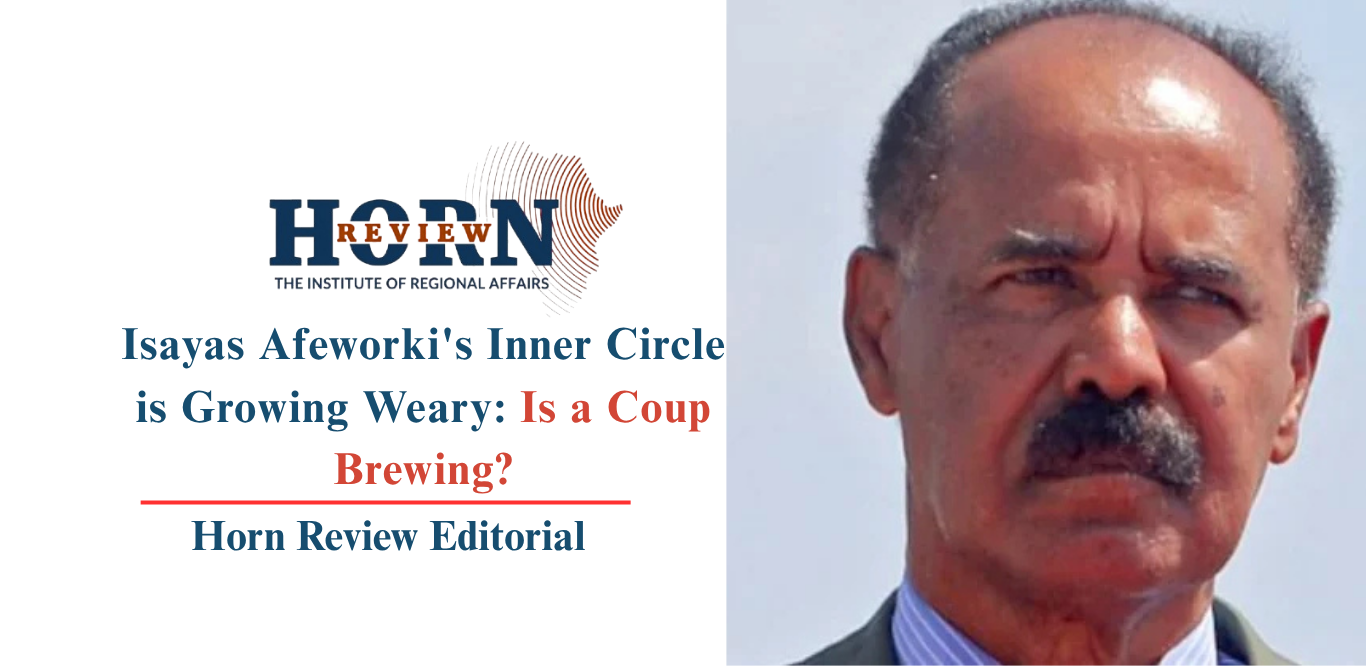
The greatest threat to Isaias Afwerki’s rule no longer lies primarily in Eritrea’s marginalized population or fragmented opposition, but within the military and intelligence establishment that has sustained his personal dictatorship for decades. As his political wilderness deepens, his regional ambitions become increasingly costly, and his unpredictable leadership leaves senior officials with diminishing confidence in the country’s strategic direction, the possibility of an internal rupture becomes increasingly consequential. Generals and key intelligence officials who once regarded their loyalty to Isaias as essential to their power are increasingly seeing his continued rule as a liability, not only to the nation whose sovereignty they claim to have fought for, but also to their institutional interests, personal security, and political survival.
What makes this potential rupture particularly significant is the growing contradiction between Isaias’s personal ambitions and the interests of the establishment around him. Military commanders and intelligence officials have spent decades defending a political order that has delivered neither institutional renewal nor a credible future for Eritrea. Instead, the country remains trapped in indefinite national service, economic stagnation, international isolation, and recurrent regional confrontations. For some of the senior officers, the question is increasingly whether the president’s political calculations are still serving Eritrea’s national interests or merely perpetuating his personal grip on power. The longer this contradiction persisted, the greater the clarity of that section of the security establishment has become to regard a change of leadership as a necessity rather than an act of betrayal.
Isaias’s greatest vulnerability, however, lies in the political architecture he has deliberately constructed. By concentrating virtually all meaningful authority in his own hands, neutralizing independent institutions, preventing meaningful international engagement, and blocking an orderly succession, he has made the regime excessively dependent on one individual. This has left not a few senior military and intelligence figures with enormous responsibilities but little certainty about their political future. Beneath the appearance of enforced unity, accumulated grievances, competing ambitions, and anxieties over succession is creating an increasingly fragile elite consensus. The irony is that the very officials entrusted with protecting Isaias’s authority are eventually concluding that his continued leadership represents the greatest threat to their own security and the survival of the Eritrean state.
The intelligence establishment deserves particular attention in this emerging equation. In Isayas’s political system that has been sustained by surveillance, secrecy, and the constant monitoring of loyalty, Eritrean intelligence officials occupy a uniquely sensitive position. Their continued cooperation has always been essential to the Isayas’s ability to anticipate and neutralize internal threats. Now that influential figures within these institutions become disillusioned with his leadership, the regime’s capacity to monitor, contain, and prevent elite dissent could become increasingly compromised. The possibility of an internal realignment involving both military commanders and intelligence officials is therefore particularly consequential. Such a development represents something far more serious than isolated dissatisfaction: it would suggest that the institutions responsible for preserving the regime are themselves growing into sources of instability.
Given these current trajectories, an eventual coup, should it materialize, would likely emerge as an elite-driven intervention rather than a popular uprising. Its architects will plausibly justify their actions in the language of national salvation, political renewal, and the restoration of Eritrea’s sovereignty, while seeking to preserve much of the existing state apparatus. Their immediate objective might not necessarily be democracy but the removal of a leader increasingly perceived as an obstacle to institutional survival, economic recovery, and a more pragmatic foreign policy. Hence, the removal of Isaias, which has become more imminent now than ever, could represent the end of his personal dictatorship without necessarily bringing an end to the authoritarian system he created. The same generals and intelligence officials who helped sustain his rule could seek to inherit its political machinery.
The regional dimension, particularly Eritrea’s increasingly consequential relationship with Ethiopia, has further accelerated these internal tensions. Isayas’s insistence on another armed confrontation, costly military mobilization, or strategic miscalculation has intensified doubts among senior commanders about the wisdom of his foreign policy. Military leaders who perceive that the country is being drawn into unnecessary regional conflicts are now questioning whether the president’s strategic ambitions are compatible with Eritrea’s security and long-term survival. This is something the TPLF has been faced with just a few weeks ago, its army generals defecting and abandoning the cause of war and another round of chaos – gradually leading to the hard liner TPLF elements’ retreat to Asmara as Federal forces continue to take control of Tigray with no major hurdle. Equally important, continued economic isolation and the absence of meaningful development offer the security establishment little prospect of a sustainable future.
Isayas Afeworki’s greatest political danger therefore is emerging now as influential insiders cease to regard his survival as synonymous with the survival of Eritrea’s ruling establishment. And that calculation would rapidly shift the balance of power inside Eritrea’s political order, and the decisive confrontation is building up to take place within the innermost circles of the regime itself. Eritrea’s next political turning point has begun as those who have spent decades protecting Isaias are now saying that the only way to secure their own future – and perhaps prevent a wider national collapse – is to remove him.
By Horn Review Editorial