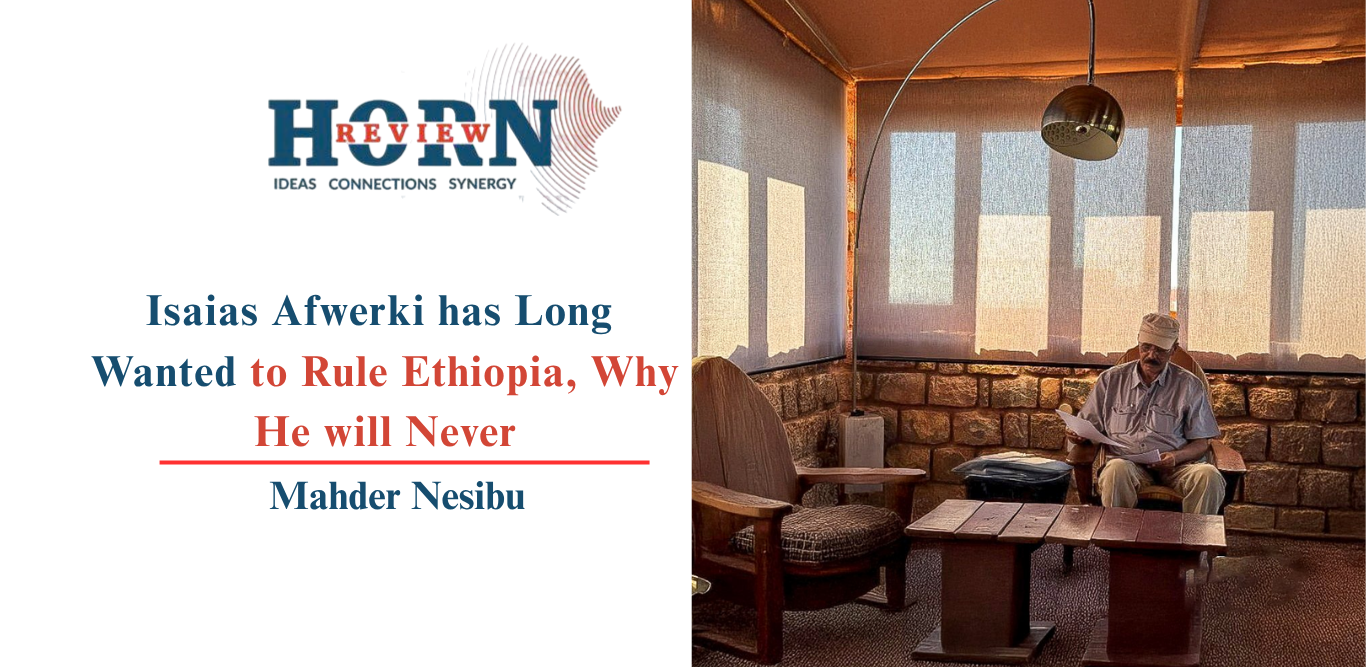
President Isaias Afwerki is among the most enduring figures in the modern history of the Horn of Africa. Now eighty, he has ruled Eritrea for more than three decades without a national election or a named successor, and he has met every internal challenge with suppression. His ambitions, what’s more, have never stayed within Eritrea’s borders. Ethiopian politics has been their recurring object, drawing his attention across successive governments in Addis Ababa and, as a result, pulling him into the affairs of the Horn of Africa.
Isaias’s political career stretches back nearly six decades. It began in the 1960s, when he left Addis Ababa University, then a hotbed of revolutionary politics, as a failed student and travelled to Kassala in eastern Sudan to join the Eritrean Liberation Front, an insurgency fighting to secede Eritrea from Ethiopia. Yet the ELF disappointed the young Isaias. Factionalism and disputes over identity had left it weak and posing little real threat to Addis Ababa. He was also never fully accepted within its ranks, owing to his Christian-Tigrinya background, a group that anchored the loyalist sentiment dominant in a politically divided Eritrea at the time. He left for a period of political training in Communist China and, on his return, began building his own organisation inside the fractured ELF, the Eritrean People’s Liberation Front, recruiting from its ranks until the EPLF was strong enough to turn on its host. The EPLF went on to defeat the ELF militarily and end Ethiopian rule in Eritrea, culminating in Eritrean statehood in 1993.
A pattern recurs across Isaias’s speeches and public appearances. He pronounces on Ethiopian politics at length, returning often to ethnic federalism as the root of the country’s troubles and criticising the administration in Addis Ababa in detail. On Eritrea itself and the work of his own government he speaks briefly and opaquely. Isaias’s attraction towards Ethiopia, in practice, has extended well beyond rhetoric. In the 1970s, the EPLF, which Isaias directed through a tightly controlled party structure, created the Tigray People’s Liberation Front as its proxy, an organisation built on similar lines and initially dedicated to seceding Tigray from Ethiopia. The TPLF proved its worth. Alongside other Ethiopian rebel groups, many shaped by the TPLF in the same manner the EPLF had shaped it, the front eventually took Addis Ababa from Mengistu’s Derg regime.
On the surface, these fronts promised to end the political violence and instability that had long defined Ethiopian governance and to open a new political future. The TPLF-led Ethiopian People’s Revolutionary Democratic Front backed Eritrean secession, and the EPLF enjoyed considerable standing among the international community. In 1993 it organised a UN-monitored referendum, accompanied by pledges toward democratic rule. Yet the informal relations between Addis Ababa and Asmara, between the TPLF and the EPLF, and Isaias’s own ambitions for a continuing political role in Ethiopia meant that disputes would eventually materialise.
Isaias’s private calculations at the time resist confident reconstruction, but several indications suggest he had far-reaching plans for Ethiopia. Mesfin Hagos, formerly a senior EPLF figure and one of Isaias’s closest confidants for years, wrote an autobiography from exile that offers some insight. He described an episode from early 1991 in which Isaias, along with like-minded EPLF leaders, made arrangements to take part in a joint government in Addis Ababa. There were also discussions at the time on how to soften Eritrean secession through some form of continued cohesion between the two territories, whether economic or otherwise, one explanation for why the Eritrean referendum took two years to materialise and why the EPLF featured so heavily in the extended deliberations over Ethiopia’s future during that period.
Relations between Isaias and Ethiopia’s leader Meles Zenawi, who was ideologically committed to Eritrean statehood, were widely assumed to be durable, yet cracks began to show. The war that broke out between the two countries in 1998 can be traced in part to a personal falling out between the two leaders. In the years leading up to the war, Meles pursued policies that sharpened the separation between Ethiopia and Eritrea on economic, territorial, and demographic lines, curbing Isaias’s hopes of influence in Ethiopia.
Isaias started the war but effectively lost it, and the defeat set Eritrea on a slow slide into authoritarian rule at home and diplomatic isolation abroad. The end of the fighting brought no reconciliation with Ethiopia. Hostilities persisted in other forms, and Isaias turned Eritrea into a base for Ethiopian rebel groups, offering them military and political backing in the hope of forcing regime change in Addis Ababa. These groups achieved little, and Isaias’s influence remained largely confined within Eritrea’s own borders.
The year 2018 brought a reprieve for Isaias and a change in his relationship with Ethiopia. Abiy Ahmed, a young reformist prime minister, took office and moved quickly to reshape regional diplomacy. Among his early steps was drawing Isaias out of the isolation that the previous Ethiopian administration had helped impose. Isaias was readmitted to regional diplomacy, and the prevailing view at the time credited the EPRDF, and the TPLF in particular, with having sustained the long animosity between the two countries. As in the early 1990s, Isaias re-entered Ethiopian politics, this time directing his energy against the TPLF.
The stated rationale for the emerging alliance between Addis Ababa and Asmara was shared concern over a TPLF still entrenched in Tigray and viewed as a security risk to both governments. Beneath that rationale ran more transactional calculation, characteristic of the long relationship between Ethiopian and Eritrean politics. For Isaias, Abiy’s rise offered a fresh opening to project influence into Ethiopia. The prime minister was confronting a powerful adversary in the TPLF, which had rejected his reform agenda and posed a genuine threat to his still-fragile government. When fighting broke out in 2020, Tigray bore the weight of Isaias’s commitment to that fight. He deployed his conscript army with the declared aim of eliminating the TPLF outright, inflicting severe damage on the region in the process.
The conflict, however, ended without delivering what he had sought.
Isaias watched the TPLF and the federal government conclude a peace agreement without him, a settlement that cut him out of decisions over Ethiopia’s political trajectory. The foothold in northern Ethiopia and the leverage over Addis Ababa that might have followed never came. Once again, an opportunity to establish lasting influence in Ethiopia slipped away. The dynamic opened a chasm between him and Abiy Ahmed instead.
Even so, Isaias keeps returning to the same objective. Now at odds with Addis Ababa, he has fallen back on the methods available to him. Ethiopia’s complex and often chaotic political landscape leaves Asmara a standing supply of grievances to attach itself to. Isaias began by rebuilding ties with the TPLF, whose leadership judged that courting Asmara would strengthen its own position against Addis Ababa after its falling out with the federal government not long after the 2022 peace deal. In the TPLF, the very group he had once vowed to destroy entirely, Isaias found a renewed avenue for exerting influence in Ethiopia.
He has since built on the post-conflict landscape to deepen ties with a wider range of Ethiopian rebel groups, which are drawn to Asmara by their shared interest in toppling Ethiopia’s current government.
Sudan, which neighbours both countries, has been central to this strategy. The country’s civil war has given Isaias a further opening to project power, backing the Sudanese Armed Forces, one of the conflict’s parties, in an alignment of convenience rooted in shared antagonism toward Ethiopia. More importantly, Sudan’s instability offers Asmara a familiar role, serving, as it did historically for both the EPLF and TPLF as a staging ground for rebel organisation and coordination. Asmara is reaching again for the tools of its insurgent past in a region that has since changed.
Cairo, with its own antagonism toward Addis Ababa, has lent its backing to him as well.
The calculation, nonetheless, carries considerable risk for Isaias, extending to the survival of his own regime. Addis Ababa under Abiy Ahmed has changed markedly since 2018. Gone is the earlier idealistic openness to regional harmony and cooperation with Asmara, replaced by a foreign policy focused on consolidating Ethiopia’s own regional standing, largely through alliances across the Middle East and beyond. These partnerships bring, among other forms of support, help in building Ethiopia’s armed forces.
Ethiopian policy toward Eritrea has hardened in parallel. Abiy recently told members of parliament that Isaias’s coalition poses little serious threat to Ethiopia’s national security, and Addis Ababa has since adopted a more assertive posture on its own interests regarding Eritrea. Access to the sea has moved to the centre of that agenda, with Ethiopia seeking to reverse the landlocked status it acquired following Eritrean secession. In another address to lawmakers, Abiy voiced scepticism about the legal standing of that secession, effectively reopening questions settled by the 1993 arrangements.
Isaias now confronts a confident and assertive adversary, in a posture that recalls Ethiopia’s stance in the lead-up to 1998. Should open hostilities return, the likely outcome would differ sharply from what Isaias might hope for.
What Isaias risks is the collapse of his own regime, and the source of that fragility lies largely at home. In more than thirty years of rule he has invested little in Eritrea’s development, treating economic growth and its rewards as a threat to authoritarian control. The country’s wealth remains undeveloped, and what exists is a clandestine economy cut off from the rest of the world. The Eritrean Defence Forces, successors to the EPLF’s army, take pride in having defeated Ethiopia’s mighty military in the early 1990s, yet they now lag behind many modern fighting forces. Isaias’s notorious indefinite national service has drained the country of its youth, and the population of soldiers it was meant to create has largely emigrated. In this sense he has miscalculated over the longer term, and the consequences could mean a different government in Asmara and a radically different future for Eritrea.
By Mahder Nesibu, Researcher, Horn Review