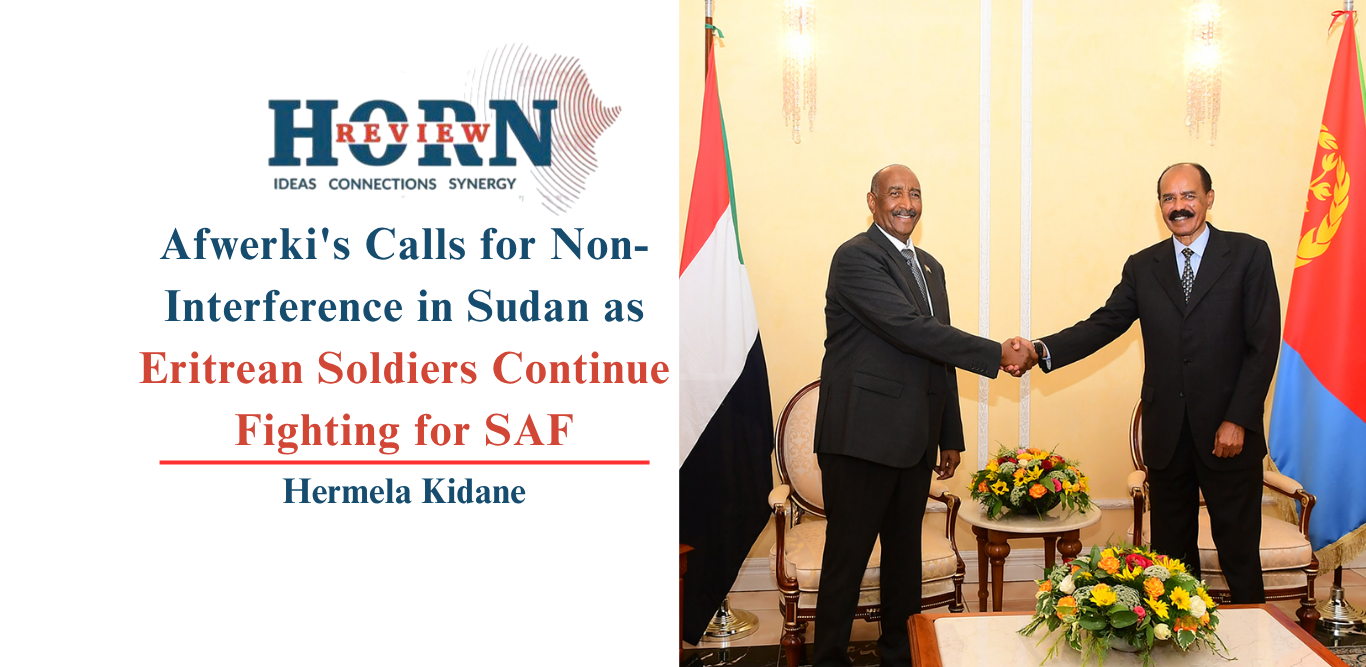
At the New Alamein summit in October 2026 Eritrean President Isaias Afwerki stood with Egyptian President Abdel Fattah el Sisi, Sudanese army chief Abdel Fattah al Burhan and Somali President Hassan Sheikh Mohamud and called for an immediate end to foreign interference in Sudan. He described the war as an unjustified crisis and endorsed a joint declaration affirming Sudan’s unity, sovereignty and a Sudanese owned political process. The language cast Eritrea as a responsible regional actor but the operational record shows the opposite. Eritrea has acted as a critical military facilitator for the Sudanese Armed Forces while converting Sudan’s instability into a platform for pressure against Ethiopia.
Training camps in Eritrea’s Gash Barka region adjacent to the Sudanese border have hosted fighters from eastern Sudanese communities. These include the Eastern Sudan Liberation Forces, the Eastern Battalion under Amin Daoud, Beja Congress factions and others. More than a dozen such militias trained and equipped with Eritrean assistance now fight alongside the SAF. Eritrean territory has also functioned as a rear base with reports of Eritrean military units providing support and Eritrean facilities used by Sudanese personnel and aircraft. Weapons and components enabling drone operations have moved through networks that use islands and coastal zones near Eritrea as temporary storage and assembly points before reaching SAF aligned forces. These arrangements have turned Eritrea into both a training ground and a logistics hub for the war effort.
The eastern Sudan corridor running through Kassala, Kumruk, Gedaref and toward the Metema crossing has become a conduit for arming Ethiopian insurgent groups active in Amhara and Oromia. Ethiopian authorities have recorded significant seizures including more than 56,000 rounds of ammunition assessed to have originated from Eritrea and transited these routes. The absence of effective control in war torn Sudan has been treated as strategic depth. Meetings with Ethiopian armed factions and the steady movement of materiel through this corridor allow Eritrea to fuel internal instability inside Ethiopia without direct conventional confrontation. What appears as chaos to others has been instrumentalized as opportunity.
Isaias Afwerki’s demand for an end to foreign interference stands in direct contradiction to Eritrea’s position as one of the most active external interveners in Sudan. His public appeals for peace on behalf of the Sudanese people are similarly inconsistent with the operation of training camps in Gash Barka, the facilitation of weapons flows through the Kassala and Metema corridor and the enabling of supply lines to groups that generate violence inside Ethiopia. The public posture at New Alamein cannot be reconciled with the documented military role. The contradiction is functional. Declaratory diplomacy provides cover complicates criticism and allows Eritrea to present itself as constructive even as its forces and proxies remain embedded in the conflict.
The preference for a Burhan led order further clarifies the assessment. Eritrea working in alignment with Egypt has backed the SAF because a military dominated regime in Port Sudan remains dependent on external support and unlikely to challenge Eritrean interests. However elevating Burhan as the face of Sudan’s national institutions requires scrutiny. Extensive reports of atrocities associated with forces under his command raise legitimate questions about whether such a figure can credibly represent a legitimate or inclusive Sudanese authority. Support for him appears driven less by concern for Sudanese civilians than by the strategic utility of a pliable partner.
The intensity of the partnership is visible in the pattern of meetings. Isaias and Burhan have conferred repeatedly including visits by Burhan to Eritrea and consultations on the sidelines of the New Alamein summit. These encounters have addressed military cooperation, the status of Eritrean trained eastern forces, border security and coordination against the Rapid Support Forces. For a leader whose bilateral diplomacy is characteristically limited the frequency of contact with Sudan’s military leadership is revealing. It points to a sustained relationship rather than occasional engagement.
Taken together these activities form part of a containment structure directed at Ethiopia. By securing a SAF aligned regime establishing trained local forces that function as a buffer presence in eastern Sudan and using the Kassala,Kumruk,Gedaref and Metema corridor to supply Ethiopian insurgents Eritrea works with Egypt to constrain Ethiopia’s strategic options on the Red Sea and the Nile. The New Alamein declaration’s emphasis on coastal state control of the Red Sea and its rejection of unilateral Nile measures translate into a coordinated posture aimed at limiting Ethiopia’s regional role. The creation of irregular forces in eastern Sudan that answer to external patrons mirrors earlier patterns of manufacturing influence through deniable proxies.
Ethiopia therefore faces both an immediate security challenge and a longer term structural challenge. Groups receiving material through the eastern corridor continue to generate instability within the country’s peripheries. At the same time a regional alignment that systematically excludes Ethiopian interests risks shaping Sudan’s post war order in ways that further narrow Ethiopia’s room for action.
Strengthened intelligence and surveillance along the critical border corridors, sustained inter agency coordination and more assertive diplomatic engagement in processes concerning Sudan’s future are essential. The evidentiary record of Gash Barka training camps, the deployment of more than a dozen Eritrean backed militias, the facilitation of weapons flows, Eritrean military support and the channeling of supplies to Ethiopian insurgents is extensive and consistent across independent sources. Rhetoric of non-interference cannot erase operational reality.
Summit declarations do not cancel the hard evidence of military involvement. Eritrea’s dual role in Sudan sustaining one side of the conflict while converting the resulting instability into a platform for pressure against Ethiopia presents a coherent strategy of peripheral influence. Ethiopia must meet that strategy with equal clarity and resolve. If any foreign force should withdraw from Sudan first it is Eritrea.
By Hermela Kidane, Researcher, Horn Review