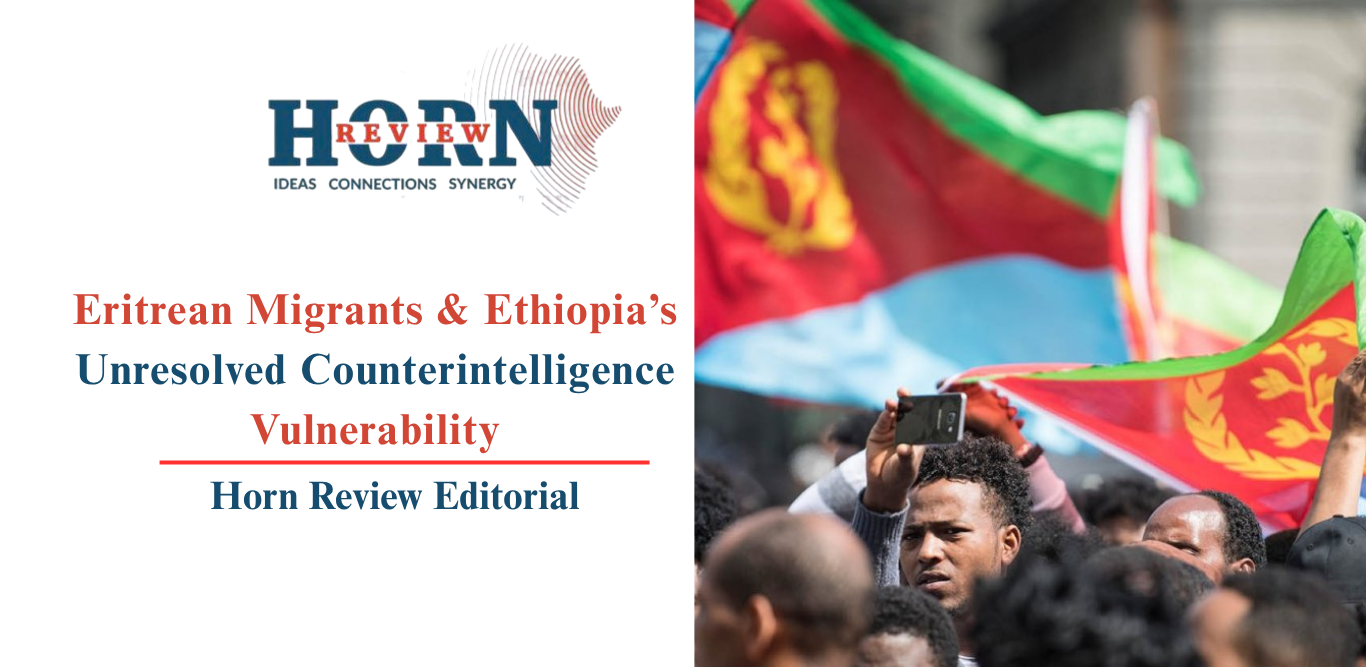
Ethiopia may be approaching a security environment in which a question that received little attention during the 2018 rapprochement with Eritrea suddenly becomes urgent: what happens when relations between two neighbouring states deteriorate while a substantial population of the other state’s nationals is already living inside your borders? The question is not whether Eritreans living in Ethiopia should be regarded as agents of the Eritrean regime. They should not. Many Eritreans came to Ethiopia seeking safety, opportunity or protection from conditions in their own country. Their nationality is not evidence of espionage. But national security cannot operate on assumptions of innocence alone. It must also account for the possibility that foreign states may attempt to exploit populations, political relationships, diplomatic access or established social networks for intelligence purposes. Where relations between governments deteriorate into confrontation, the state has a responsibility to reassess vulnerabilities that may have been created during periods of openness and rapprochement.
That is particularly relevant to Ethiopia because the 2018 peace process fundamentally changed the relationship between the two countries. Borders reopened, movement became easier, diplomatic relations were restored and years of hostility appeared to be giving way to normalization. The security assumptions appropriate to that period cannot simply be carried forward unchanged after the collapse of the political relationship. The available refugee statistics also require precision. UNHCR reported that Eritreans represented approximately 15 percent of Ethiopia’s refugee and asylum-seeker population at the end of 2025, with a total refugee and asylum-seeker population exceeding 1.1 million. Those figures do not establish the total number of Eritrean nationals living in Ethiopia because they do not include every Eritrean migrant, worker, resident or other person outside the refugee system. Nor do they establish that a particular proportion of Eritreans are involved in intelligence activity. That distinction matters because counterintelligence is not a numbers game.
A foreign intelligence service does not need an entire community. It needs access to information, institutions and people who occupy strategically useful positions. One individual with access to military planning, government communications, diplomatic reporting, telecommunications or security institutions can potentially provide information of greater value than thousands of ordinary residents. The question Ethiopia should therefore be asking is not how many Eritreans are in the country, but whether it has sufficient knowledge of the individuals who may have access to sensitive institutions or individual authorities and whether its counterintelligence system is capable of detecting foreign attempts to exploit that access. The current state of relations between the two states makes that question more pressing. The diplomatic environment is no longer comparable to the one created by the 2018 rapprochement. Eritrea has now severed diplomatic relations with Ethiopia after Addis Ababa closed its embassy in Asmara and expelled Eritrean diplomats.
When relations reach that point, governments not only reassess diplomatic personnel, border security, and military readiness, but also intelligence threats including those potentially posed by Eritreans residing inside Ethiopia. The appropriate response, however, is individualized scrutiny based on evidence. Refugees and intelligence operatives can exist within the same broad population without being remotely equivalent. A refugee may have fled precisely because of opposition to the government in Asmara. Another Eritrean may have no political involvement whatsoever. Another may have maintained relationships that deserve scrutiny. They may be maintaining clandestine relationships with political or armed organizations in Addis Ababa. Or engaged in unlawful intelligence collection, recruitment, financing, sabotage or coordination, in a completely different category, an individual could potentially be acting on behalf of a foreign intelligence service, or against the national interest of the Ethiopian state – posing a security risk thereof. A functioning intelligence system, however, must be vigilant to all sorts of categories and carefully scrutinise political history or organizational association of migrants and refugees from a hostile neighbouring state. It is what makes counterintelligence effective. Yet, the national intelligence and security services must be cautious about collective suspicion, for it produces precisely the opposite of what the intelligence service needs. If every member of the Eritrean community in Addis Ababa or elsewhere in the country is regarded as suspicious, investigators lose the ability to distinguish genuine threats from ordinary civilians. Resources will be unnecessarily wasted and real intelligence indicators can disappear inside a mass of irrelevant suspicion. The more sophisticated approach is targeted.
Ethiopia should rather know the legal status of every Eritrean national within its territory, maintain effective records, strengthen information-sharing between immigration authorities and security institutions, and conduct appropriate security reviews around sensitive government and military facilities. Individuals with access to classified or strategically important information should be subject to appropriate personnel-security procedures regardless of nationality. The government should also be capable of identifying unusual financial relationships, unexplained access to restricted facilities, attempts to obtain protected information, clandestine communications with foreign officials, recruitment activity and other indicators that would justify further investigation.
The broader lesson is that diplomatic rapprochement should never be confused with the permanent disappearance of security risks. States can normalize relations, open borders and encourage economic exchange while retaining the institutional capacity to respond if circumstances change. The 2018 rapprochement created legitimate reasons for reducing confrontation between Ethiopia and Eritrea. It did not eliminate the possibility that the relationship could deteriorate again, which it did – and the assumptions made during that period of reconciliation have now become liabilities. Ethiopia therefore needs to conduct a retrospective security assessment of the post-2018 period. What changed in the movement of people across the border? Which institutions became more accessible? What new networks developed? Did foreign diplomatic, commercial or political actors establish relationships that could now present security concerns? Are Ethiopia’s immigration databases, intelligence systems and law-enforcement institutions sufficiently integrated to identify genuine threats?
These are questions that should also be asked about every foreign actor with a strategic interest in Ethiopia, not only Eritrea. This is not a call for counterintelligence to become a nationality-based exercise. It is clear that Addis Ababa is a place where diplomatic missions, international organizations, political organizations, military institutions, businesses and government ministries operate in close proximity. And that the capital is not merely a political centre; it is an information environment in which access, relationships and influence can have strategic value.
The question facing Ethiopia is therefore larger than the status of Eritrean nationals. Ethiopia needs a counterintelligence policy based on evidence, institutional discipline and preparedness. Ethiopia should not discover during an armed confrontation that sensitive institutions were inadequately protected, that foreign intelligence networks had developed unnoticed relationships, or that authorities lacked the information necessary to distinguish legitimate residents from individuals engaged in hostile activity. Intelligence services should investigate credible indications of foreign espionage and hostile actors that could be instrumentalised by adversaries wherever they lead. Sensitive institutions should be protected against infiltration regardless of the nationality of the person attempting it. The post-2018 period demonstrated the benefits of reducing hostility between Ethiopia and Eritrea. The current deterioration demonstrates the danger of assuming that today’s political relationship will necessarily define tomorrow’s security environment. Ethiopia does not need to choose between humanitarian responsibility and national security. It needs the institutional competence to pursue both. As Eritrea’s war against Ethiopia appears inevitable by the day, Ethiopia should not wait until the first shot is fired to discover where its vulnerabilities are.
By Horn Review Editorial