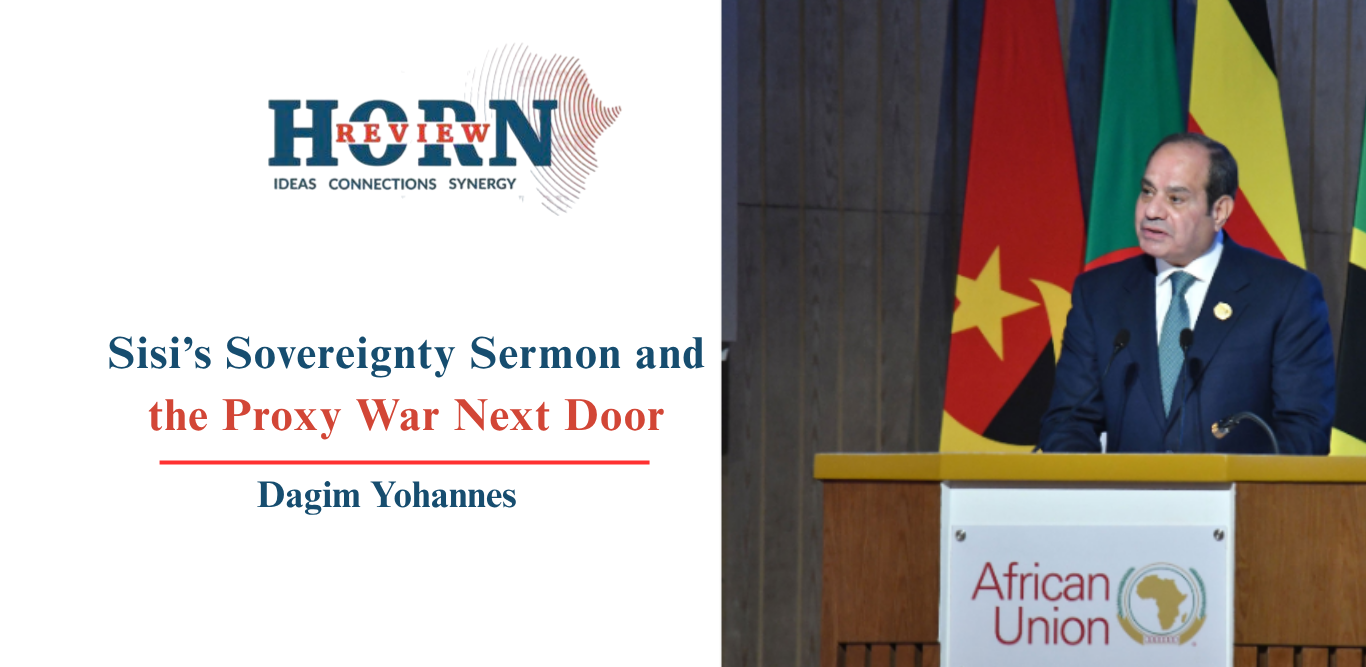
In New Alamein this past weekend, Egyptian President Abdel Fattah el-Sisi delivered a carefully polished lecture on African political morality. Standing before heads of state, AU officials, and business leaders at the inaugural Alamein Africa Business Forum, he declared that security on the continent “begins with empowering the nation-state and its institutions, respecting its unity and sovereignty, prioritizing peaceful solutions to conflicts and crises, and upholding the principle of good neighborliness.” Economic development, he insisted, cannot take root in unstable nations. Stability, he argued, is “the essential cornerstone” demanded by investors and producers alike. The language is unimpeachable. It tracks the African Union Charter. It sounds statesmanlike. It is also, when measured against Egypt’s conduct toward Ethiopia, a study in selective principle.
Sisi’s remarks were not abstract. They were delivered at the precise moment Ethiopia is again confronting a TPLF-led opposition alliance in the north, while Addis Ababa has accused Cairo, Asmara, and Khartoum of enabling that alliance. Ethiopia has closed its embassy in Eritrea, expelled Eritrean diplomats, and entered reciprocal diplomatic expulsions with Egypt. Egyptian officials, meanwhile, have responded with textbook denials: Cairo does not interfere in the internal affairs of other states and regards respect for sovereignty as a cornerstone of Egyptian foreign policy.
Yet the same Egyptian leadership has spent more than a decade treating Ethiopia’s exercise of sovereignty over the Blue Nile as an existential challenge. The Grand Ethiopian Renaissance Dam, launched in 2011 under the TPLF-dominated EPRDF government of Prime Minister Meles Zenawi and inaugurated in September 2025 under Prime Minister Abiy Ahmed, has been framed in Cairo as a unilateral project that threatens Egypt’s water security. Egyptian officials have reserved the right to “legitimate self-defense” if Nile flows are reduced and have rejected arrangements that would allow Ethiopia to fill and operate the dam without binding guarantees for downstream interests. The colonial-era allocation framework, which excluded Ethiopia while granting Egypt and Sudan the overwhelming majority of Nile flows, remains an important historical backdrop to Cairo’s position. A president who lectures Africa on respecting national unity and sovereignty cannot easily reconcile that principle with a policy that seeks to constrain how Ethiopia exercises its sovereign right to develop water resources on its own territory. That is not a rejection of sovereignty in the abstract. It is a hierarchy of sovereignty, in which Egyptian strategic interests determine the limits of what Ethiopia is permitted to do.
The contradiction is not accidental. It is the outward expression of a durable Egyptian strategic doctrine: the preservation of Nile primacy and the prevention of a peer competitor in the Horn of Africa. Because Egypt regards control over the Nile as existential, any upstream state capable of regulating its flow is treated as a structural threat rather than a normal neighbor. When diplomacy failed to lock Ethiopia into a subordinate water regime, Cairo shifted to the cheaper and more deniable tools of perimeter pressure and internal distraction. A stable, industrialized Ethiopia with sovereign sea access would permanently alter the regional balance; a fragmented, landlocked, and conflict-ridden Ethiopia would not. The deepening alignment with Eritrea, the cultivation of a hostile diplomatic front, and the alleged facilitation of opposition forces inside Ethiopia are therefore not deviations from principle. They are the operational methods of a containment strategy that has outlived successive Egyptian governments.
This logic was stated with unusual clarity by Eritrea’s long-ruling leader himself. In a 1996 public Q&A session, Isaias Afwerki observed that any Egyptian support for Eritrea during the independence struggle had been driven by historical calculations and was primarily a means to use Eritrea as a tool to destabilize Ethiopia and deny it peace. He added that Egypt’s main strategic agenda was control of the Nile waters, and that Egyptian policymakers believed the only way to maintain that control was by continuously creating disagreements and unrest among the upstream source countries. He also linked this to Egyptian concerns over the Red Sea. The assessment still captures the transactional nature of the current Cairo–Asmara relationship: Eritrea supplies geographic pressure and deniable leverage; Egypt supplies the strategic purpose and the resources.
Once diplomacy and international pressure failed to halt the GERD or lock Ethiopia into a subordinate water regime, Egypt shifted toward a more systematic perimeter strategy. It has deepened its strategic alignment with Eritrea through high-level visits, offers of technical support and training “in whatever areas Eritrea needs,” and the recent Alamein Joint Declaration with Eritrea, Sudan, and Somalia. That declaration asserts exclusive Red Sea governance, state sovereignty, and the rejection of unilateral Nile measures, a clear attempt to constrain Ethiopia from multiple sides.
This approach is not new. Egypt’s engagement with forces opposed to Ethiopian state power has deep historical roots. In the late 1950s and early 1960s, Cairo became a central hub for Eritrean nationalism. The Eritrean Liberation Front (ELF, known as Jebha) was founded in Cairo in 1960. Egyptian authorities provided the movement with offices, political refuge, and a platform on Radio Cairo, where figures such as Woldeab Woldemariam broadcast anti-Ethiopian messaging in Tigrinya. Egypt also offered military training near Alexandria, modest financial assistance, and arms in the early years of the armed struggle. While the intensity and reliability of that support fluctuated across different Egyptian governments, the pattern of using Cairo as a rear base for groups seeking to weaken Ethiopia was established early and served clear strategic purposes: reducing Ethiopia’s Red Sea presence and limiting its capacity to threaten Egyptian interests on the Nile.
The same logic has resurfaced in later decades. Ethiopian authorities have repeatedly accused Egypt of providing space, training, or financing to Ethiopian opposition groups, most notably the Oromo Liberation Front (and its armed wing, the OLA) in the mid-2010s, with claims that OLF leaders relocated from Asmara to Cairo. Egypt has consistently denied these charges. Yet the recurrence of such allegations, against the backdrop of Egypt’s long record of hosting and amplifying Eritrean separatist organizations, reinforces the perception that Cairo views internal Ethiopian fragmentation as a usable instrument of pressure.
The current embrace of Asmara therefore fits a familiar pattern: a distracted, internally conflicted, landlocked Ethiopia is less able to complete further Blue Nile projects or pursue sovereign access to the sea. Ethiopian accusations that Eritrea (with Egyptian and Sudanese facilitation) is coordinating with a TPLF-led opposition front and allied armed groups are therefore not wild speculation; they align with a documented history of pressure through proxies once direct leverage over the dam collapsed.
The hypocrisy becomes almost theatrical with the TPLF. The Tigray People’s Liberation Front was the dominant force in the Ethiopian government that broke ground on the GERD and advanced its early construction. That same political formation is now part of an opposition alliance whose sustainability depends on external support. If Egypt and its Eritrean partner are indeed enabling or tolerating that alliance, they are working directly or indirectly with the very political current that once facilitated the dam’s launch, against the federal government that finished and inaugurated it. This is not coherent water diplomacy. It is opportunistic destabilization. A country that claims to seek only orderly, cooperative management of shared rivers does not cultivate the conditions for renewed civil war on the upstream state’s northern frontier.
Sisi’s Alamein speech is not wrong in the abstract. African states do need strong institutions, respect for sovereignty, and peaceful conflict resolution if they are to attract investment and deliver development. The problem is that Egypt appears to apply these norms selectively. Ethiopia’s assertion of water sovereignty is treated as a strategic challenge requiring containment, while Egypt’s own regional alignments, historical support for forces opposed to Ethiopian state power, and current diplomatic posture are presented as defensive and lawful. The result is a familiar double standard dressed in continental rhetoric. When the Egyptian president tells African leaders that stability begins with respecting the nation-state, the contradiction is difficult to ignore when Egypt simultaneously seeks to constrain Ethiopia’s exercise of sovereignty and deepens relationships with actors positioned against Addis Ababa. When the Egyptian president tells African leaders that stability begins with respecting the nation-state, the uncomfortable corollary is clear: sovereignty appears to command universal respect until the nation exercising it is Ethiopia and the resource in question is the Nile.
By Dagim Yohannes, Researcher, Horn Review