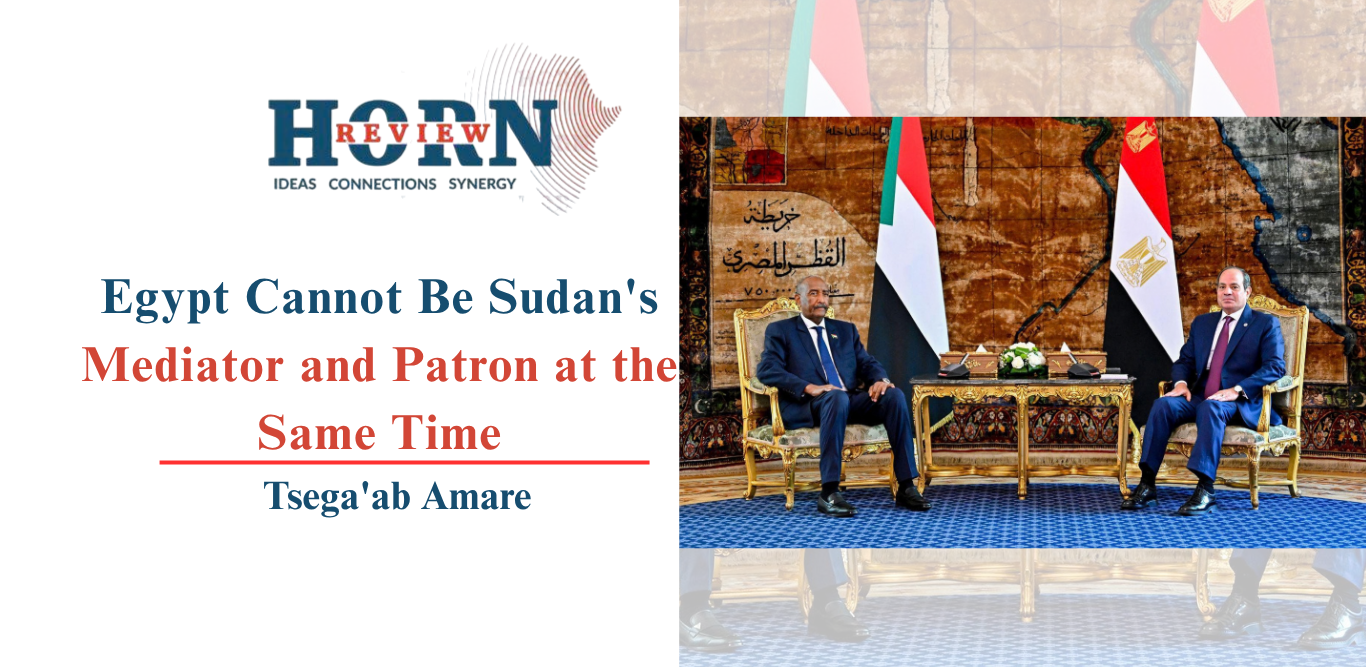
Abdel Fattah el-Sisi received Abdel Fattah al-Burhan in New Alamein on 4 October 2026, and restated its commitment to Sudan’s unity, sovereignty, territorial integrity and national institutions, and pledged continued regional and international efforts toward a political solution.
The formula echoes October 2025, when Cairo rejected any “parallel governing entities to the legitimate Sudanese government.” Although every neighboring state has interests in Sudan, Cairo’s difficulty begins when it pairs a declared preference for the SAF-led state order with a standing as one of the actors shaping how this war ends. That combination and the evidence present place Egypt closer to an interested patron than to an impartial broker, and the costs of the confusion fall on Sudanese civilians.
Egyptian officials rarely call themselves neutral, but the claim lies in the roles Cairo occupies. Egypt convened the July 2023 neighboring-states summit, holds a seat in the Quartet pursuing a ceasefire, pushes Sudan’s readmission to African Union structures, and hosts conferences of Sudanese civilian actors. A state that convenes, sits at the ceasefire table, and shapes the regional agenda asks to be judged as more than a bystander with a preference.
The composition of the table magnifies the problem. Any serious track will eventually seat the RSF opposite the Quartet, of which Egypt is a member, and its delegation would face a government that Mohamed Hamdan Dagalo has accused of airstrikes against his forces since October 2024. This falls short of a mediation that treats both sides as parties to be persuaded. The RSF therefore has little reason to attend in good faith.
The phrase “National institutions” sounds neutral, yet in the Sudanese context it effectively identifies the SAF as the country’s legitimate governance institution while excluding other belligerents in the war. A government may recognize a state authority and still take part in diplomacy, yet Cairo has announced who holds legitimacy on the very question the talks exist to answer. The better reading is that Cairo is defending not only the Sudanese state but a particular configuration of political authority within it. The phrase names Burhan’s army and the career officer who commands it, a man with long ties to Egyptian commanders whose rise mirrors Sisi’s own path from barracks to presidency. If sovereignty were Cairo’s only objective, its position would be easier to reconcile with a genuinely open-ended transition. Its sustained backing of Burhan through a coup, a war, and the SAF’s rejection of the September 2025 Quartet proposal instead suggests a preference for a political settlement in which the military retains decisive authority.
Egypt’s own political model also creates an obvious preference. Since 2013, Cairo has placed the military at the center of the Egyptian state and relegates civilian institutions to administrative roles. A Sudan in which the armed forces relinquished political power and civilian parties exercised meaningful authority would therefore produce a political model markedly different from Egypt’s own. That does not prove that Cairo seeks to reproduce its domestic order in Sudan, but it helps explain why a military-dominated settlement is more compatible with Egyptian preferences than a genuinely civilian transition. This explains why Cairo’s interest in a political solution does not extend to the transition sequence civilians have proposed.
Political alignment runs through named people. In October 2025 Burhan went to Cairo with his intelligence chief and met Sisi, Foreign Minister Badr Abdelatty and intelligence chief Hassan Rashad. The military dimension has moved from allegation toward documentation. Satellite imagery reviewed by Reuters showed Turkish-made Akinci combat drones at Egypt’s East Oweinat airbase near the Sudanese border, and the New York Times reported that drones flying from the base have struck RSF convoys and positions deep inside Sudan for at least six months. The New Arab quoted an Egyptian military official saying Egypt struck an RSF convoy in the border triangle on 9 January. Cairo denies direct involvement, the imagery does not establish use in particular attacks, and Reuters could not verify some strikes. Even then, the combination of Egyptian territory, military infrastructure and reported Egyptian involvement in strikes would place Cairo closer to an active party to the conflict than to an impartial mediator.
Gold shows how the partnership pays for itself. The SAF has steered exports toward Egypt, partly to keep it away from the UAE, and Egypt has removed import duties to absorb the flow. The Central Bank of Sudan recorded only about 16 million dollars of gold exports to Egypt in 2024, around 1 percent of the total, and that number captures officially declared shipments alone. Researchers estimate the physical flow at 44 to 48 tons that year, because unofficial and smuggled gold, which never reaches the central bank’s accounts, is thought to account for about 60 percent of production in the northern states. The gap between the two figures is a rough measure of informal trade. A reported formal channel has grown alongside it.
Leaked documents show that the Egyptian Sudanese Company, a joint venture of the two governments, agreed in January 2024 to import Sudanese gold, and Egypt reportedly imported 4.9 tons worth about 517 million dollars in 2025, twentyfold the previous year, which remains a fraction of the estimated flow even allowing for the different years. Much is re-exported to the UAE, so Egyptian trading carries revenue to the SAF and to the Gulf state accused of sustaining the RSF, a flow Chatham House attributes to the SAF’s dependence on Egyptian support.[ An intermediary that facilitates one belligerent’s war economy and provides it with access to external markets inevitably acquires an interest in that belligerent’s continued viability, an interest that complicates any claim to impartial mediation.
The Nile shows that Egypt’s stake reaches beyond Sudan, and that some forms of political settlement could reduce the leverage Cairo derives from its relationship with Khartoum. Burhan stressed in October 2025 the alignment of Sudanese and Egyptian interests on the water dispute. Before the war Khartoum had pursued a policy of strategic pragmatism in the dispute and come to value the Grand Ethiopian Renaissance Dam for regulated flows and irrigation. A stable civilian Sudan would have every incentive to negotiate its allocation directly with Addis Ababa and to revisit the arrangements binding it to Cairo.
Cairo’s conduct supports a harder reading, because a civilian settlement would produce the independent midstream actor Egyptian planners have long feared. A Sudan kept dependent on Egyptian guarantees could therefore be an instrument of leverage against Ethiopia and a buffer in a containment arrangement running through Eritrea and the Red Sea. Burhan’s reliance on Egypt for military access, border security, gold markets and diplomatic cover makes Cairo a critical security partner for his government and a key external guarantor of the SAF’s military position.
Egypt’s humanitarian standing rests heavily on its role as a major host country. UNHCR reports that the number of registered refugees and asylum seekers has surpassed one million, with Sudanese nationals accounting for the overwhelming majority. While this massive intake represents a significant national burden, the domestic protection environment has sharply deteriorated. Rights organizations have documented tightening entry requirements, residency restrictions, arrests and deportations affecting Sudanese nationals. The resulting contradiction is important: Cairo can legitimately point to the scale of its refugee hosting, while the tightening of access and protection makes it harder for Sudanese civilians to reach or remain in safety. The issue, therefore, is not whether Egypt has hosted Sudanese refugees, but whether that humanitarian record should also be treated as evidence of an impartial civilian-protection role.
The cost of the dual role is the larger concern. It strengthens the RSF’s case that every Cairo-shaped process is rigged, and it reduces pressure on Burhan to concede because a patron sits at the table and buys his gold.
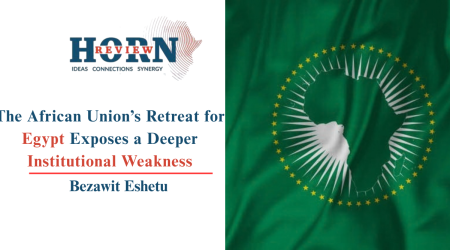
Cairo’s commitment to a political solution is credible only to the extent that it accepts the label its conduct earns. On the documented record, Sisi, Abdelatty and Rashad lead a state aligned with the SAF diplomatically, financially, and militarily. Three steps would test its sincerity: accepting independent verification of the alleged strikes, publishing data on Sudanese entries, deportations and gold imports, and agreeing that any process it convenes will treat the RSF and civilian coalitions as legitimate participants without prejudging who leads. The African Union, IGAD and the Quartet should stop crediting Egypt as a neutral facilitator and treat it as an interested party whose mediation carries less weight.
By Tsega’ab Amare, Researcher, Horn Review