
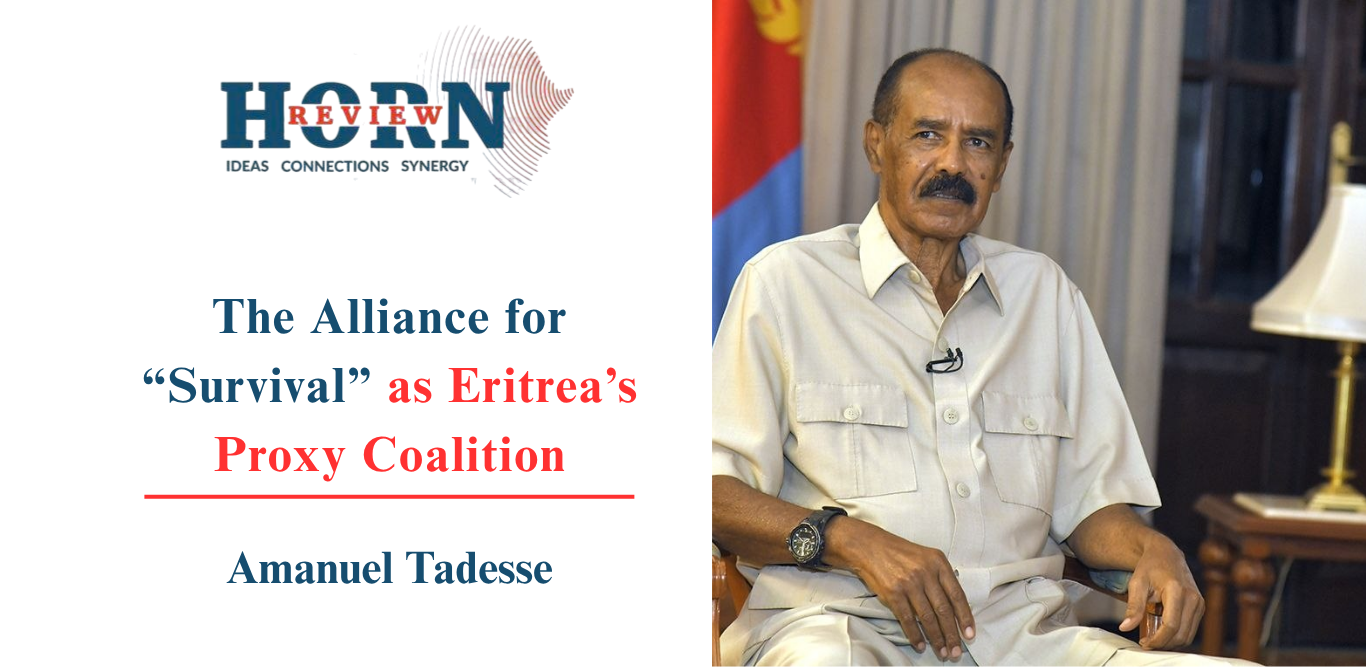
The Alliance for “Survival” as Eritrea’s Proxy Coalition
By Amanuel Tadesse, International Law and Foreign Relations Expert
Eritrea’s relationship with Ethiopia has historically been shaped not only by conventional interstate rivalry, but also by competing conceptions of security, sovereignty, and regional power in the Horn of Africa. From the period of armed struggle to the post-independence era, Eritrea’s security calculations have been closely linked to Ethiopia’s political and military trajectories. Eritrea perceives a powerful Ethiopian state capable of projecting influence toward the Red Sea and the Horn of Africa as an existential threat to its existence. Conversely, Ethiopia has consistently viewed Eritrea’s alliances with Ethiopian opposition forces as direct threats to its national security and territorial integrity.
This competition has continually adapted under changing political circumstances. Throughout the armed struggle, the Eritrean People’s Liberation Front (EPLF), which later rebranded itself as the People’s Front for Democracy and Justice (PFDJ), embraced this doctrine while operating as a liberation movement opposing the Derg regime. After Eritrea gained statehood, the 1998-2000 Ethiopian-Eritrean transformed the relationship into overt and covert interstate animosity, deeply entrenching a strategic mindset within Eritrea’s foreign policy that later manifested itself through various proxy strategies.
Although the 2018 rapprochement temporarily altered this trajectory, Asmara’s adversarial posture intensified following the 2022 Pretoria Agreement, which concluded the northern conflict without Eritrea being a party to the conflict. Excluded from the post-war political order in northern Ethiopia, Asmara sought to alter the developing regional power dynamics by prompting Ethiopian opposition factions to vigorously pursue external political, logistical, and military support.
Eritrea’s state-led policy toward Ethiopia is best characterized as a doctrine of transnational power projection. Within this framework, cross-border militarization, the deployment of conventional forces, the creation of proxy collations, and the establishment of fortified military buffer zones are employed alongside other overt and covert instruments of statecraft as interconnected elements of a unified security strategy.
Rather than relying exclusively on conventional interstate deterrence or direct military confrontation, the regime in Asmara has sought to develop a multi-layered security architecture that extends beyond Eritrea’s territorial boundaries and penetrates the political, military, and security environments of neighboring states. Within this basis, a transnational security network functions as a web of state and non-state relationships through which the government extends its influence far beyond its borders.
The regime in Asmara consistently frames this posture as a pre-emptive security doctrine, ostensibly designed to neutralize perceived threats before they cross into Eritrean territory. From this perspective, external military and political engagement is viewed as a defensive measure intended to establish strategic depth and prevent hostile forces from consolidating along Eritrea’s borders.
However, Eritrea’s conduct can also be understood as a pattern of externalized threat management and an expanding web of political influence aimed at shaping Ethiopia’s political and security landscape. The regime’s destabilizing activities indicate a clear intent to alter Ethiopia’s internal political equilibrium, cultivate leverage over competing political and armed factions, and influence the broader strategic environment in which the Ethiopian federal government operates. By utilizing armed proxies and political ties with anti-government actors, the regime creates rooms to exert influence without necessarily relying on conventional interstate war with Ethiopia.
The features of this transnational strategy within Ethiopia demonstrate how these overt and covert mechanisms operate in practice under continuous strategic surveillance. Against this background, this piece probes how the Eritrean regime uses proxy alliance-building as a strategy to destabilize Ethiopia, how its subversive activities remain under surveillance, and how such monitoring should be maintained.
As part of its destabilization strategy, Asmara facilitated the official unveiling of the Ethiopian Peoples’ Forces Alliance for Survival on September 20, 2026. This move directly operationalizes Eritrea’s strategy of transnational power projection. The coalition brings together diverse Ethiopian local insurgents, including the Tigray Peoples’ Liberation Front (TPLF), Oromo Liberation Army (OLA), Amhara Fano National Movement (AFNM), Ogaden National Liberation Front (ONLF), Afar Revolutionary Democratic Unity Front (ARDUF), Benishangul Peoples Liberation Movement, and Gumuz Peoples Democratic Movement.
The emergence of the Alliance and its official public declaration, are the direct operational outputs of secret, high-level strategic planning engineered by the Eritrean regime in Asmara. Following initial exploratory meetings held in Sudan, Mekelle, Axum, and Adigrat, secret consultations were convened in Asmara in August 2026, featuring key opposition leaders, including TPLF Politburo Chairperson Debretsion Gebremichael.
During the alliance consultations in Asmara, the Eritrean regime formally introduced the Roadmap for Transitional Government, a strategic blueprint designed to guide the coalition toward replacing Ethiopia’s constitutional government. The member factions unanimously adopted and harmonized the Roadmap’s core objectives into their official launch statement read by one of the faction’s groups chairman, which calls for safeguarding survival of the people, conducting constitutional dialogue, and establishing an inclusive transitional government.
For considerable period, members of the coalition denied receiving support from Eritrea’s transnational network. However, the TPLF chairman Debretsion Gebremichael publicly acknowledged that the group was no longer operating in isolation to end the existing political system, explicitly stating: “we are not alone as we were in the past: we have allies now.“ This admission marks a clear departure from earlier denials, confirming coordinated political and military cooperation among anti-government actors under the Tsimdo framework. Following the Shererina incident on 2 August 2026, the TPLF leadership met with Eritrean military and political officials in Gulo Mekeda aimed to harmonize operational strategies designed to destabilize the federal government and facilitate Eritrean military incursions into internationally recognized Ethiopian territory.
By uniting these distinct groups under a common framework, the alliance seeks to target Ethiopia’s constitutional order, territorial integrity, and national security. The formation of this proxy front epitomizes a deliberate attempt to destabilize the Ethiopian state, reshape the political landscape, and install a pliable transitional government in Ethiopia that would be more receptive to Eritrea’s interests, particularly regarding Eritrea’s efforts to counter Ethiopia strategic aspirations to Red Sea access.
The PFDJ is widely characterized as having mastered the art of bringing together fundamentally incompatible and ideologically divergent insurgent factions. The alliance gathers ethno-nationalists, radical secessionists, unionist factions, and peripheral rebel groups whose political objectives have historically contradict one another. The confrontation between the TPLF and Amhara Fano militias during the northern conflict illustrates the depth of these differences. Their joint participation, despite having fought a devastating war against one another, shows that the alliance lacks cohesive ideological glue or a positive state-building vision and is therefore fundamentally fragile. Instead, they have come together simply to implement the substantive elements of the Roadmap for Transitional Government designed by the Eritrean regime and to serve as a trojan horse of the Isais regime.
Previously, Fano and related groups accused the TPLF of dragging Ethiopia into war and committing massacres against innocent civilians in places like Chenna and Mai Kadra. Yet, by gambling on the blood and scarifies of these victims, they have formed a tactical partnership. Similarly, while the TPLF repeatedly asserts its claim over Western Tigray (Welkait), the alliance sets no ground to resolve this territorial dispute. Furthermore, while Fano has condemned the OLA for targeting innocent Amhara civilians living in Wollega, and the OLA has likewise accused the FANO militias of targeting the Oromo civilians in the same area, both groups have now entered into an alliance, setting aside these longstanding grievances and mutual accusations.
Its sole common denominator is an anti-state posture aimed at ousting the legitimate Ethiopian government. This tactic shows the PFDJ’s classic playbook of utilizing “rebels without a cause” to wage surrogate warfare and externalize threat management beyond Eritrea’s physical borders. In doing so, it ignores the genuine interests of the population for peace to temporary focus on unseating the government rather than building a viable political future of Ethiopia. Ultimately, the alliance lacks the capacity to reconcile these unsettled differences. Even assuming they succeeded in taking control of the federal government, they would inevitably turn on one another over issues like the status of Welkait. Their partnership is nothing more than a sham alliance designed to serve Eritrea’s regional destabilization agenda and execute the Roadmap of Eritrea.
To enforce this blueprint, the PFDJ established an external, high-level political, military, and security command structure based in Eritrea. This overseeing body is mandated to monitor the coalition’s compliance with the Roadmap while directly coordinating intelligence, tactical operations, and communications across the Tigray, Amhara, and Afar regions. Through this governance architecture, Asmara seeks to institutionalize its influence over Ethiopia’s internal political affairs and strategic direction.
The activation of the Tsimdo Alliance directly serves the core pillars of Eritrea’s transnational security perimeter. First, it seeks to safeguard regime survival in Asmara by creating a managed buffer zone of instability inside Ethiopian territory, thereby absorbing security threats before they reach Eritrea’s borders. Second, it facilitates disproportionate power projection, enabling a smaller state to exert heavy leverage over a larger neighbor. Third, it preserves operational asymmetry by weaponizing internal Ethiopian insurgencies, and political divisions, imposing severe political, military, and economic costs on the federal state without requiring Eritrea to engage in direct conventional interstate warfare.
While the alliance appears to have been engineered as a destructive instrument intended to paralyze Ethiopia’s state apparatuses, the activities of these anti-government remnants, together with Eritrea’s overt and covert operations inside and outside Asmara, have remained under the close surveillance of Ethiopian security agencies from the inception. Because the coalition brings together actors with fundamentally divergent and, in some cases, irreconcilable political agendas, its structural foundation remains inherently fragile. Maintaining rigorous intelligence monitoring, tracking transnational supply networks, and exposing external orchestration are therefore critical to countering this proxy strategy and protecting Ethiopia’s national integrity.
The activities of the Eritrean regime and its support for the alliance remain under close and continuous surveillance. The order given by Eritrea, as well as the Roadmap prepared under its direction, are known to Ethiopian authorities. The consultations held in the Tigray region and neighboring states, as well as the recent meeting in Asmara to finalize the alliance, have likewise remained under Ethiopia’s watch.
In addition to maintaining close surveillance on Eritrea’s role in implementing the Roadmap, the federal government should closely monitor how local factions advance Asmara’s destabilization agenda. Given their deep irreconcilable differences, the federal government can derive wedges between these ideologically incompatible groups by encouraging rank-and-file fighters to defect from a coalition engineered solely to serve external interests, particularly Eritrea’s welfares.
Furthermore, the government should systematically declassify and publish credible evidence of the secret meetings, transnational command structures, and clandestine logistical support provided by the Eritrean regime. Publicizing these links internationally and at home will expose the coalition as a foreign proxy and undermine its political legitimacy.
Finally, on the diplomatic front, Ethiopia should engage the international community and multilateral bodies to formally document Eritrea’s cross-border interference and proxy warfare, exposing actions that destabilize the Horn of Africa.

RELATED
Posts
21
Sep
How Cairo’s Institutions Read Ethiopia
Egypt’s policy thinking toward Ethiopia has evolved from a primarily...
21
Sep
Sudan’s Rejection of War with Ethiopia Despite Hardline Voices in Khartoum
The closed door meeting in Djibouti in early May...

21
Sep
Somalia’s Informal Economy in U.S. Security and Financial Policy
In various settings, the line between formal and informal economic...
21
Sep
Security Dependencies and Al Shabaab’s Dominance
The Federal Government of Somalia exists in a condition that...
19
Sep
Eritrea’s Sanctions Expired, Not Formally Lifted
The U.S. sanctions on several Eritrean entities and individuals did...
16
Sep
Why Eritrea Turned from Engaging Somaliland in 2019 to Opposing It Today
In March 2019 Eritrean Foreign Minister Osman Saleh accompanied by...
16
Sep
Ethiopia and the U.S. After the War on Terror: Within a New Arc of Terrorism
The War on Terror began as a direct response to...
16
Sep
Why the Abraham Accords Will Not Expand Yet
The claim that Israel is unlikely to find an...
16
Sep
The Real Houthi Weapon Was Mobilization, Not Missiles
Fatima Abo Alasrar frames the Houthi ground strategy as...
16
Sep
The Houthis Reached Zuqar Island: Can Eritrea Be a Neutral Observer?
The island of Zuqar sits in the southern Red Sea,...