
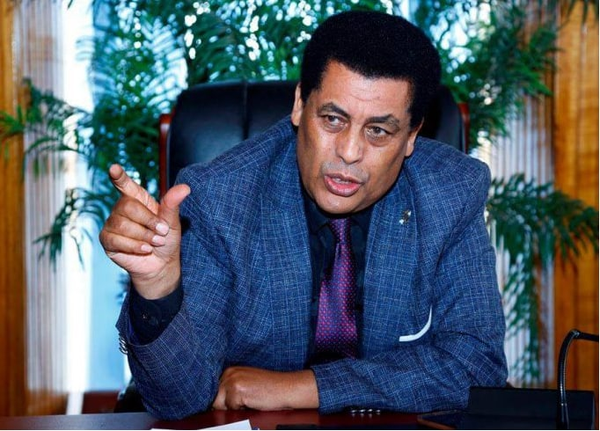
Ambassador Dina Mufti: In conversation with Horn Review Executive Director Blen Mamo on the Ethiopia-Eritrea crisis
Ambassador Dina Mufti, a career diplomat and former spokesperson for Ethiopia’s Ministry of Foreign Affairs, has spent decades navigating the country’s most sensitive external relationships, none more consequential today than its deteriorating relationship with Eritrea.
As tensions along the northern border escalate and reports mount of Eritrean military assets moving into Tigray, Horn Review’s Executive Director Blen Mamo sat down with Ambassador Dina to examine the evolving strategic landscape surrounding Ethiopia, the fragmentation within TPLF hardline elements, & the posture of Isaias Afwerki’s Eritrean regime.
Blen Mamo: How do you describe the current state of affairs between Ethiopia and Eritrea?
Ambassador Dina Mufti: The Ethio-Eritrean border has evolved from a hard international boundary into a blurred line of diminishing relevance. Military assets and personnel are crossing from Eritrea into Ethiopia on an unprecedented scale. Eritrea is increasingly enmeshed in the security and political landscape of northern Ethiopia. It has become the senior partner in a collusion of forces hostile to the Federal Government of Ethiopia. TPLF hardliners and Fano elements are junior partners in this anti Ethiopia enterprise.
This development has been underway for some time, but it has now become unmistakably public. Through its open and incontestable violation of Ethiopia’s sovereignty and territorial integrity, the Eritrean government has brought into play Ethiopia’s inherent right to self-defense.
Ethiopia’s response to Eritrea’s acts of aggression is both legitimate and justified under international law.
As matters currently stand, Eritrea’s publicly documented actions constitute a clear violation of international law and of the principles of sovereignty and territorial integrity.
Further escalation by the Tsimdo, particularly the launch of an offensive in the Raya and Alamata areas for which they are preparing, would compel Ethiopia to respond forcefully to what would clearly constitute a major act of aggression. Such a response would need to repel the forces of aggression, eliminate their ability to threaten Ethiopia’s security, if necessary, including through regime change in Eritrea, with the objective of safeguarding Ethiopia’s long-term security interests and ensuring enduring peace and stability between the two countries and across the wider region.
Blen Mamo: How should the international community interpret Eritrean military presence inside Ethiopian territory, an isolated incident or part of a broader strategy? And what would that broader strategy be in this context?
Ambassador Dina Mufti: The Eritrean military presence inside Ethiopian territory is not an isolated incident rather it reflects a broader, deliberate strategy of destabilization. Currently, Eritrea’s regime under Isaias Afwerki is working with splinter TPLF factions to weaken Ethiopia, militarize Tigray, and maintain regional instability as a tool of regime survival. The history of the Eritrean regime bears witness to their broader strategy of working to destabilize the entire region.
First, the strategy stems from the regime’s ill-conceived belief that its survival can be sustained only by fomenting instability, havocs and perpetuating conflicts in the Horn of Africa and beyond. I can give you a number of instances for this: right after its secession, the Eritrean regime rushed to ignite a war with Yemen over the Hanish Islands and went to militarily confrontation in 1995. Then the regime further disclosed its bellicose behavior by invading Ethiopia in the pretext of a border dispute in 1998. The aggressive posturing of the regime is further revealed by its military aggression against Djibouti over the dispute on Ras Doumeira Islands area along the Red Sea in June 2008. These constituted the very nature of the Eritrean Regime. Even after assuming power, The PFDJ never abandons its Sahelian mentality and continues to govern as a rebel and a criminal enterprise disguised as a government. It stained its hands with blood by meddling in conflicts all over the world from the Democratic Republic of Congo to Sri Lanka.
Second, the Eritrean Regime frames the survival of Eritrean regime and the destabilization of Ethiopia as two sides of the same coin. The regime is guided by a policy that its interests are safeguarded if Ethiopia bleeds or fails. The regime’s absurd ambition of becoming a Denmark or Singapore or Israel of East Africa at the expense and demise of Ethiopia clearly illustrates its misguided approach.
Third, to truly grasp the regime’s nature, one must look at how Isaias Afwerki and his inner circle see themselves. They project Eritrea as a principled state, a regional powerhouse led by the “visionary” statesmanship of their president. But this grandiose self-image is nothing more than a hollow illusion. The reality is stark: entrenched poverty, suffocating repression, and a mass exodus of Eritrea’s youth desperate to escape. The regime’s inflated pride masks its utter failure to deliver even the basics of dignity and survival to its people.
“Regional destabilization is the regime’s explicit modus operandi.”
In general, the regime breaches peace in the Horn of Africa with purpose. If peace prevails in the region, they fear that Isaias will perish. His self-styled rule prioritizes regime survival over peaceful coexistence and the pursuit of shared economic interests. Regional destabilization is the regime’s explicit modus operandi.
This belligerent action of Eritrea must be viewed vis-a-vis the basic principles of international law, that clearly stipulates states to refrain from the threat or use of force against the territorial integrity of a state, respect of borders as well as non-interference in the internal affairs of other states. It should be underlined that Eritrea’s action is an evident violation of Ethiopia’s Sovereignty and territorial integrity against this principle. There is no way around that.
Blen Mamo: From your perspective, what makes today’s Ethiopia–Eritrea tensions different from earlier disputes; both before 2018 and during the years following the Pretoria Peace Deal?
Ambassador Dina Mufti: The fundamental causes of tension between Ethiopia and Eritrea have always resulted from the behavior of the regime in Asmara that we have discussed about earlier. Tension has persisted despite change of regime in Ethiopia and this tells a very clear story that the regime in Asmara seeks to destabilize Ethiopia despite the internal context of the country. However, we could also talk about some differences in details. For instance, the PFDJ’s insistence to continue the patron-client relations of EPLF/Shabia-TPLF of the old-days of the rebel movement could explain the tension. As you recall, the Algiers agreement ruled that Eritrea resorted to armed force to attack against Ethiopia. Thereafter, the relations reached a deadlock as both adopted a “no war, no peace’’ policy.
Fast forward to 2018, Ethiopia pursued a new approach to break the stalemate as Prime Minister Dr. Abiy Ahmed accepted the Eritrea-Ethiopia Boundary Commission ruling without conditions. However, the Eritrean regime failed to alter its behavior and continued harboring anti-Ethiopian armed groups in that very first moment, demonstrating the regime’s claim of border dispute was a mere hoax and its policy remains unchanged.
On the contrary, ignoring initiatives suggested to solidify the partnership between the two countries, the Eritrean regime exploited the security vacuum to unleash its vengeance on those whom perceived as enemies in Tigray Region. The regime in Asmara also strongly opposed any development that warrants sustainable peace in Ethiopia. This can be demonstrated through the strong objection voiced by the Eritrean Government against the Pretoria Peace agreement, an Agreement for Lasting Peace through a Permanent Cessation of Hostilities in 2022.
This is why the recent unholy marriage between TPLF and PFDJ comes as an ironic development. It is perplexing and difficult to fathom, that the two arch-enemies- TPLF and the Eritrean regime have formed tactical alliance called-Tsimdo-Alliance and working together to destabilize Ethiopia and the region. In fact it is an alliance of evils. Beyond their common ground for the subversive efforts against Ethiopia, both engaged in illegal gold mining and trade, human-trafficking and other trans-border crimes. In and after 2018, although Ethiopia pursued rapprochement, the fundamental of the Eritrean policy is intact and unchanged across shifting contexts.
Blen Mamo: Ethiopia has repeatedly accused Eritrea of coordinating with TPLF hardliners. What evidence can be presented to the international community to support this claim?
Ambassador Dina Mufti: The evidence is visible and undeniable. Eritrean military and intelligence operatives are openly colluding with TPLF elements both inside Ethiopia and across the border in Sudan. Their partnership, known as the Tsimdo Alliance, is no secret it is publicly acknowledged by the parties themselves. Recent joint military gatherings in places like Zalambesa and Adigrat have been conducted in plain sight, observable to anyone willing to look. Regional security experts and organizations such as the International Crisis Group have already warned of the grave implications of this alliance, while Eritrea and the TPLF openly boast about their cooperation.
Blen Mamo: How significant is the reported deployment of heavy Eritrean military assets inside Tigray in terms of escalation risk?
Ambassador Dina Mufti: I strongly believe that it is a serious development and Eritrea’s actions represent a major escalation; I am informed that Eritrean trucks loaded with weapons, fuel and other military logistics are entering Tigray. This is dangerous for Ethiopia as it poses a national security threat. I think the Ethiopian government has no option but to act before the situation unfolds any further. Their military movements in different places are under constant surveillance.
Blen Mamo: Would you characterize Eritrea’s actions as direct aggression, proxy warfare, or something in between?
Ambassador Dina Mufti: Eritrea’s action is a combination of direct aggression and proxy warfare against Ethiopia. Its action amounts for violation against one’s sovereignty and territorial integrity. Eritrea is a political enclave without strategic depth. On one hand, it operates under the assumption that it can survive a conflict by turning Northern Ethiopia a buffer zone. On the other hand, the regime plotted to use TPLF hardliners as proxy to fuel civil war and both are also proxies of other historic enemies of Ethiopia. All this is to keep Ethiopia in the state of perpetual instability. This anachronistic approach would not succeed given Ethiopia’s current capabilities. In general, Eritrea’s move contravenes core international non-aggression and non-interference principle, as I stated before, and violates state sovereignty.
Blen Mamo: Ethiopia emphasizes that it has exercised restraint for over two years. What has guided this strategy, and what has it cost Ethiopia? And at what point does restraint risk being interpreted as weakness, either by adversaries or even by international partners?
Ambassador Dina Mufti: Ethiopia showed a maximum and unimaginable restraint in the face of immense provocations over the past two years. Sometimes, I am dismayed by the level of restraint in the face of these ongoing provocations from Eritrea and TPLF. However, it tells me two things: a commitment to peace and a strategic effort to break the vicious circle of conflict in order to focus on prosperity and economic development. The government is giving Eritrea a chance to reconsider its bellicose and aggressive posture, and its misguided policy and engage in constructive way. Nevertheless, the regime seems to turn a blind eye rather insisting on its making further provocations.
Conversely, Ethiopia is a nation that has lost an appetite for an armed conflict. It is a nation so much focused on ensuring development. It is for this reason that Ethiopia has been exercising maximum restraint and remained focused on its economic endeavors and priorities. The completion and inauguration of its mega Dam, GERD, massive urbanization and modernization projects, the inauguration of the Ogaden Natural Gas Development phase I and the launch of its Phase II, and the laying of cornerstone for Dangote-Gode fertilizer plant, the inception of the construction of the new Bishoftu Airport, conducting and the successful completion of the election as well as the undergoing national dialogue would not have been possible had Ethiopia allowed itself to be trapped by provocations. Ethiopia prioritized bringing an overall economic development and building a new democratic political culture over violence and destabilization.
Blen Mamo: Is Ethiopia truly capable of maintaining restraint in the face of ongoing provocations from Eritrea?
Ambassador Dina Mufti: In reality, no. Although Ethiopia’s government has consistently exercised restraint, Eritrea’s regime continues its repeated provocations. Public pressure is mounting for the government to defend the nation’s sovereignty and territorial integrity, its foremost duty. Prolonged restraint risks projecting weakness both domestically and to Eritrea, which could prove counterproductive and even embolden further aggression.
Blen Mamo: Ethiopia has warned that its restraint has limits, what do you think are those limits? What would trigger a shift from defensive posture to broader military action? Would Ethiopia consider cross-border action against Eritrean forces a legitimate act of self-defense?
Ambassador Dina Mufti: I remain struck by the extraordinary patience shown by Ethiopia’s government. Yet it is clear that the threshold has been crossed. Eritrea’s regime has violated every boundary, provoking both the state and the people of Ethiopia. “At this stage, Ethiopia is fully justified in defending itself against these relentless provocations.” Protecting sovereignty and territorial integrity is the government’s foremost duty, and the public’s demand for action against Eritrea and its criminal allies grows louder by the day. It would therefore come as no surprise if the government were to declare that it can no longer uphold its policy of restraint.
Blen Mamo: How would escalation affect regional stability, particularly in Sudan and the Red Sea corridor?
Ambassador Dina Mufti: It simply means more devastation in a region that already has plenty.This unfortunately is music to the ears of the octogenarians in Asmarathat enjoys and works towards igniting tensions in the region. It is evident that it is actively working to transform the conflict into a regional war. As I have clearly stated earlier, following its cession from Ethiopia, the regime in Asmara and its affiliated party, the PFDJ initiated conflicts against Yemen, Sudan, Djibouti and others. Their desire for war and instability has consistently reached alarming levels.
The Eritrean regime along with TPLF hardliners is striving to escalate tensions and provoke a regional conflict. I strongly believe that the region would benefit greatly from the avoidance of this war and the establishment of lasting peace. The Eritrean regime has effectively recruited its mercenaries, like TPLF hardliners who are committed to create havoc, instigate chaos and disruption in the region. They have created a coalition, which I earlier discussed, known as Tsimdo, and Sudan is serving as a sanctuary, launching pad and logistical base for this anti-peace faction.
“This unholy alliance has been formed solely to instigate chaos in Ethiopia and the surrounding region.”
This unholy alliance has been formed solely to instigate chaos in Ethiopia and the surrounding region. Sudan is suffering as a result of this axis of violence. The actions of this anti-peace group is unsettling the entire region and pose a further threat to maritime security, including the Red Sea corridor.
Blen Mamo: You’ve raised concerns about forced conscription and the exploitation of ethnic Tigrayan civilians. How urgent is the humanitarian dimension of this crisis? Are we looking at a potential large-scale Humanitarian crisis if tensions are not contained?
Ambassador Dina Mufti: TPLF is taking advantage of the people of Tigray by implementing forced conscription among the youth. Its loyal militias are rounding up young individuals and forcefully transporting them to training camps. As a result, there has been a significant exodus of Tigrayan youth from the region including to Addis Ababa. The residents of Tigray are opposed to war. Mothers are unwilling to sacrifice their children for a conflict that lacks purpose. However, they are being forcibly separated from their children.
What hurts me the most is that this situation has escalated into a crisis for the people of Tigray. The hardliners within the TPLF have drawn this lesson from the regime in Asmara. As they say, association shapes character, or as we rather say in Ethiopia, “a heifer that spends time with a donkey learns to fart like one.” They have also taken Internally Displaced Persons (IDPs) as hostages, primarily to further their agenda. This tactic mirrors the actions of the PFDJ throughout its tenure in government.
Blen Mamo: What message do these developments send about the effectiveness of international norms on sovereignty and territorial integrity? And what does “accountability” look like in practical terms for Eritrea’s actions?
Ambassador Dina Mufti: I strongly believe that the international community must speak out clearly and demand that the Eritrean government end its aggressive actions. The authorities in Asmara must be warned to halt their illegal occupation of Ethiopian territory by undermining our sovereignty without delay. It should be clear that the collaboration between the Eritrean regime and its ally, Tsimdo to reignite conflict by supporting armed factions not only endangers Ethiopia’s stability but also jeopardizes peace and security throughout the Horn of Africa. Such disruptive actions of the Eritrean regime will further undermine maritime safety in the Red Sea. Hence, the international community must swiftly impose targeted sanctions on this oppressive regime aiming to curb its destabilizing conduct and prevent further chaos across the region.
Blen Mamo: Is there still a viable diplomatic off-ramp, or are we moving toward inevitable confrontation? What role could mediators – African Union, Gulf states, or others – play at this point?
Ambassador Dina Mufti: I believe it is still not too late, but patience cannot last forever. Ethiopia’s Foreign Minister, H.E. Dr. Gedion has extended an invitation to his Eritrean counterpart to engage in dialogue and resolve the tensions peacefully. He even sent a formal letter, which to date, remains unanswered. Time is running out. Therefore, the international community must take constructive actions to halt the aggressive moves by the Eritrean regime, its mercenaries and its criminal gangs. It should be quite clear that their reckless course of action threatens not only Ethiopia but also the stability of the entire region.
Blen Mamo: You’ve acknowledged statements by the EU and sanctions by the United States, why have these measures not changed behavior on the ground? What specifically is Ethiopia asking the international community to do at this stage?
Ambassador Dina Mufti: Despite repeated appeals and statements from the international community and numerous countries, the Eritrean regime remains unchanged in its actions and conduct. It persistently engages in destabilizing activities and sow chaos as usual. As a usual strategy, the regime routinely ignores criticisms and statements from various countries and multilateral organizations.
This calls for the international community to implement strict measures, such as imposing regulatory bans on the so-called 2% recovery and rehabilitation tax the regime collects from Eritreans overseas. I also believe that imposing targeted penalties on this oppressive government is essential and that could involve sanctions, including a comprehensive arms embargo.
Blen Mamo: How should the international community interpret Ethiopia’s consistent messaging on this: as a warning, a deterrent, or preparation for action? Are we at a turning point where inaction could make a larger conflict unavoidable?
Ambassador Dina Mufti: The Ethiopian government is urging the international community to act swiftly to prevent an escalating crisis from spiraling out of control. It should be clear that once crossed, certain thresholds may render the situation irreversible. The persistent aggression and provocations by the Eritrean regime, along with its allies in fostering chaos, have gone too far.
Ethiopia’s policy of exercising maximum restraint is not infinite. The Ethiopian people expect their government to safeguard national sovereignty and territorial integrity. Ethiopia will not stand idle while its legitimacy is challenged and its sovereignty undermined. Immediate action is essential and delay will be dangerous. The clock is ticking and the Eritrean regime must be clearly and firmly told to cease its destabilizing activities and end its support for unrest and create instability in Ethiopia and the entire region.
Blen Mamo: Ambassador Dina Mufti, thank you for laying out Ethiopia’s position with such clarity. It’s clear this is a moment the region cannot afford to overlook. We are grateful for your time.

Leave a Reply Cancel reply
RELATED
Posts
15
Oct
Why Every Diplomatic Break in the Horn Traces Back to Water
Analysis of instability in the Horn of Africa and...
15
Oct
The AU’s Uneven Geography of Urgency
Since Mahmoud Ali Youssouf assumed leadership of the African Union...
15
Oct
The Aswan Dam and Ethiopia’s Longstanding Rejection of Egypt’s Nile Veto
On 29 May 1956, before construction of the Aswan High...
15
Oct
Why Somalia’s Hedge between Ethiopia and Egypt Cannot Last
The public position articulated by Somalia’s Deputy Foreign Minister Hassan...
15
Oct
Ethiopia Somaliland Defence Ties and the Practice of Keeping the Door Ajar
The recent meeting between Brigadier General Nimcaan at the...
15
Oct
Ethiopia’s Right to Self-Defence and the Strategic Fallacy of Symmetrical De-escalation
The growing calls for de-escalation to the Ethiopia–Eritrea crisis risks...
12
Oct
The Recurring Script of Eritrea’s Invasion-Victim Cycle
In the Horn of Africa, history under Isaias Afwerki does...
12
Oct
Under the Banner of Red Sea Security, Egypt Encircles Ethiopia
Reports of Egyptian naval movements toward the southern Red...
12
Oct
Egypt's Attack on Sudan's Gold Mines and the Long Road That Led to It
The airstrikes that tore through the artisanal gold mining...
9
Oct
Where Somalia’s Federal and Regional Fight Is Going
The 2012 federal settlement was less a constitutional order...
Comment (1)
I admire the patience of the Ethiopian Government but at what price?