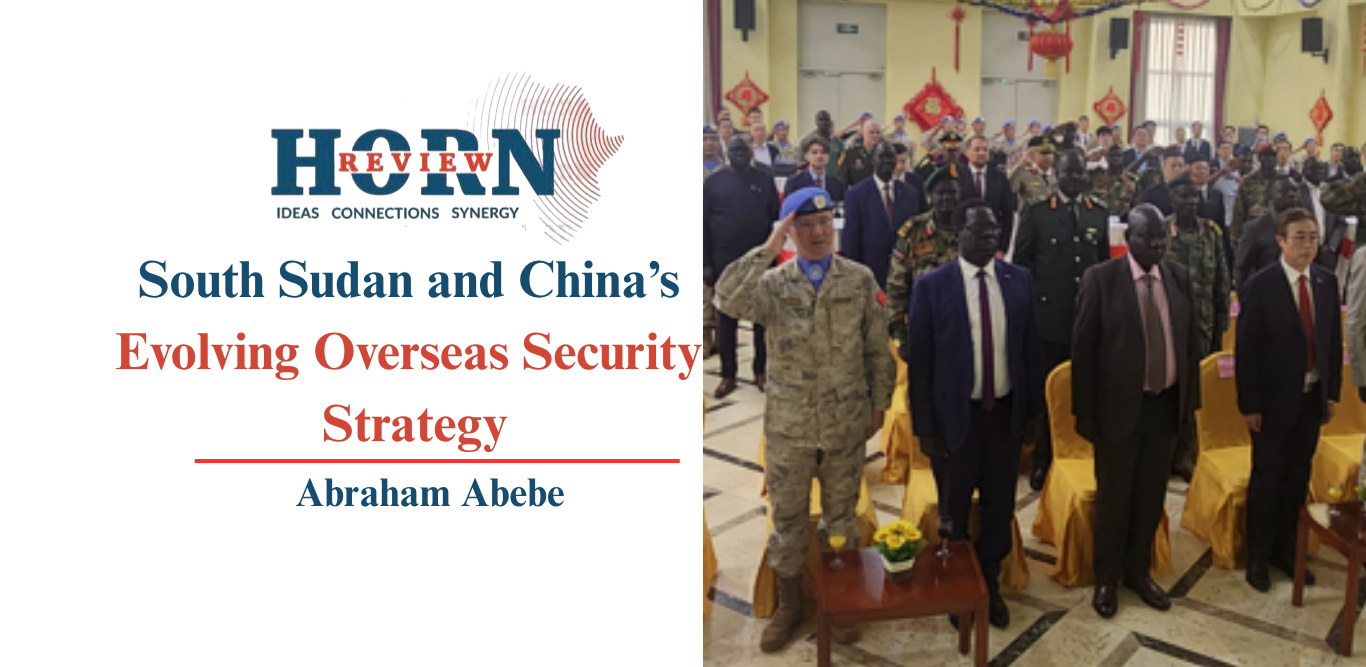
China’s decision to deepen military cooperation with South Sudan reflects a broader adjustment in Beijing’s overseas security strategy. The commitment made in Juba on 24 July 2026 to expand military exchanges and defence cooperation illustrates China’s growing effort to manage risks surrounding its expanding global interests. Rather than signalling a drive for overseas military expansion, the move reflects a broader strategic logic: security has become an enabling condition for protecting investments, sustaining political partnerships, and securing long-term economic engagement.
This shift reflects a broader transformation in China’s overseas engagement. As one of the world’s largest investors, Beijing increasingly combines diplomatic, economic, and security instruments to manage risks surrounding its external interests. Defence diplomacy, peacekeeping participation, and institutional cooperation have become tools through which Beijing seeks to reduce instability before it threatens its strategic objectives. South Sudan provides an important example of this evolving approach, where China is attempting to balance economic interests with a longstanding preference for sovereignty, non-interference, and limited overseas military involvement. The country demonstrates how this broader approach is being applied in a fragile political environment.
The July 2026 commitment to deepen military cooperation followed the elevation of China-South Sudan relations to a strategic partnership during the 2024 Forum on China-Africa Cooperation (FOCAC) Summit, reflecting the broader expansion of bilateral ties beyond economic cooperation. For Beijing, security cooperation is becoming an increasingly important component of maintaining stable political and economic relationships in fragile environments.
China has long shaped its engagement with South Sudan to serve its energy interests. Before South Sudan’s independence in 2011, Chinese companies, particularly the China National Petroleum Corporation (CNPC), became major investors in Sudan’s oil sector. Independence created a complex situation: while South Sudan inherited most oil reserves and production capacity, essential infrastructure, including pipelines and export routes, remained dependent on Sudan.
Beijing therefore had to maintain relations with both Khartoum and Juba while protecting its energy interests. However, the outbreak of civil war in South Sudan in 2013 demonstrated the limits of economic diplomacy alone. The conflict disrupted oil production, threatened Chinese investments, and exposed personnel and commercial operations to security risks. For Beijing, the crisis reinforced a wider lesson: as China’s global economic footprint expands, protecting overseas interests requires security instruments alongside investment and diplomacy.
South Sudan subsequently became an important testing ground for this approach. Rather than establishing an independent military role, China expanded its security engagement mainly through multilateral mechanisms. In 2015, Beijing deployed an infantry battalion to UNMISS, marking China’s first infantry deployment in a UN peacekeeping mission. Under a UN mandate, the deployment allowed China to contribute to conflict management while gaining practical experience operating in complex security environments.
The significance of UNMISS extends beyond peacekeeping participation. Through the mission, China developed a model of security engagement that combines international legitimacy with practical involvement in conflict management. The UN framework enables Beijing to more precisely evaluate unstable political environments and safeguard its interests, while limiting the political repercussions of direct intervention in domestic conflicts.
The armed patrol mission conducted by the 12th Chinese Peacekeeping Infantry Battalion in the Mongalla region in July 2026 provides a concrete example of this approach. The operation involved patrolling a vital supply route connecting Juba with northern states and coordination with local government and police officials. Such activities illustrate Beijing’s preference for expanding security engagement through existing multilateral institutions rather than establishing independent military structures. These activities demonstrate how China has used multilateral peacekeeping frameworks as the foundation for a broader security engagement with South Sudan.
The 24 July 2026 development represents a further evolution of this approach. Expanding military dialogue, exchanges, and institutional cooperation provides China with additional channels for communication with South Sudan’s security institutions. The objective is to create a more predictable security environment in which economic and diplomatic relationships can continue.
For South Sudan, closer cooperation with China offers opportunities for institutional support, professional exchanges, and continued economic engagement. For Beijing, maintaining stability in Juba helps protect energy interests and reinforces its position as a major external partner in Africa. The relationship demonstrates how China increasingly links development and security rather than treating them as separate areas of foreign policy.
However, South Sudan also highlights the limits and challenges of China’s approach. The country’s instability is rooted not only in armed conflict but also in governance weaknesses, elite competition, institutional fragility, and economic dependence on oil revenues. Defence cooperation may help manage immediate risks, but it cannot resolve the deeper political challenges affecting long-term stability. These limitations also help explain why China’s approach in South Sudan differs from other forms of overseas security engagement.
This approach differs significantly from China’s overseas military presence in Djibouti. While Djibouti hosts China’s first overseas military support facility, South Sudan represents a different model based on peacekeeping, defence diplomacy, military exchanges, and cooperation with national institutions. Beijing appears to favour flexible security partnerships that protect overseas interests without creating a network of permanent military bases.
The implications of this security model also extend beyond the China-South Sudan relationship. The war in Sudan since 2023 has reinforced the strategic importance of stability in South Sudan, given the country’s continued reliance on export infrastructure located in Sudan. Prolonged instability therefore undermines economic recovery, regional connectivity, and the broader environment in which Chinese energy and investment interests operate.
South Sudan illustrates the central dilemma facing China’s expanding global role: how to protect overseas interests without becoming a conventional security provider. Beijing seeks to avoid the costs and political risks associated with permanent military commitments, yet the scale of its investments increasingly requires deeper engagement with security challenges. How Beijing manages this tension will shape the evolution of its overseas security strategy.
The trajectory of China-South Sudan relations therefore suggests neither a continuation of purely economic diplomacy nor a move toward traditional military expansion. Instead, it reflects a selective security model built around defence diplomacy, peacekeeping participation, institutional cooperation, and political engagement. Rather than transforming South Sudan into a military outpost, China is seeking to create conditions in which its economic and strategic interests can remain secure.
As instability increasingly affects China’s overseas investments and partnerships, the key question is not whether Beijing will expand its security engagement, but how far it will go. South Sudan exemplifies this evolving balance: China seeks to protect its economic interests, strengthen political ties, and manage insecurity there, while avoiding permanent military commitments.
By Abraham Abebe, Researcher, Horn Review