SAF’s Rhetorical Escalation and Political Reconfiguration in Ethiopia’s Tigray
A Convergent Regional Timing Analysis
Recent developments in Sudanese official rhetoric directed toward Ethiopia have unfolded within an increasingly complex Horn of Africa security environment in which internal wars, contested sovereignties, and shifting regional alignments interact within a dense and highly politicized informational space. Within this environment, Sudan’s escalating public accusations, Egypt’s diplomatic interventions – expressed through official statements that are widely interpreted as indirectly reinforcing Sudanese allegations – Eritrea’s perceived strategic positioning, and Ethiopia’s internal political restructuring, particularly in Tigray, must be framed as temporally convergent processes with potential strategic interdependence, even as their causal relationships remain open to interpretations.
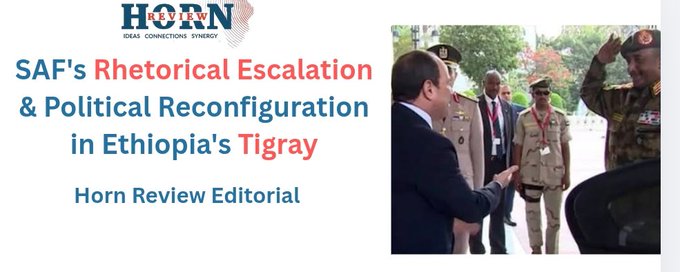
At the center of Sudan’s evolving posture is General Abdel Fattah al-Burhan and the Sudanese Armed Forces (SAF), whose role in the ongoing civil war has increasingly been interpreted in regional discourse as extending beyond internal conflict management into broader regional strategic maneuvering. Burhan has been repeatedly alleged to have engaged in patterns of external alignment and proxy facilitation that intersect with Ethiopian internal security dynamics – allowing Sudanese territory, at various points, to function as a convergence space for multiple armed actors and insurgents operating inside Ethiopia, including factions associated with Fano formations, elements described as remnants or reorganized components of Tigrayan armed structures also referred to as “TPLF army 70”, and smaller insurgent-linked groups including OLA and Gumuz-related dissident elements. Burhan’s SAF have also reportedly engaged in providing support, facilitation, and logistical enablement to some of these groups, while some of such actors are being used in a mercenary-like capacity in Sudan within broader regional bargaining dynamics.
Intelligence backed reports also asserted that al-Buhran has repeatedly hosted and facilitated meetings involving radical ethno-nationalist Ethiopian diaspora political figures, Fano-linked representatives, TPLF-associated elements, and other dissident actors under varying circumstances. Such engagements occurred with the presence and full awareness of external regional stakeholders, including Egyptian and Eritrean officials. In parallel, Eritrea’s Isaias Afwerki is part of an informal regional alignment alongside SAF’s and Egypt’s Abdel Fattah El-Sisi’s strategic interests. Eritrean intelligence structures play a coordinating and enabling role in shaping cross-border security dynamics involving Ethiopia, particularly in relation to armed and political actors operating in borderland or contested regions.
Egypt’s role in this regional configuration, beyond its numerous covert operations aimed at strategically suffocating Ethiopia, is reflected most clearly in its official diplomatic statement following the alleged drone attack on Khartoum International Airport. In that statement, issued from Cairo on 5 May 2026, Egypt strongly condemned the targeting of civilian infrastructure in Sudan, characterizing it as a violation of Sudanese sovereignty and a destabilizing escalation. It further expressed concern regarding attacks reportedly originating from the territory of a neighboring country, i.e. Ethiopia, a formulation that deliberately avoids explicit attribution while expanding the perceived geographic scope of the conflict. Egypt also warned that such developments risk broadening the conflict and undermining ongoing mediation efforts under the Jeddah platform, while reaffirming its rejection of external interference in Sudan’s internal affairs and emphasizing Sudan’s unity, sovereignty, and territorial integrity.
This diplomatic posture is in tension with Egypt’s broader regional security behavior, including its past military engagement in Sudanese theatres during periods of heightened RSF–SAF escalation. Within this interpretive frame, observers point to an apparent dissonance between Egypt’s public emphasis on sovereignty and de-escalation and its more assertive security role in Sudan’s evolving conflict landscape, a contrast that has fueled accusations of double standards in regional discourse. It sits uneasily with its sustained strategic alignment with the Sudanese Armed Forces – to the extent of conducting air operations and strikes against the RSF just recently – and also with its broader security interests in Sudan’s political trajectory, creating a perceived inconsistency between its principled diplomatic language on non-interference and its historically close military and intelligence cooperation with one of the main belligerents in the conflict. Rather, the Egyptian statement reinforces a broader triadic perception of alignment involving Egypt, Sudanese military leadership under Burhan, and Eritrean regime under Isaias Afwerki – where Ethiopia is frequently positioned as the central reference point around which their security anxieties and strategic calculations are organized, particularly in relation to internal instability and border security dynamics.
In addition, the asymmetry in the visibility and intensity of responses from Egyptian aligned regional institutions, particularly the Arab League, across different phases of the Sudan conflict – including the current one, have at times appeared more robust in moments that align with certain diplomatic narratives favoring Egypt, while remaining comparatively muted or non-committal during earlier periods of heightened military escalation involving Egypt itself and other actors in Sudan’s internal war. Such patterns are not just formal bias, but also evidence of the long asserted structural influence of dominant regional stakeholders within multilateral Arab diplomatic frameworks, contributing to perceptions of uneven enforcement of sovereignty and non-interference norms across different phases of the Sudanese conflict or any development in the Horn of Africa for that matter.
While the Eritrean government remains deliberately muted in its public diplomatic posture, internal political developments in Ethiopia’s Tigray region have added further complexity to the broader regional diplomatic environment in which Sudan and Egypt’s positioning toward Ethiopia is being interpreted. Following the Pretoria Agreement for the cessation of hostilities in 2022, Tigray has experienced significant internal political reconfiguration, including restructuring of interim governance arrangements and renewed elite competition within the regional political order. This process has been marked by tensions between successive interim administrations, including the transition from the initial post-Pretoria Interim Regional Administration led by Getachew Reda, and subsequent leadership changes associated with General Tadesse Worede, whose appointment by the federal government formed part of ongoing efforts to stabilize transitional governance structures. These evolving dynamics are further complicated by emerging informal alignments involving TPLF splinter elements and the Eritrean regime, the “Tsimdo Alliance” – that led to not just the opening of borders but also the cross-border movement and illicit transactional exchanges occurring through Ethiopia-Eritrea border frontiers – without formal federal authorization of course. Today’s reassertion of competing political factions within the Tigray People’s Liberation Front (TPLF), including the consolidation of leadership structures under Debretsion Gebremichael, is the extension of this renewed phase of internal political centralization within the organization. In parallel, the reactivation of TPLF-affiliated institutional frameworks in Tigray raises unresolved questions regarding the interpretation of transitional governance arrangements established under the Pretoria framework. Collectively, these internal developments contribute to a broader environment of political fluidity in northern Ethiopia, which in turn intersects with regional security narratives involving Sudan, Egypt, and Eritrea, where Ethiopia’s domestic political tensions and transitions are increasingly read through a wider geopolitical lens.
Within this broader context, the convergence of SAF’s allegation, El-Sisi’s diplomatic signaling, Afeworki’s strategic opportunism, and TPLF’s internal political restructuring reflects a loosely coordinated and mutually reinforcing regional dynamic. Al-Burhan is operating within a shifting alliance environment in which Sudan functions as a platform for regional bargaining, while Ethiopian armed opposition actors – including Fano-linked forces, TPLF-associated remnants, and other localized insurgent groups – are indirectly engaged within overlapping regional political and security spaces – as Ethiopia stands weeks ahead of its 7th National Election – a period of heightened strategic vulnerability, potentially influencing timing considerations in regional political maneuvering. According to reports attributed to security sources, a meeting was reportedly held in Khartoum in recent days involving a range of Ethiopian opposition figures and armed political actors. These accounts allege that representatives linked to the Amhara Fano movement, including an individual identified as Zemene Kassaie, participated alongside figures described as affiliated with the Tigray People’s Liberation Front (TPLF) and the Oromo Liberation Army (OLA), within the framework of an initiative presented as a broader opposition convergence platform. The same reports further suggest that opposition figure Andargachew Tsige, speaking remotely from London, addressed the gathering online in his capacity as an independent political opponent of the Ethiopian government following his departure from earlier opposition structures in 2022. In addition, the intelligence accounts claim that representatives associated with Sudanese and Eritrean security establishments were present at the proceedings, and that Eritrea’s ambassador to Sudan, Issa Ahmed Issa, made a notable public appearance in Khartoum amid the ongoing conflict environment. Separately, an additional intelligence account asserts the observation of armed Fano-linked groups operating in the broader al-Fashqa region near the Atbara River, allegedly engaged in armed confrontation with Ethiopian government forces.
From the Ethiopian government’s perspective, as articulated in the Ministry of Foreign Affairs’ official communications, a contrasting narrative is consistently advanced. Its framing emphasizes Ethiopia’s exercise of restraint in relation to Sudan’s internal conflict, repeated diplomatic engagement aimed at de-escalation, and a commitment to non-interference in Sudanese internal affairs. Ethiopian positions also stress that prior notifications and warnings were communicated to Sudanese counterparts regarding the risks of provocation and regional escalation, while maintaining that Ethiopia has sought to preserve fraternal relations with Sudan despite mounting tensions and competing regional narratives.
All that noted, these overlapping and often contradictory narratives reflect a broader structural condition within the Horn of Africa security environment, in which internal conflicts, external diplomatic positioning, and contested attribution claims increasingly interact within a tightly coupled informational system. Within this system, simultaneity across Sudan’s civil war dynamics, Ethiopia’s internal political restructuring in Tigray, and shifting regional alignments involving Egypt and Eritrea is an evidence of strategic convergence. One way or another, the contemporary Horn of Africa landscape is defined not only by material conflict and political transformation, but also by the intensification of narrative and rhetoric among regional and international actors.
In this environment, attribution itself becomes a central arena of geopolitical contestation, where allegations, diplomatic ambiguity, and strategic framing shape perceptions of reality as much as – if not more than – verified developments on the ground, thereby creating the conditions under which narratives can later be mobilized to manufacture consent and legitimize actions that might otherwise lack sufficient justification.
By Horn Review Editorial

RELATED
Posts
7
Sep
Abiy Ahmed and the Remaking of the Ethiopian State
Blen Mamo
The political trajectory of Abiy Ahmed cannot be adequately...
3
Sep
Is Ethiopia Ready for a Presidential System?
By Blen Mamo
Ethiopia has spent much of its modern political...
28
Aug
Ethiopia-U.S. Strategic Defense Partnership
The recalibration of United States–Ethiopia relations recently reflects a deeper...
20
Aug
Eritrea’s Buffer Zone Politics from Eastern Sudan to Ethiopia's Tigray
The most consequential development in the Horn of Africa may...
14
Aug
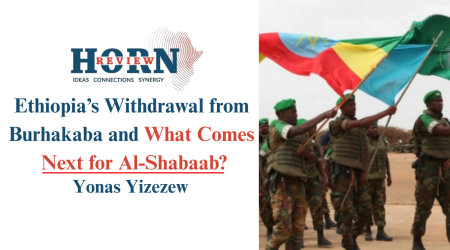
Ethiopia’s Withdrawal from Burhakaba and What Comes Next for Al-Shabaab?
The recent handover of the Burhakaba forward operating base...
13
Aug
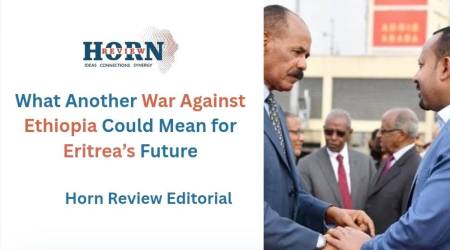
What Another War Against Ethiopia Could Mean for Eritrea’s Future
Another Ethiopia–Eritrea war would not be a replay of 1998....