Bravado, aggressive warlike rhetoric, a fear of peace, and self-aggrandizing claims to be the sole arbiter of Tigray’s future have become defining traits of the rump Tigray People’s Liberation Front (TPLF). A once-venerated political organization, the TPLF now projects insecurity through unsettling belligerence, as though confrontation were the organization’s sole language. Having failed to adapt to the demands of postwar recovery, pluralistic politics, and democratic governance, the TPLF leadership remains trapped in the habits of militarized politics and an unsettling sense of entitlement – fatal flaws that continue to exact a steep price from the people of Tigray.
Recent remarks by Adisalem Balema, a member of the TPLF Central Committee, are a case in point. In a recorded audio of a briefing to Tigrayans in the diaspora, he made a number of alarming claims that confirmed the TPLF’s casual adventurism. Adisalem boasts of the fact that Tigray is no longer politically and strategically isolated, and that it has cultivated alliances of convenience with armed domestic groups and external actors, including the Eritrean regime, in its confrontation with the Ethiopian federal government. He also asserted that, although the TPLF has shown “restraint” for the sake of peace, it has now finalized preparations with its allies for a militarized route. Furthermore, he claimed that the Sudanese government has allowed “us” access through Sudanese ports and logistical channels. Needless to say, these are reckless claims tantamount to open political provocation at a moment when concerted efforts towards peaceful solutions are desperately needed.
Adisalem’s recorded assertions, whose authenticity was corroborated by himself, reflect a pathological instinct on the part of the old guard TPLF leadership: when confronted with political uncertainty, organizational fragmentation, and the demands of give and take, it reverts to the only language it has command of: militarized confrontation. Instead of crafting policies that improve the lives of ordinary Tigrayans, the TPLF leadership continues to invoke the specter of war, as if war were a source of legitimacy, not unmitigated disaster. Such an instinct doesn’t demonstrate organizational prowess; rather, it is unmistakable evidence of political bankruptcy.
Those of us who have been in positions of responsibility understand the destructive consequences of such rhetoric. What Tigray needs is peace, not tired slogans; reconstruction, not the usual overinflated bravado; and stability, not fantasies of favorable domestic and foreign alliances.
To speak casually of preparations for war is to trivialize the immense sacrifices paid by the people of Tigray. Adisalem’s rhetoric, representing the rump party’s consensus of sorts, is decidedly far from strategic sophistication. Rather, it signals a dangerous adventurism, the consequences of which will be borne by the people of Tigray. Tigray cannot live in peace, much less rebuild, while the TPLF continues to normalize the language of militarized conflict and wallow in fantasies of shifting alliances, as if the suffering of the last war taught them nothing.
The political symbolism of such talk coming from Adisalem is also too glaring to miss. Adisalem’s freedom was secured through the Pretoria Agreement, a peace accord he and his comrades have pronounced dead. Pretoria created the conditions for prisoners to be released, services to resume, and political space to reopen. Above all, it silenced the guns. Although significant issues, such as the return of IDPs and the restoration of Tigray’s territories remain unresolved, Pretoria laid the framework for their eventual resolution based on the FDRE constitution. Instead of intensifying efforts towards lasting peace, the TPLF leadership is now beating the drums of war.
Let us be frank: another war would not empower or rehabilitate Tigray; it would ruin it. The brunt of the destruction would be borne, as before, by the youth of Tigray. It would also make Tigray a ghost region, with its socioeconomic foundation even more decimated than before, reducing our people to perpetual dependence and long-term physical and psychological trauma.
Those who fantasize about political abstractions, such as shifting alliances and battlefield leverage, rarely account for the one constant in war: the parents who bury their children, the farmers who lose their harvests, and the generations of children who know nothing other than conflict and strife. There is no doubt in my mind that Tigray’s future lies not in opportunistic and highly destructive arrangements with domestic and foreign actors pursuing their own interests, but in long overdue reconstruction, peaceful politics, and constructive engagement with the federal government. Anyone who truly cares for our people must unequivocally reject the deceptively seductive allure of war once and for all. Adisalem and his colleagues must retire the drums of war and embark on the more honorable path of healing a wounded society and a shattered region.
Unfortunately though, the most recent developments only seem to prove once again that these so-called leaders are terminally uninformed.
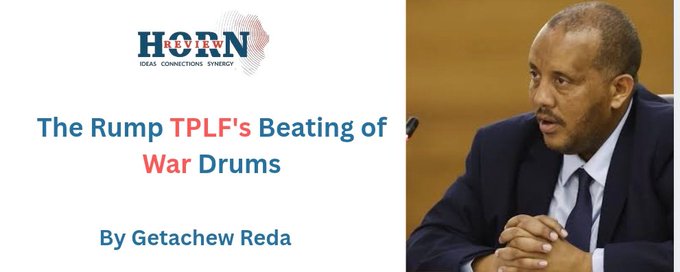
By Getachew Reda