
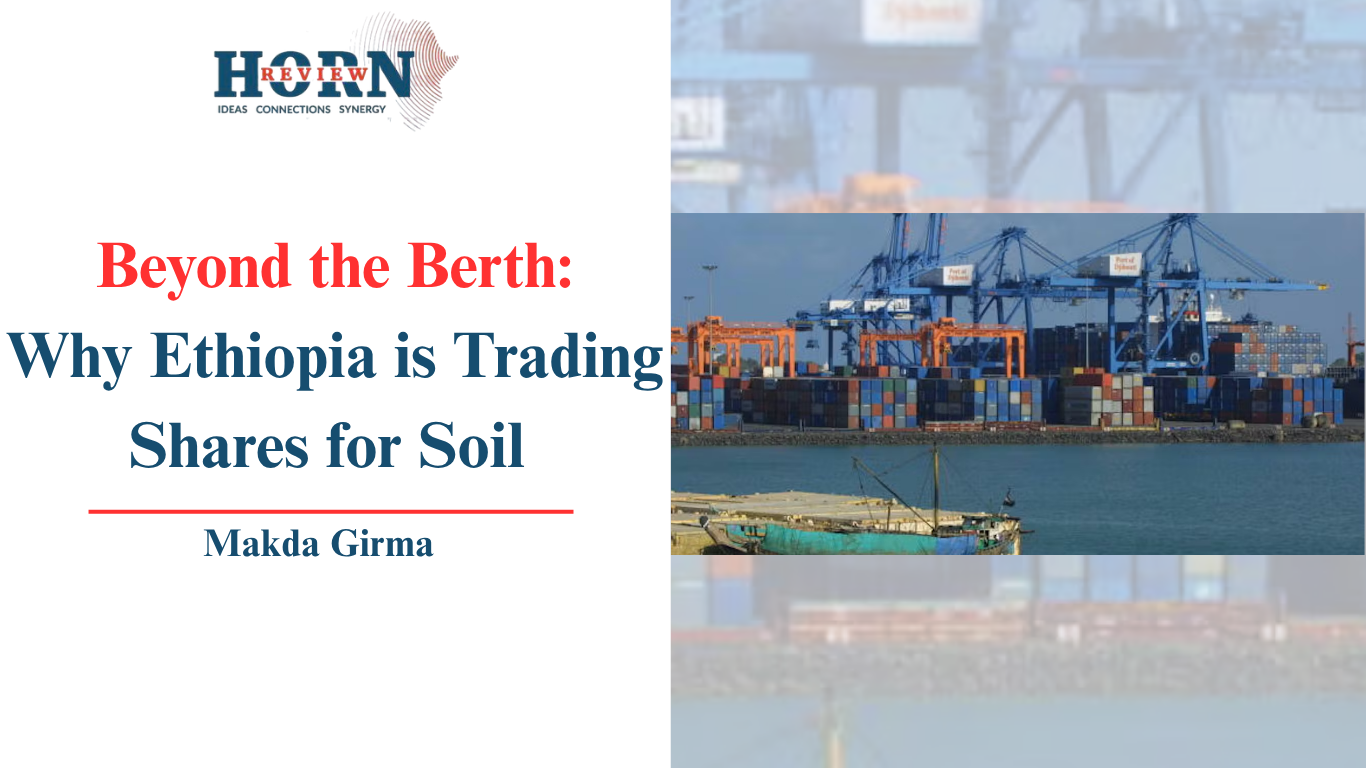
Beyond the Berth: Why Ethiopia is Trading Shares for Soil
When news broke on April 11, 2026, that Ethiopia had turned down a 60 percent stake in Djibouti’s Port of Tadjoura, it sent a clear jolt through the region’s logistics circles. At first glance the move looked almost reckless for a country that has spent decades chained to foreign harbors. After all, why walk away from majority ownership in a port literally engineered to carry its northern freight? But this was no knee-jerk reaction. It quietly closed the book on an old bargain, the so-called equity model, that Ethiopia once treated as the only realistic lifeline for a landlocked giant. For years the Djibouti-Ethiopia axis stood out as a shining example of African cooperation: a Chinese-backed railway humming between the two capitals, streamlined customs, and Djibouti ports moving more than 95 percent of Ethiopia’s trade. Stability came with the package, yet permanence never did. What Addis Ababa is signaling now is something bigger. It is stepping past the old habit of buying pieces of someone else’s dock and embracing a fresh Corridor Doctrine, one that demands real sovereign guarantees over the very arteries that keep its economy breathing.
The reasons for walking away from Tadjoura cut straight to why a simple majority no longer cuts it. Even with controlling ownership, Ethiopia would still answer to Djibouti on customs rules, labor laws, environmental standards, and how disputes get settled. A big shareholder can nudge boardroom choices, but it cannot stop a host government from slapping on new fees, rerouting berths in a crisis, or bending to local politics when dockworkers walk out. In plain terms, Ethiopia would keep renting its windpipe from a neighbor whose budget depends on squeezing every possible dollar from transit traffic. A population now well over 120 million and an economy that has posted strong growth despite its geography simply cannot treat its sea access like some flexible business deal. The annual bill for Djibouti port services and logistics already runs between $1.5 billion and $2 billion, quietly inflating import prices and shaving the edge off exports. Logistics costs eat up 20 to 30 percent of product value, far above world norms, turning what ought to be routine supply chains into a built-in brake on development.
Yet those big external numbers hide an even tougher internal ceiling that no corridor can smash on its own: the iron grip of the Ethiopian Shipping and Logistics Services Enterprise, known as ESLSE. This state-owned behemoth has long dominated every link in the chain, trucking fleets, freight forwarding, dry ports, and final delivery, leaving almost no room for genuine private competition, local or foreign. Some voices in Addis Ababa and beyond quietly argue that the whole Corridor Doctrine serves partly to protect this monopoly. By claiming administrative control over the corridor’s “soil,” the government can make sure ESLSE keeps priority on every container rolling through Ethiopian territory. Global players like Maersk or DHL might set up terminals elsewhere, but inside a sovereign zone they would still have to route through the state network. The danger is clear: even if the foreign landlord’s veto vanishes, the home-grown monopoly could keep costs stubbornly high, dressing up old inefficiencies in the language of national security. In this view the push for corridors is not just about escaping Djibouti’s reach; it is also about locking down the entire supply chain under state oversight. Unless ESLSE faces real liberalization or honest public-private deals, the Corridor Doctrine risks handing Ethiopia sovereign control without the lower costs it so badly needs.
Events at Doraleh Container Terminal in 2024 and 2025 brought these limits into sharp relief. Ethiopian factories watched shipment queues stretch longer and longer while multimodal operators ran into fresh layers of red tape. Despite years of joint planning and upgrades on the Addis-Djibouti railway, congestion kept choking raw-material deliveries to the new industrial parks. Vessels sat idle, assembly lines slowed, and just-in-time orders for textiles and food processing took hit after hit. These were not random glitches. They exposed a basic imbalance: Djibouti’s ports rely on Ethiopian cargo for 70 to 85 percent of their business, yet final say on operations stays firmly in Djiboutian hands. Whenever Gulf tensions or rival priorities pull ships elsewhere, Ethiopian goods end up fighting for space. Equity deals can line up interests on paper, but they cannot erase the landlord’s final word when national agendas start to clash.
That hard lesson has pushed Ethiopia toward a bolder idea: the sovereign corridor. At its heart the concept is simple but far-reaching. Instead of chasing partial ownership inside someone else’s port, Ethiopia now insists on defined zones where it can set its own rules, dedicated roads, rail lines, dry ports, and logistics hubs governed by its laws, its security, and its operational standards. A corridor is more than concrete and steel; it is a lasting territorial promise that access cannot be yanked away when a neighbor’s mood or alliances shift. The January 2024 memorandum with Somaliland shows exactly how this works in practice. In return for commercial and naval rights at Berbera and a slice of coastline, Ethiopia secured commitments that go well beyond ordinary port access to include long-term development guarantees. Addis made it plain: it will commit serious money and political weight only where such ironclad assurances are on the table. Rejecting the Tadjoura stake simply follows that same logic. Why accept 60 percent of a Djiboutian asset when a properly anchored corridor offers something far more durable?
The real force making the Somaliland option workable is one that rarely makes the headlines: the United Arab Emirates. Through its port giant DP World, Abu Dhabi has sunk hundreds of millions into Berbera, turning a sleepy fishing port into a modern deep-water gateway ready for Ethiopia’s northern traffic. The UAE’s fresh security guarantees in April 2026, formal defense and intelligence pacts, gave Addis the breathing room to say no to Tadjoura without worrying about immediate isolation. In strategic terms Ethiopia is handing much of the financing, construction, and maritime protection for its corridors to a distant power instead of a small neighbor. The uncomfortable question is whether one kind of dependence is simply swapping places with another. Djibouti’s leverage was close and geographic; the UAE’s is financial and geopolitical. Abu Dhabi gets a stronger Red Sea foothold, naval options that fit its broader Horn interests, and a growing economic partner in Ethiopia. For Addis the deal buys time and hardware, but it also plants a new outside player whose goals may not always match Ethiopia’s long-term independence. The Corridor Doctrine, seen this way, is not some purely homegrown bid for self-reliance; it rides on Gulf money and Gulf diplomacy.
Still, the doctrine collides head-on with a sovereignty dilemma that neighbors and continental bodies are only starting to face. What Ethiopia calls a vital necessity for national survival looks to others like a direct threat to their own borders. Djibouti, Eritrea, Somalia, and even South Sudan see any handover of administrative power over coastal or frontier zones as a dangerous precedent that could chip away at their integrity. They have turned to a legal defense in Article 125 of the United Nations Convention on the Law of the Sea. That clause gives landlocked countries a right of access to the sea, but only through “mutual agreement” with transit states and only by agreed means of transport. It says nothing about handing over administrative control or carving out sovereign corridors.
Eritrea and Somalia have leaned hard on this wording in diplomatic cables and African Union meetings, insisting that Ethiopia’s demands stretch beyond basic transit rights and test the very limits of the UNCLOS order. Addis Ababa counters that this is not a breach but an update: in today’s world of tightly woven supply chains and climate-stressed sea routes, mutual agreement has to grow into enforceable corridors if landlocked rights are to have real meaning. The clash is not theoretical. It shows up in rival infrastructure bids, energy pacts, and military moves all along the Red Sea coast. The African Union, bound by its charter to respect colonial-era borders, still lacks effective tools to referee these hybrid arrangements. What results is a zero-sum standoff, Ethiopia’s search for secure access versus its neighbors’ dread of setting precedents they cannot control.
Making matters tighter is the quiet counter-push coming from Cairo. Late in 2025 Egypt and Djibouti sealed a package of deals built around the Green Port Solar Project at Doraleh and wider energy ties. By helping Djibouti produce steady renewable power on its own soil, Egypt is steadily cutting the small country’s old reliance on Ethiopian electricity. The step looks modest, yet its strategic bite is sharp. Ethiopia’s hydropower surplus, boosted by the Grand Ethiopian Renaissance Dam, has quietly given Addis leverage in bilateral talks for years. Once Djibouti no longer needs that power, it gains freedom to push back harder against corridor demands without fearing blackouts. Cairo’s brand of green soft power is more than environmental goodwill; it is part of a wider effort to keep Ethiopia’s economic lifeline exposed. If Djibouti can break free of energy dependence, it can more easily stall the corridor talks. Ethiopia’s drive for sovereign guarantees has therefore become a race against the clock, securing commitments before its neighbors finish decoupling from its economic orbit.
The hazards of chasing this hard form of integration are serious and many-sided. Addis must juggle talks with Somaliland, keep pressure on Djibouti, and scout options in South Sudan or possibly Eritrea, all without sparking a united front of containment among its neighbors. Overstretch could drain diplomatic energy and military focus when internal calm is still a daily priority. On top of that, the approach sits awkwardly beside the African Continental Free Trade Area, which dreams of frictionless, borderless trade. By arguing that real security demands leased or re-administered corridors, Ethiopia quietly questions the AfCFTA’s faith that goodwill and common rules will be enough. In this perspective borders do not simply melt away; they sometimes need renegotiation or practical redrawing so that twenty-first-century trade can actually function. The gap in legitimacy is slim but politically explosive.
That pressure gains extra edge from Ethiopia’s southern fallback: the LAPSSET Corridor. Meant to connect Lamu Port in Kenya through South Sudan and into Ethiopia, LAPSSET would open a direct route to the Indian Ocean and finally shatter the northern chokehold. Costed at around $25 billion, the scheme has dragged on for more than ten years, held back by funding gaps, security worries in northern Kenya, and shifting national agendas. Yet its mere existence changes the math. The Tadjoura rejection carries more weight exactly because LAPSSET, though half-built, offers a credible Plan B. If the Red Sea corridors hit roadblocks, Ethiopia can turn south, even if it means higher upfront costs and longer waits. The southern track proves the Corridor Doctrine springs not from panic but from deliberate leverage: turning down second-best deals today because workable alternatives, however slow, sit on the horizon.
Everything still rests on whether Ethiopia can sell these corridors as zones of shared prosperity rather than slices of someone else’s land. Neighbors must see real upside, equity stakes in Ethiopia’s markets, joint financing for infrastructure, and security arrangements that strengthen rather than weaken their own sovereignty. None of this means Addis is slamming the door on cooperation. Quite the opposite. The Tadjoura decision rejects only the fragile sort of partnership that leaves the economy forever at the mercy of outside whims. By demanding corridors rooted in sovereign guarantees, Ethiopia is rewriting what it means to be landlocked in an age of great-power rivalry and climate-shaken supply lines.
The Red Sea has stopped being a far-off line on the map; it has become the ground under Ethiopia’s future expansion. Whether this turn brings a steadier Horn of Africa or a more splintered one will hinge on Addis Ababa’s skill in forging a grand bargain. That bargain must give Djibouti, Somaliland, and the rest concrete shares in Ethiopia’s demographic boom and industrial surge, returns far richer than port fees alone. It must show that sovereign corridors can live alongside genuine respect for territorial integrity. And it must persuade the African Union and wider partners that Ethiopia’s fresh take on landlocked strategy is not a danger to continental order but a necessary adjustment driven by raw geography, population pressure, and the cold realities of modern logistics.
The sovereignty pivot is Ethiopia’s blunt statement that it will no longer play the role of customer to the Red Sea. It aims instead to become a true shareholder of the soil, putting capital, administration, and defense into the corridors that carry its people’s hopes. The April 11 rejection of the Tadjoura stake did not end the conversation with Djibouti; it opened a tougher, more candid round of talks about the only kind of partnership that can last. For a nation of 120 million determined to claim its spot in the global economy, half-measures of access are no access at all. Only genuine sovereign command over its economic lifelines, balanced by domestic reform and clear-eyed alliances, can turn geography from a curse into a lasting edge. The years ahead will show whether Ethiopia’s Corridor Doctrine can deliver that edge without tearing apart the very region it hopes to lead. The prize, counted in billions of dollars saved each year and in the daily livelihoods of millions who rely on steady trade, could hardly be larger.
By Makda Girma, Researcher, Horn Review

RELATED
Posts
12
Oct
Ethiopia or Eritrea, Who Is the Aggressor?
Eritrea has answered, in kind, a letter that Ethiopia...

9
Oct
Eritrea’s Post-Pretoria Strategy and the Escalation in Ethiopia
Our latest report examines Eritrea’s post-Pretoria trajectory and how selective...
8
Oct
After Years of Turnover, Ethiopia Chooses Continuity in Its Foreign Ministry
Abiy Ahmed’s decision to retain Gedion Timothewos as foreign minister...
8
Oct
Ethiopia’s Northern Crisis: Actors, Interests and the Anatomy of Escalation
Our latest report, examines the renewed conflict in northern Ethiopia...
7
Oct
“Decaffeinated Sovereignty”: Eritrea’s One-Way Street with Ethiopia
There is a peculiar contradiction at the heart of Eritrea’s...
7
Oct
Leaked Documents Allege Sudanese Army Weapons Pipeline to TPLF-Aligned Forces as Tigray War Reignites
Leaked documents alleging a Sudanese army weapons pipeline to TPLF-aligned...

7
Oct
Eritrea Has Officially Invaded Ethiopia, Says Government Communication
Ethiopian Government Formally Condemns Eritrean Territorial Incursion as Its Forces...
7
Oct
The Northern Ethiopian Crisis has Surpassed the Intra-State Conflict Threshold, Inter-State War is Inevitable
The Eritrean regime and its newly allied TPLF hardliners share...

6
Oct
What Abiy Ahmed’s Parliamentary Address Says About Ethiopia’s Next Five Years
In his reappointment to the premiership, Abiy Ahmed offered a...

5
Oct
Egypt Displays Its Anti-Addis Coalition as Ethiopia Gains Against Rebels. What Comes Next?
Egypt's strategy of cultivating relationships around its chief rival in...