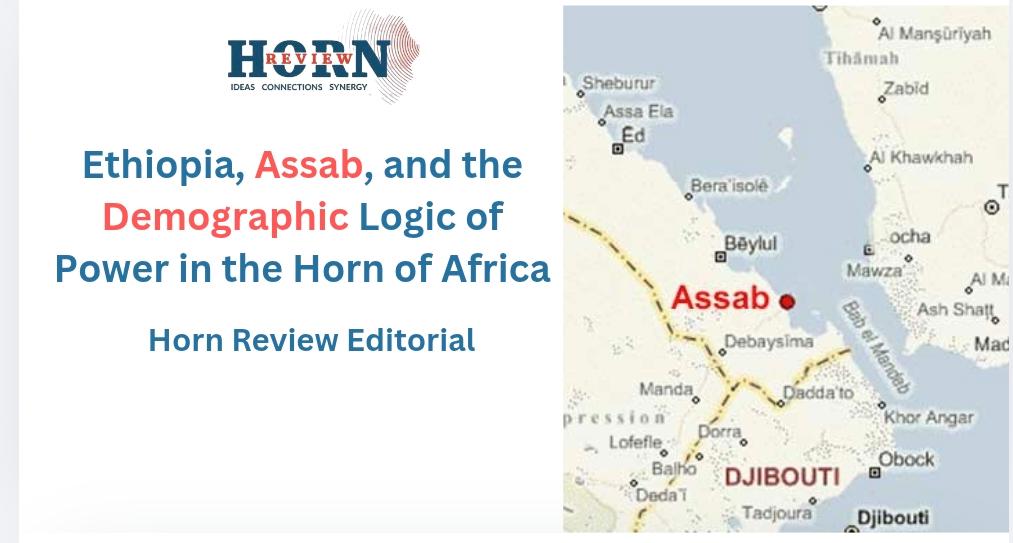
The question of Assab, the Red Sea port city, has increasingly been framed in Ethiopian discourse through the language of access, sovereignty, and regional integration. Yet beneath these familiar categories lies a quieter and more consequential analytical dimension: the demographic. For Ethiopia, a state defined by demographic integration with its neighbours, the structural pressures generated by population scale naturally shape its economic and geographic orientation. For Eritrea, whose governing system is anchored in rigid control and demographic containment, such pressures are not interpreted as benign spillovers but as potential sources of systemic vulnerability. A serious analytical treatment of a potential Ethiopian demographic approach to Assab must therefore proceed not only from abstract models of economic interdependence, but from a granular understanding of how demographic presence is interpreted within the political psychology of the Eritrean state.
At a conceptual level, demography is not merely a matter of population size or movement; it is a vector of influence, a carrier of norms, and, in the eyes of highly securitized political systems, a latent instrument of political transformation. It is therefore necessary to situate the question of Assab within its historical trajectory. Prior to Eritrean secession, the city functioned less as a bounded national space than as an extension of Ethiopia’s coastal interface, with a population composition shaped by longstanding patterns of labor mobility, administration, and commercial exchange. The consolidation of control by the Eritrean People’s Liberation Front initiated a deliberate reordering of this demographic landscape. Displacement and out-migration of populations associated with Ethiopian state structures and economic networks occurred in successive phases – during the transition to de facto control in 1991, more systematically following formal secession in 1993, and again in the lead-up to the 1998 Ethiopian-Eritrean War. This process was not incidental but constitutive: it reflected an effort to align territory, population, and sovereignty within a tightly defined national framework. As a result, contemporary perceptions of demographic presence are filtered through a historical experience in which population composition was actively securitized, rendering any possibility of renewed Ethiopian demographic footprint – however economically framed – susceptible to interpretation as a reversal of that foundational restructuring.
While Ethiopia’s demographic weight – its labor surplus, internal mobility, and expanding urban-industrial base generates outward economic pressure – which in most regional settings would be absorbed through migration, cross-border trade, and settlement patterns that gradually knit adjacent economies together – Assab is unfortunately not embedded in such a permissive environment. It is governed by a system whose historical experience and institutional structure produce a highly securitized decision-making logic in which external exposure – military, economic, or demographic – may be assessed through worst-case assumptions, even when the material incentives point toward integration and efficiency. Hence, the Eritrean state’s posture toward demography is inseparable from its broader architecture of control. The legacy of the liberation struggle, followed by decades of largely self-imposed isolation and over-militarization, has produced a governing ethos in which sovereignty is not a legal abstraction but an unreasonably and continuously guarded condition. Within this framework, population flows are not neutral. They are read as potential conduits of disorder, carriers of alternative political imaginaries, and precursors to dilution of centralized authority. The persistence of indefinite national service, the restriction of internal movement while encouraging outward immigration, and the broader closure of the social space reflect a system that systematically conflates mobility with vulnerability, leading even low-risk or economically beneficial interactions to be treated as potential vectors of destabilization. This does not suggest just the absence of strategic logic, but rather the presence of a constrained form of rationality in which regime preservation consistently overrides economic efficiency, producing outcomes that diverge from conventional cost–benefit expectations.
However, this does not imply that demography is irrelevant to Ethiopia’s strategic calculus regarding any possible bilateral negotiations or rather different strategic operations on Assab. On the contrary, it suggests that in a hypothetical analytical framework where the Eritrean regime is open to transactional diplomacy, the demographic dimension must be reconceptualized. Direct approaches – settlement schemes, permanent labor migration, or large-scale civilian presence tied to port operations – would in such a framework be analytically significant precisely because they collapse the distinction between economic cooperation and political encroachment in the eyes of Eritrean decision-makers. What may appear in Addis Ababa as a rational extension of economic geography could be received in Asmara as a potential precursor to the erosion of sovereignty. The asymmetry here is not one of information, but of interpretation. This interpretive gap becomes particularly visible when examining brief moments of attempted normalization in the post-2018 period.
A brief reopening of this analytical question occurred in the post-2018 rapprochement between Ethiopia and Eritrea, when improved diplomatic relations between Addis Ababa and Asmara temporarily reintroduced Assab into technical and infrastructural discussions. In this period, exploratory planning around transport corridors and maritime diversification included consideration of Assab as part of a broader Red Sea access strategy. Ethiopian institutions proceeded with preliminary steps toward infrastructure alignment and logistical preparation, reflecting an expectation that improved political relations could translate into operational economic coordination. However, as the initial momentum of rapprochement gave way to a more cautious and selectively defined phase of engagement by the Eritrean leadership, the trajectory of cooperation became less linear. Divergences in sequencing, scope, and interpretation of infrastructure priorities contributed to a gradual deceleration of coordinated activity, and elements of the early logistical agenda were effectively placed in abeyance as broader political recalibration reshaped the parameters of implementation.
A more sophisticated analytical approach begins by disaggregating demographic influence from demographic visibility. Ethiopia’s advantage lies less in the physical projection of population across borders than in its capacity, in theory, to generate what might be termed demographic gravity: the structuring of economic and social environments in ways that pull adjacent spaces into its orbit without necessitating overt population transfer. In the case of Assab, this implies a framework in which influence operates primarily through spatial and infrastructural reconfiguration rather than demographic relocation. Such a framework would begin from the Ethiopian side of the border, particularly the Afar regions contiguous with Assab. Concentrated infrastructure investment, industrial activity, and logistical development in these areas would create a dense economic hinterland whose natural orientation is toward the Red Sea. Roads, rail links, energy corridors, and dry ports directed toward Assab would not alter sovereignty, but they would reshape regional economic geometry. Over time, Assab would increasingly appear not as an isolated territorial asset, but as the most efficient maritime interface for a structurally expanding Ethiopian economic periphery.
Within this model, the demographic component lies in internal redistribution and spatial concentration rather than cross-border movement. Encouraging settlement, employment, and urbanization in border-adjacent zones externalizes demographic pressure without crossing political boundaries. Population remains within Ethiopian jurisdiction, but its economic orientation becomes outward-facing. This produces a situation in which the viability of Assab as a port becomes functionally linked to Ethiopian demand systems, labor flows, and logistical networks, even in the absence of any formal Ethiopian demographic presence within the city itself.
Where cross-border movement becomes relevant in such a framework, it would be structured in tightly regulated, temporary, and functional forms. Rotational labor arrangements focused on technical or operational roles would serve economic efficiency while maintaining clear separation from permanent settlement dynamics. The analytical distinction here lies between functional participation in economic systems and the formation of enduring demographic communities.
The cross-border Afar population presents both an opportunity and a constraint within this analytical landscape. Shared identity across the Ethiopia–Eritrea–Djibouti triangle could facilitate forms of localized economic interaction, yet it also intersects with sensitivities surrounding territorial integrity and political cohesion. Accordingly, any demographic framework that foregrounds identity as a political instrument would likely generate resistance, whereas approaches centered on livelihoods, trade, and service provision without politicization would be more stable. Underlying all of these considerations is a temporal dimension that favors gradualism. Ethiopia’s demographic and economic trajectory continues to evolve in ways that increasingly emphasize regional connectivity over time. This does not imply immediacy, but rather structural directionality: long-term population growth and economic expansion gradually reshape spatial and infrastructural priorities.
The most coherent way to approach the demographic dimension of Assab is therefore not through immediate policy prescription, but through structural analysis. The port’s significance is shaped less by short-term political intent than by the long-run interaction between demography, infrastructure, and geography. In this sense, Assab becomes analytically relevant not as an object of action, but as a lens through which broader regional dynamics of economic integration and demographic evolution can be understood.
By Horn Review Editorial