While international discourse continues to emphasize the importance of concepts such as sovereignty, territorial integrity, and non-interference, their implementation has become increasingly inconsistent and subject more to questions of power rather than universal principles.
This transformation has unfolded gradually. The annexation of Crimea marked a critical inflection point, demonstrating that territorial revisionism through force remains viable in the 21st century. This possibility was reinforced during China’s increasing control of the South China Sea, as incremental actions outpaced the ability of international legal mechanisms to respond.
The protracted Russo-Ukrainian War serves as, yet another indicator of the ongoing changes in the global international system. What began with Russia’s annexation of Crimea in 2014 evolved into a full-scale war in 2022, becoming the largest interstate conflict in Europe since World War II and illustrating the return of prolonged, high-intensity warfare to the center of international politics. More recently, the confrontation between Iran, Israel, and the United States illustrated a decisive shift in the logic of international order. Rather than mediation or institutional arbitration, the conflict was governed by deterrence, escalation control, and the calibrated use of force. In this emerging environment, stability is no longer produced by rules, but by the balance of risk and retaliation.
Therefore, the ongoing processes cannot be considered signs of the demise of the global international order. Instead, it is safe to claim that the latter undergoes a fundamental change as liberal expectations are being challenged by realist principles.
As for the former post-1991 international order, it rested on the basis of liberal assumptions, according to which economic interdependence would lead to a decrease in conflicts, while international institutions and law would serve as effective mediators. Over the course of the last decade, these assumptions have proved to be unrealistic.
Theoretically, the ongoing evolution can be considered as a natural outcome of structural realism theory because it implies the existence of the anarchical nature of international order, with states being rational agents of self-interest. Thus, while norms play an important role in the international system, they depend heavily on the distribution of power.
These implications are significant as sovereignty ceases to serve as an absolute guarantee, becoming a negotiation in light of state geopolitical significance. Within this context, international law retains procedural relevance even as its implementation becomes selective and partial. Multilateralism persists and is often employed as a tool of influence as much as an instrument of governance. For strategically competitive regions, like the Horn, the shift moves from theoretical discussion to practical implementation.
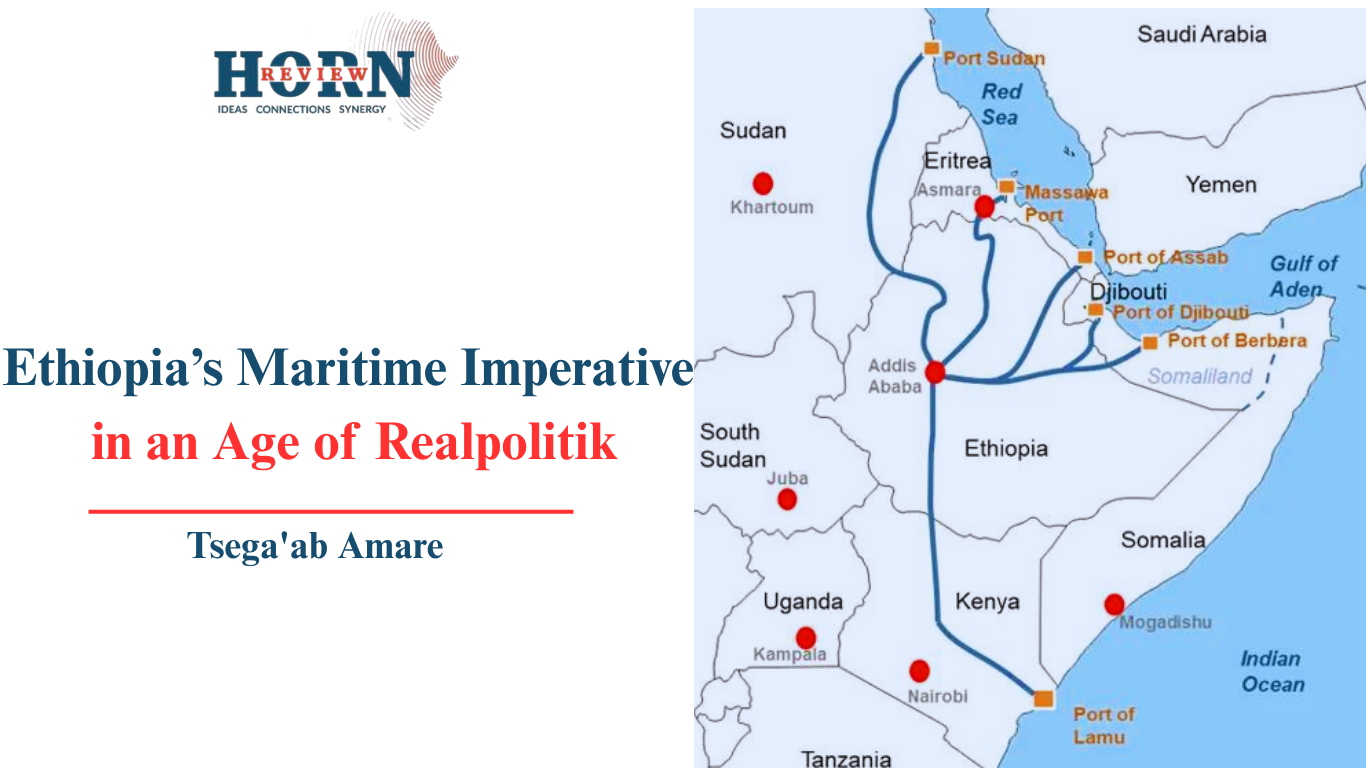
The convergence of the new international environment and Ethiopia’s position as a landlocked country results in a complicated structural problem. With the loss of maritime access following the separation of Eritrea, the heavy reliance of Ethiopia on other countries’ corridors for trade and commerce has grown from a logistical necessity to a key strategic and national security concern.
As one of the world’s most populous landlocked states, with a demographic trajectory expected to surpass 150 million within a decade, Ethiopia faces a deep-seated structural vulnerability. Its economic trajectory, trade efficiency, and national security are inherently contingent on external actors and regional stability. In a liberal order, such interdependence might be mitigated through institutional guarantees and cooperative regimes. In a realist environment, dependence translates into leverage and vulnerability into risk.
The transition toward a global climate of realpolitik significantly intensifies Ethiopia’s maritime dilemma. As the power shifts toward zero-sum competition, Ethiopia’s lack of direct sea access has moved from a logistical hurdle to a strategic vulnerability. While neighboring states have characterized Ethiopia’s landlocked status as a mere economic inconvenience, these geopolitical pressures have transformed it into a profound strategic liability. This shift underscores the legitimacy of Ethiopia’s persistent diplomatic stance of treating a sovereign maritime access as a core national security issue that is structural for the survival of more than 130 million people, reflecting the geopolitical significance of its dependence on external corridors.
At the same time, the newly established global political order allows Ethiopia to navigate this problem strategically. The relaxation of the rigid hierarchy provides opportunities to expand the scope of its strategic partnership to attract other external actors. With a proper strategy, Ethiopia can become an indispensable piece of geopolitics in the Red Sea and the larger region, leveraging its position to mitigate its dependency and increase strategic freedom.
On the other hand, this same environment heightens the risk of regional securitization. As global and regional powers deepen their presence in the Red Sea corridor, local disputes risk becoming entangled in broader geopolitical rivalries. In such a setting, efforts to secure maritime access, if not carefully structured, could intensify tensions rather than alleviate constraints.
To move through this contradiction calls for a strategy that is simultaneously assertive and moderate. To create a durable and sustainable strategy, three main pillars can be looked at; First, Ethiopia needs to diversify access corridors in order to avoid putting all its eggs in one basket. Second, maritime access in the region should be presented as a common economic opportunity rather than Ethiopian unilateralism. Third, legal and diplomatic instruments should be stacked up to provide necessary guarantees for each of the strategically important projects that would be proposed and implemented by Ethiopia.
Operationalizing such a strategy requires a shift in approach. Rather than pursuing broad regional consensus, which remains elusive in a fragmented geopolitical landscape, Ethiopia should prioritize targeted, issue-specific arrangements. Flexible partnerships with littoral states and external stakeholders can deliver tangible outcomes where larger multilateral frameworks have struggled.
Ethiopia also possesses strategic assets that can be leveraged to support this approach, national Airline, expanding telecommunications sector, large consumer market and the existence of great potential regarding energy considering the inauguration of the Grand Ethiopian Renaissance Dam, constituting significant sources of bargaining power. This should form the basis of the broader strategy of maritime statecraft, based on the connection of access with co-financing and equity ownership of infrastructure projects.
In this regard, the issue of the Assab port can be considered as an example. While Ethiopia’s current phase of political and economic development has demonstrated a readiness to establish itself as a state willing to enter into diversification and cooperative access agreements of varying types, ranging from corridor projects to port operations, the reaction of the Eritrean side however is more cautious, if not resistant, especially in cases where there is some implication of sharing access and common usage of infrastructure. Despite all this, Ethiopia’s diplomatic signaling, combined with its expanding economic and demographic weight, indicates that the question is unlikely to recede. Rather, it is being incrementally repositioned within a broader regional calculus shaped by connectivity, trade flows, and external interest.
The trajectory of the current international order offers a quiet but consequential warning for the Horn of Africa. The longer viable options will not be realized, the higher the probability that shifting geopolitical forces will impose outcomes rather than negotiating them. In an era where power increasingly precedes principle, unresolved structural issues and questions will not just dissipate; they will transform according to changes in the balance of interests and opportunities.
The absence of deliberate, cooperative frameworks today increases the probability that future alignments will emerge under less favorable and less predictable conditions. In this sense, the region stands at a narrowing strategic window, one where the choice is no longer between action and inaction, but between shaping the terms of integration or adapting to them once they have already been set.
By Tsega’ab Amare, Researcher, Horn Review