Strategic depth has long served as a cornerstone of military and geopolitical thinking, referring to the geographical, logistical, and operational space that allows a state to absorb enemy advances, regroup, and mount effective countermeasures before its core interests face existential threats. In traditional warfare, this concept drew heavily from terrain advantages vast plains or mountain barriers that bought time for mobilization as Russia exploited against Hitler and Napoleon, or the United States leveraged its oceans to deter continental threats. Classical theorists like Carl von Clausewitz implicitly wove it into discussions of defensive depth, where space translated directly into decision-making latitude, enabling commanders to trade territory for tactical breathing room.
Ahmet Davutoğlu elevated the idea into a proactive doctrine in his influential 2001 book Strategic Depth, arguing that Turkey’s Ottoman heritage and central Eurasian position granted it multilayered historical and geographic buffers to project power across multiple regions without overextension. Davutoğlu envisioned strategic depth not merely as passive defense but as an activist framework for soft power diplomacy, balancing alliances to maximize leverage amid shifting global dynamics. His approach contrasted with more rigid interpretations, like Pakistan’s pursuit of depth in Afghanistan to counter India, which often led to proxy entanglements. These perspectives demonstrate depth’s dual role: a natural endowment for land-rich powers like Russia or China, and a manufactured asset for others through alliances and positioning.
Modern warfare has upended this paradigm, compressing time and space in ways that render sheer geography obsolete. Precision-guided munitions, drones, satellites, and cyber intrusions can bypass traditional physical buffers, turning rear areas into immediate vulnerabilities. The Russia–Ukraine conflict demonstrates that strategic depth no longer guarantees the safety of critical military or infrastructural assets.
Digital networks and global supply chains further erode borders, allowing adversaries to degrade defenses remotely or manipulate logistics without crossing frontiers. In the Russia-Ukraine conflict, persistent ISR and long-range fires shifted depth from territory to agility as dispersion, deception, mobility, and cognitive superiority became the new currency.
This compression forces leaders into tactical-tempo decisions, where deliberation evaporates amid hypersonic speeds and AI-driven targeting. Yet this spatial logic began to erode even earlier, with late twentieth- and early twenty-first-century technologies fundamentally altering the relationship between space and security. An adversary no longer needed to traverse mountains or cross deserts to reach a state’s center of gravity as it could strike directly, digitally, economically, or from afar. The front line, once a clearly defined boundary, became increasingly ambiguous.
Small states like Israel, lacking natural depth, have long “manufactured” it via alliances, rapid mobility, and cyber preemptions a model now essential for all. Larger powers integrate “breadth” expeditionary forces and partnerships to reclaim lost time, evident in the U.S. emphasis on long-range strikes to project depth offshore. The UAE and most Gulf States exemplifies this hybrid with limited terrain offset by Horn of Africa basing and coalition engagements, blending internal resilience with external buffers.
In the Horn of Africa, the concept of “outward-looking” strategic depth is increasingly being imported by Middle Eastern powers, who view the region as an extension of their own security perimeters. While none of the regional countries specifically Somalia, Djibouti, Eritrea, or Sudan officially employ “strategic depth” as a primary military label, they remain central to the influence and interests of other nations. Their own pursuit of depth is purely political, rooted in the nature of their congenial relationships with one another. It is for this reason that analysts now describe the Horn of Africa as the Middle East’s “New Geopolitical Confluence”.
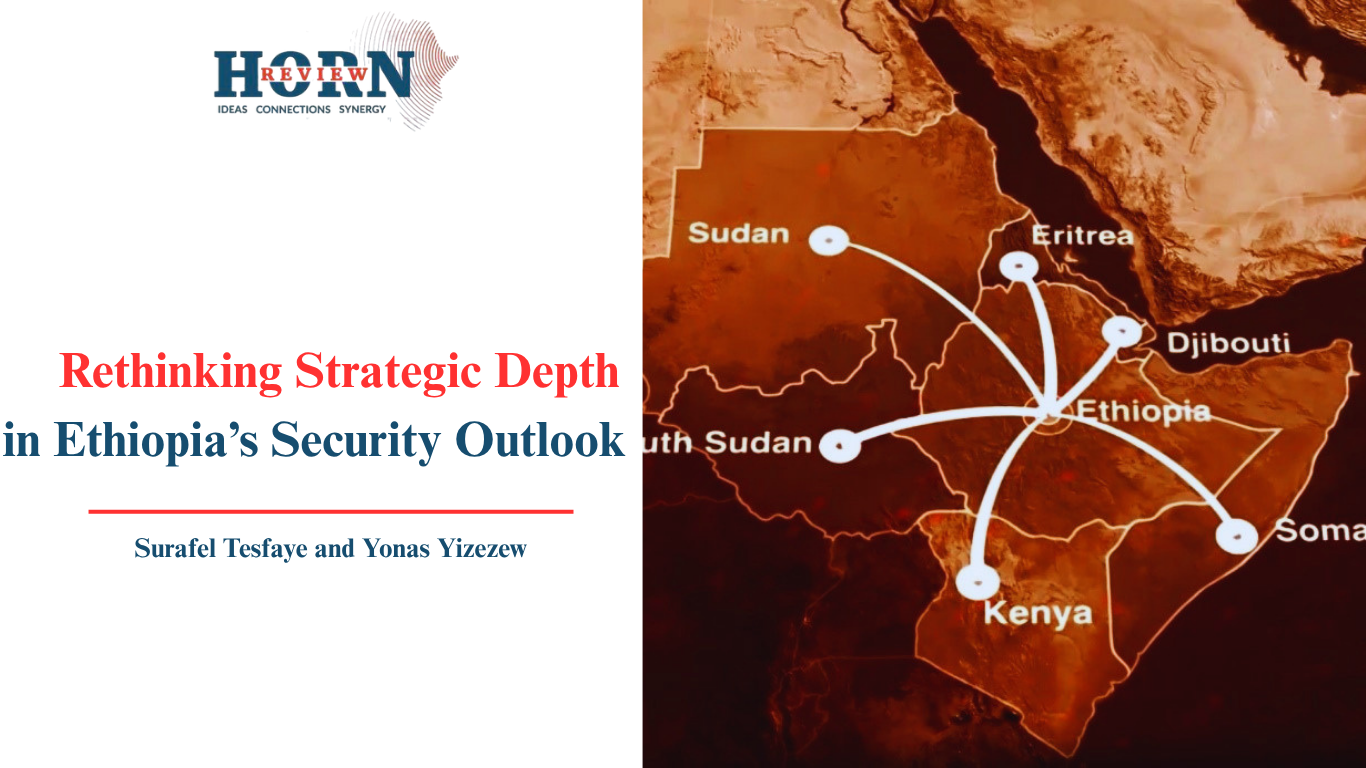
For landlocked states like Ethiopia, the absence of a sovereign maritime access compounds this vulnerability, constraining its strategic horizon to dependence on neighboring corridors. Ethiopia faces inherent constraints in cultivating traditional geographic buffers, yet the evolving nature of conflict demands innovative approaches to strategic depth that prioritize adaptability over sheer territorial expanse. In an era where precision strikes, cyber operations, and proxy maneuvers render distance less relevant, Addis Ababa can engineer resilience through layered, non-physical domains alliances, technological prowess, economic diversification, and informational superiority that buy critical time and options amid regional volatility.
Ethiopia’s most pressing innovation lies in securing reliable sovereign sea outlets, transforming logistical chokepoints into proactive assets. Beyond dependence on Djibouti, which drains billions annually in transit fees, diversifying and securing a sovereign coastline has become a matter of existence and survival. In this context, the pursuit of sovereign access to the Red Sea is not simply an economic ambition but a strategic recalibration. Regional corridors, such as LAPSSET with Kenya or AfCFTA integration, further extend this reach, creating economic depth that underpins military mobility and deters blockades by rivals. By extending its reach to the Red Sea, Ethiopia would not only diversify its economic lifelines but also expand its strategic depth outward, reducing the risk of encirclement.
Cyberspace emerges as a domain where landlocked status imposes no penalty, allowing Ethiopia to “manufacture” early warning and denial capabilities. Cyber capabilities, for instance, have introduced a new form of vulnerability as states’ financial systems, communication networks, and critical infrastructure can now be targeted without crossing a single physical boundary. In such a context, depth is measured by resilience the ability to absorb, isolate, and recover from disruption. Redundancy, decentralization, and cyber deterrence become the modern equivalents of mountains and rivers.
A formalized cyber doctrine building on “Digital Ethiopia 2025” initiatives would deploy national firewalls, AI-driven threat intelligence, and offensive tools to disrupt adversaries’ command networks, mirroring Israel’s preemptive hacks. Satellite partnerships with allies like Israel or Turkey could provide persistent ISR over the Horn, compensating for terrain blindness and enabling “defend forward” operations against insurgent sanctuaries in Eritrea, Sudan or Somalia.
Complementing this, informational depth via state media and diaspora networks shapes narratives around GERD or sea rights, preempting Egyptian disinformation and fostering societal resilience to hybrid threats. At the same time, the psychological dimension of warfare has acquired unprecedented importance. Modern conflicts often begin not with military confrontation, but with attempts to fracture internal cohesion, disinformation campaigns, social media manipulation, and political destabilization efforts aim to weaken a state from within before any physical engagement occurs. In this environment, national unity becomes a strategic asset.
Modern depth hinges on rapid adaptation, which demands a robust defense-industrial base immune to supply disruptions. Ethiopia’s defense modernization, such as ventures like SkyWin Aeronautics for indigenous drones and munitions, positions it to iterate weapons systems UAV swarms, electronic warfare suites against countermeasures from better-funded foes. This industrial layering affords operational flexibility since producing interceptors locally ensures sustained air defense, while AI integration accelerates decision cycles in compressed battlespaces. Realizing these advantages, however, requires sustained and substantial investment in human capital and technological infrastructure, including specialized training, research and development, and the institutional capacity to absorb and operationalize advanced systems.
Alliances serve as virtual territory, extending Ethiopia’s maneuver space through partners’ basing and shared intel. Ties with Israel should yield cyber and missile tech, alarming Cairo and countering its encirclement. Ethiopia should consolidate its alignments with the UAE and deepen its engagements with Turkey, including leveraging Ankara’s presence in Mogadishu and its mediation role to establish forward buffers. Strategic depth is further reinforced through readiness gradients, reflected in expanded national service, agile command structures, and civil defense mechanisms designed to absorb and manage shocks.
For Ethiopia, the challenge is not the absence of depth, but the need to redefine and integrate it. The traditional advantages of geography remain relevant, but they are no longer sufficient. Strategic depth must now be actively constructed through technological investment, economic policy, alliance formation, and regional engagement. The goal is not simply to defend territory, but to create a system in which threats are absorbed, delayed, and ultimately neutralized across multiple domains. In this sense, the question facing Ethiopia is no longer how far an enemy must travel to reach its capital. It is how many barriers physical, digital, economic, and psychological stand between the initial point of pressure and the collapse of the state’s ability to function. Given its geographic confinement sharing borders with all of its neighbors, Ethiopia’s surrounding neighbors should be used as strategic buffers rather than sources of vulnerability.
Strategic depth, in its modern form, is the accumulation of those barriers. It is the difference between immediate vulnerability and sustained resilience. In a region where geopolitical competition is increasingly indirect, fluid, and technologically mediated, that difference is becoming the defining factor of national survival.
By Surafel Tesfaye and Yonas Yizezew, Researchers, Horn Review