Analysis of Somalia’s constitution crisis
Introduction
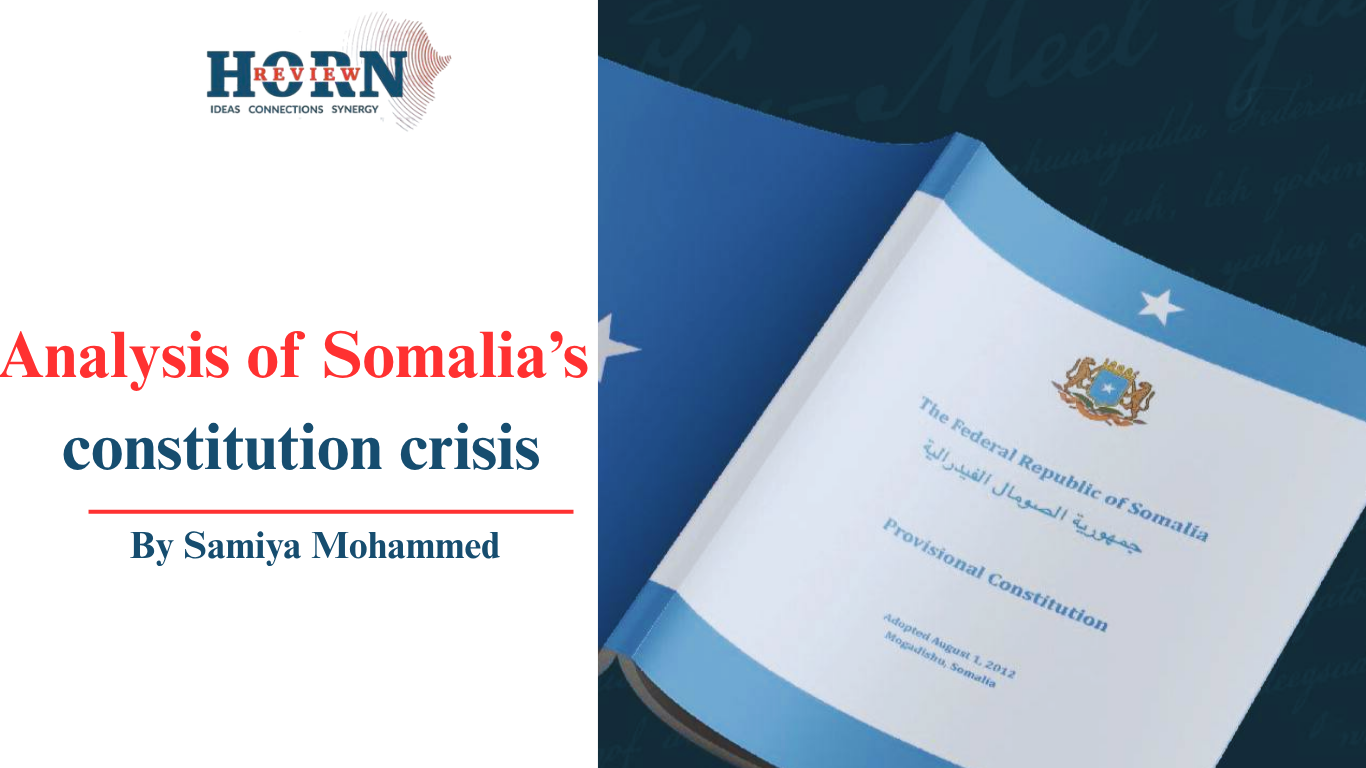
The modern Somali state has been shaped by successive constitutional experiments each attempting to reconcile the competing demands of centralized authority and clan based power sharing. From the optimism of the 1960 independence constitution through the authoritarian centralism of the 1979 Siad Barre era to the statelessness that followed the regime’s collapse in 1991, Somalia’s governance frameworks have repeatedly faltered against deep societal fragmentation and external pressures. After more than two decades of transitional arrangements the Provisional Federal Constitution (PFC) of 2012 emerged as a foundational, albeit imperfect compromise. Adopted on 1 August 2012 by a National Constituent Assembly, the PFC established the Federal Republic of Somalia as a federal democratic and Islamic republic. Explicitly provisional under Chapter 15, it deferred comprehensive review and public ratification until security and political conditions permitted while creating dedicated mechanisms the Parliamentary Oversight Committee (OC) and the Independent Constitutional Review and Implementation Commission (ICRIC) to guide the process.
The constitution making journey itself reflected persistent challenges. At the 2000 Arta conference in Djibouti Somali delegates opted against simply amending the 1960 constitution instead tasking a respected committee with drafting a Transitional National Charter. That charter ambitiously required the Transitional National Government to produce a new constitution within its mandate, an objective the government failed to meet before collapsing. Subsequent efforts under the 2004 Transitional Federal Charter (Article 71(9)) similarly encountered political and security obstacles including the 2008 resignation of President Abdullahi Yusuf Ahmed and the 2009 Djibouti reconciliation process. The eventual 2012 text finalized through a process widely criticized for its haste, limited consultation, and reliance on a small group of signatories bore the marks of these constraints. As a result mistrust among stakeholders rendered the Provisional Constitution inherently incomplete from its inception.
For fourteen years, this provisional framework nevertheless anchored a reconstruction amid Al-Shabaab insurgency and regional centrifugal forces. As of April 2026, the long delayed review process has reached a formal conclusion with parliamentary amendments initiated in March 2024 and finalized on 4 March 2026 were signed into law by President Hassan Sheikh Mohamud on 8 March 2026 allowing the Federal Government of Somalia (FGS) to proclaim an Official Constitution. However this milestone has not consolidated institutions. Instead, the 2024–2026 finalization exercise has triggered Somalia’s most acute institutional crisis since the founding of the Federal Republic. Rather than resolving the provisional document’s ambiguities, the amendments encompassing shifts in electoral models, term lengths and the balance of federal regional powers have exposed and exacerbated underlying fractures. This crisis arises from four interlocking structural weaknesses: the historical legacies of contested state building, procedural and legal shortcomings in the amendment process, the erosion of federal power sharing arrangements and entrenched clan based elite bargaining.
Collectively, these factors undermine the constitution’s legitimacy, risk institutional paralysis following the April 2026 expiry of parliamentary and presidential mandates and imperil the viability of Somalia’s federal project. This analysis examines each of these four dimensions in turn. It draws on the road of Somalia’s constitutional efforts from the ambitious but unrealized mandates of the Transitional National and Federal Charters through repeated deferrals and reinventing the wheel by successive Oversight Committees to the contested 2026 outcome to illuminate why the completion of the provisional framework has paradoxically deepened division. The study concludes by synthesizing their cumulative impact and outlining policy implications for international stakeholders. At stake is whether Somalia’s federal experiment can survive its own constitutional maturation or whether the latest attempt at permanence will instead accelerate fragmentation.
1. Historical and Constitutional Legacies
The present constitutional crisis in Somalia cannot be adequately comprehended in isolation and it must be situated within the republic’s protracted historical oscillation between unitary centralism and decentralized clan federalism an inherent tension that has been into successive constitutional frameworks since the nation’s independence in 1960. This dialectic reflects not just institutional design choices but societal cleavages rooted in clan identities, regional disparities between the former Italian Trust Territory of Somalia and British Somaliland and competing visions of state authority. Far from a linear progression toward stability, Somalia’s constitutional evolution has been characterized by path dependent cycles of centralizing ambition followed by centrifugal fragmentation each phase reinforcing the structural vulnerabilities of the next.
The 1960 Constitution promulgated at independence enshrined a unitary parliamentary democracy that initially appeared promising. It established a centralized national government with a bicameral legislature and a prime ministerial system ostensibly equipped to foster national cohesion across a newly unified territory. This model proved ill-suited to the realities of Somali society. Clan rivalries deeply embedded in social and political life quickly eroded institutional functionality, while north-south grievances particularly those emanating from the more administratively experienced British Somaliland protectorate remained unaddressed. The unitary structure’s inability to accommodate these centrifugal forces precipitated governmental paralysis setting a precedent for future experiments in centralization that would similarly falter under the weight of unresolved sub-national identities.
The 1969 military coup d’état led by General Siad Barre marked a decisive rupture. The subsequent 1979 Constitution formalized a highly centralized one party socialist state predicated on Scientific Socialism. This ideological framework aggressively suppressed overt expressions of clan affiliation, recasting them as retrograde tribalism antithetical to national unity. While the Barre regime achieved short term successes in infrastructure development and literacy campaigns, its authoritarian centralism proved counterproductive. By denying the legitimacy of clan-based social organization the very fabric of Somali political economy it inadvertently intensified subterranean resentments. These grievances ultimately coalesced into clan-based insurgencies in the late 1980s culminating in the state’s catastrophic collapse in 1991. The ensuing two decades of statelessness entrenched a powerful path dependent preference for localized, clan mediated security and governance. Warlords, clan militias, and nascent Islamist movements filled the vacuum, demonstrating the resilience of decentralized power structures when central authority evaporated.
The post collapse era witnessed the first concerted attempt to reconstitute state institutions through federal principles. The 2004 Transitional Federal Charter (TFC) introduced a federal architecture explicitly incorporating the 4.5 clan based power sharing formula as a mechanism to regulate elite competition and mitigate zero sum politics. This formula while imperfect and widely criticized for institutionalizing clan primacy, provided a temporary bridge across factional divides. The 2012 Provisional Federal Constitution (PFC) built upon this foundation but deliberately retained a provisional character acknowledging that Somalia’s political settlement remained incomplete.
Chapter 15 of the PFC mandated a comprehensive constitutional review within the first parliamentary term, underscoring the document’s transitional status rather than its finality. Most critically, the PFC deferred resolution of the core federal question with the precise delineation of powers between the Federal Government and the Federal Member States (FMS). Article 54 enumerated exclusive federal competencies while relegating shared and residual powers to subsequent negotiation and legislation an omission that preserved flexibility at the cost of clarity and predictability.
This historical pattern resonates powerfully in the ongoing 2024–2026 constitutional amendment process which has reanimated the foundational debate over centralization versus devolution with renewed intensity. The Federal Government of Somalia (FGS) has framed the amendments as an essential maturation beyond the provisional framework. By seeking to transcend the clan-based 4.5 indirect electoral system in favour of universal suffrage democracy, proponents argue that the process fulfills the 2012 Constitution’s implicit promise where the completion of a permanent institutional architecture capable of delivering stable, modern governance. From this perspective the provisional text was always intended as a temporary scaffold not an enduring settlement.
Yet this interpretation has encountered vigorous opposition from several Federal Member States, notably Puntland, Jubaland, and South West State. Critics contend that the accelerated finalization of amendments has resurrected the specter of pre-1991 centralized authoritarianism, concentrating power in Mogadishu at the expense of regional autonomy. They maintain that the 2012 provisional compromise rested upon an explicit foundational bargain, any permanent constitution must emerge from inclusive, consensus driven negotiations involving all federal stakeholders. The current process by marginalizing key FMS bypassing meaningful public consultation and dispensing with a promised referendum is alleged to have breached this covenant. Such procedural deficiencies, detractors argue, not only undermine the legitimacy of the resulting document but risk reigniting the very clan based insurgencies and regional estrangement that precipitated earlier state failure.
In analytical terms the unresolved tension between Mogadishu centric state building and the imperative of regional autonomy constitutes the republic’s primary constitutional fault line. The 2024–2026 amendments rather than forging a durable synthesis have inadvertently exacerbated this cleavage. By prioritizing centralizing reforms without securing broad based consensus, the process has reinforced historical patterns of mistrust and fragmentation. Somalia’s constitutional history demonstrates that neither pure unitary centralism nor unchecked decentralization has proven sustainable, viable governance requires a carefully calibrated federal equilibrium one that respects clan realities while gradually transcending them through inclusive institutions. Until this equilibrium is achieved through genuine negotiation rather than imposition, the oscillation between centralist ambition and federalist resistance will continue to define and destabilize the Somali political landscape. The current crisis, therefore represents not an aberration but the latest manifestation of a structural dialectic whose resolution remains essential to the republic’s long term cohesion and prosperity.
2. Procedural and Legal Dimensions of the Amendment Process
The procedural conduct of the constitutional review and amendment process from 2024 to March 2026 has generated substantial concerns regarding legality, transparency, and adherence to the 2012 PFC’s own requirements. Chapter 15 of the PFC establishes a clear amendment framework requiring a two thirds majority in both houses of the Federal Parliament followed by a public referendum for most substantive changes particularly those affecting fundamental rights, the federal system, or the amendment procedure itself. The FGS pursued a two stage parliamentary amendment process without a referendum a decision that has become the central legal point of contention.
The first phase occurred in March 2024 when Parliament approved amendments to Chapters 1 through 4. These changes shifted the electoral model toward one person one vote universal suffrage, granted the President authority to appoint the Prime Minister without parliamentary confirmation extended presidential and parliamentary terms from four to five years and imposed new limits on political parties. The second phase culminating on 4 March 2026 saw a joint session of Parliament approve the final package of amendments covering Chapters 5 through 15 addressing federal structure details, power distribution and electoral laws. President Hassan Sheikh Mohamud signed the consolidated text on 8 March 2026 declaring it the “Official Constitution.”
Opposition actors and dissenting FMS have raised multiple procedural objections. First the absence of a public referendum directly contravenes Chapter 15 for amendments of this magnitude. The FGS has maintained that on going insecurity from Al-Shabaab precludes a nationwide referendum but critics contend that this rationale has been opportunistically extended to avoid popular scrutiny. Second the parliamentary votes were marred by procedural irregularities including disputes over quorum allegations of online voting by absent members and reports of intimidation against opposition MPs. A particularly concerning incident in February 2026 involved police storming the parliamentary compound and the assault of a female MP which preceded the final vote. Third the joint session that approved the final package was boycotted by a significant number of opposition MPs and representatives from dissenting FMS, raising questions about whether the two-thirds threshold was legitimately met.
Proponents of the FGS position argue that the 2012 PFC was always understood as a transitional document and that the parliamentary process overseen by the Constitutional Review and Implementation Commission provided sufficient deliberative space. They further contend that the absence of a functioning nationwide electoral infrastructure makes a referendum impractical and that parliamentary ratification is an acceptable alternative given the security context. Nevertheless, analysis indicates that the procedural shortcuts have fatally undermined the perceived legitimacy of the new constitution. The result has been a legal vacuum in which two competing constitutional texts now claim authority, the 2012 PFC supported by dissenting FMS and the 2026 amended version supported by the FGS. This dual constitutional reality directly precipitated the withdrawal of recognition by Puntland on 30 March 2024 and subsequent similar actions by Jubaland and South West State.
3. Federalism, Power-Sharing, and Institutional Autonomy
Beyond procedural objections the substantive content of the 2024–2026 amendments has fundamentally altered the federal compact envisioned in the 2012 PFC. Somalia’s federal model was deliberately designed as a decentralized system to prevent the reemergence of the oppressive centralization that characterized the Barre era. The 2012 text established a framework in which the FGS holds exclusive powers only over clearly enumerated matters foreign affairs, national defense, citizenship, immigration and monetary policy while all residual powers remain with the Federal Member States. The amendments in contrast have shifted authority toward the center particularly in the areas of security coordination, resource management and electoral administration.
The expanded presidential authority is a primary source of contention. Under the amended text the President’s power to appoint the Prime Minister without parliamentary confirmation reduces legislative checks on the executive. Combined with the extension of presidential and parliamentary terms from four to five years, this have been characterized as changes in an incumbent driven effort to entrench executive dominance. The FGS has defended these modifications as necessary for policy continuity and administrative efficiency noting that four year terms in a security environment produce perpetual electoral cycles that hinder long term planning. However stakeholders contend that the timing of these changes coinciding with the expiration of the current parliamentary term in April 2026 and the approaching end of the presidential term suggests a self perpetuating logic rather than neutral institutional design.
The erosion of FMS autonomy is most clearly evidenced by the reaction of regional governments. Puntland which has maintained a functioning regional administration since 1998 immediately withdrew recognition of the FGS following the March 2024 amendments declaring the 2012 PFC as the only legitimate constitutional text. Jubaland suspended ties in late 2024 after the passage of electoral laws that it argued infringed on regional authority subsequently conducting its own parallel elections. South West State followed suit in March 2026 bringing the number of dissenting FMS to three out of six. These regions have effectively begun operating with semi independent governance structures coordinating among themselves while rejecting FGS authority. Only Galmudug, Hirshabelle and the federal capital region of Mogadishu remain aligned with the FGS.
The FGS perspective emphasizes that federalism does not preclude a strong central government and that the amendments just clarify the distribution of powers that the 2012 PFC left ambiguous. It is further argued that the 4.5 formula while a necessary transitional mechanism has perpetuated clan-based fragmentation and that direct elections are essential for democratic consolidation. Nonetheless, this indicates that the amendments have been interpreted by dissenting FMS as a unilateral abrogation of the federal bargain.
The result has been the very centrifugal dynamic the 2012 PFC was designed to avoid with three federal member states now reject the central government’s constitutional authority and localized clashes have erupted in border areas such as Gedo and Bakool. Somalia’s federal experiment far from being completed is now facing its most severe test of internal cohesion.
4. Clan Dynamics, Elite Bargaining, and Political Legitimacy
The constitutional crisis cannot be fully explained by institutional or procedural factors alone however it is equally a product of Somalia’s persistent clan based elite bargaining which the 2012 PFC sought to transcend but never fully displaced. The 4.5 formula allocating equal representation to the four major clans (Darod, Hawiye, Dir, and Digil-Mirifle) plus a half share for minority groups has been the foundational mechanism for political inclusion since the 2000 Transitional National Charter. While the 2012 PFC nominally committed to moving beyond clan based politics toward multiparty democracy in practice the 4.5 formula has remained the operative framework for parliamentary selection, government formation and resource distribution. The 2024–2026 amendments’ shift toward universal suffrage represents a direct challenge to this entrenched system.
The FGS has framed the move to one-person-one-vote as a democratic advancement that would reduce clan based manipulation and clientelism. However, some contend that the timing and manner of this transition are driven by elite interests rather than democratic principle. The current political elite including President Mohamud and allied MPs stand to benefit from a system that centralizes electoral administration under FGS control while displacing the clan based consensus mechanisms that have historically constrained executive power. The opposition Somali Future Council comprising former presidents, prime ministers and senior political figures has condemned the amendments as a power grab that violates the informal but binding elite bargains underpinning Somali politics since the TFC.
The use of parliamentary intimidation further illustrates the breakdown of elite bargaining norms. The February 2026 incident in which security forces entered the parliamentary compound and an MP was physically assaulted marked a qualitative escalation in the coercive tactics employed to secure the amendments’ passage. While the FGS has denied authorizing such actions and attributed them to rogue elements, the pattern of pressure on opposition MPs has been well documented by domestic and international observers. The 4.5 formula for all its flaws had established predictable mechanisms for elite negotiation and dispute resolution. The current process has abandoned these mechanisms in favour of majoritarian parliamentary votes that exclude dissenting FMS and opposition factions.
From the FGS perspective the opposition’s resistance reflects a vested interest in preserving the clan-based status quo which has enriched a small political class while failing to deliver basic services or security to the broader population. It is further argued that the 4.5 formula originally designed as a temporary transitional device has become an obstacle to state building and must be superseded for Somalia to develop functioning democratic institutions.
However this indicates that the manner of its supersession unilateral, procedurally irregular and without consensus among major clan constituencies has triggered a backlash that may prove more damaging than the status quo. Elite actors on all sides continue to treat constitutional processes as instruments for short term power retention rather than long term institution building, perpetuating the very clan politics the 2012 PFC sought to transcend. The current crisis is thus not an aberration but an intensification of Somalia’s enduring political logic.
Synthesis: Why the Crisis Is Happening
The convergence of the four analytical categories reveals a coherent causal chain explaining the current crisis. Historical legacies of contested state building produced a 2012 PFC that was deliberately provisional leaving unresolved the fundamental tension between centralization and federalism. Procedural shortcuts in the 2024–2026 amendment process including the absence of a referendum, parliamentary irregularities and intimidation violated both the letter and spirit of that provisional framework eroding the new constitution’s legitimacy from its inception. The substantive erosion of federal power sharing arrangements particularly expanded presidential authority and reduced FMS autonomy, transformed a procedural dispute into a material threat to regional governance structures. Finally the breakdown of elite bargaining norms, as clan based consensus mechanisms were supplanted by majoritarian coercion eliminated the informal conflict resolution channels that had previously prevented outright institutional collapse.
The result has been a cascade of institutional failures. Three of six FMS have withdrawn recognition of the FGS. The Federal Parliament’s term expired on 14 April 2026 without elections creating a legislative vacuum. The Presidency’s term is similarly approaching expiration with disputes over whether the amended five year term applies retroactively to the current officeholder. Al-Shabaab has exploited the political fragmentation launching offensives in contested areas between FGS and dissenting FMS forces. International partners including the African Union, United Nations, and IGAD have called for dialogue but have not intervened decisively. Aid flows remain uncertain as donors reassess engagement with an increasingly fractured federal structure.
A simplified causal diagram captures this dynamic: Historical legacies of centralization versus federalism → Procedural shortcuts in amendment process → Erosion of federal power-sharing → Breakdown of elite clan bargaining → Institutional paralysis and parallel governance structures. Each factor reinforces the others creating a self sustaining crisis that resists simple resolution. The 2026 constitutional ‘finalization’ has thus achieved the opposite of its stated intent: rather than completing Somalia’s transition to stable democratic governance, it has reopened the foundational questions of Somali statehood and placed the federal project at existential risk.
References
- ConstitutionNet. 2012. “The Federal Republic of Somalia: Provisional Constitution.” http://constitutionnet.org/vl/item/federal-republic-somalia-provisional-constitution-adopted-august-1-2012-sep-19-2012.
- ConstitutionNet. 2026. “From Provisional to Permanent Constitution? Assessing the End of Somalia’s Constitutional Review Process.” April 7. http://constitutionnet.org/news/voices/provisional-permanent-constitution-assessing-end-somalias-constitutional-review-process.
- United Nations. 2012. “UN Officials Welcome ‘Historic’ Approval of New Constitution for Somalia.” August 1. https://news.un.org/en/story/2012/08/416812.
- Library of Congress. n.d. “Somalia: Siad Barre and Scientific Socialism.” Country Studies. https://countrystudies.us/somalia/24.htm.
- Peacemaker. 2004. “Transitional Federal Charter of the Somali Republic.” https://peacemaker.un.org/en/node/9471.
- University of Minnesota Human Rights Library. 2012. “The Federal Republic of Somalia Provisional Constitution.” https://hrlibrary.umn.edu/research/Somalia-Constitution2012.pdf.
- Somalia Public Agenda. 2026. “Somalia’s Constitutional and Electoral Conundrum.” March 11. https://somalipublicagenda.org/contested-rules-contested-legitimacy-somalias-constitutional-and-electoral-conundrum/.
- Bertelsmann Stiftung. 2026. BTI 2026 Somalia Country Report. Gütersloh: Bertelsmann Stiftung. https://bti-project.org/en/reports/country-report/SOM
- Heritage Institute for Policy Studies. 2025. “Commentary: From Gridlock to Governance—Addressing Somalia’s Constitutional and Electoral Challenges.” August 11. https://heritageinstitute.org/wp-content/uploads/2025/08/Commentary-From-Gridlock-to-Governance-Addressing-Somalias-Constitutional-and-Electoral-Challenges-3.pdf.
- Horn International Institute for Strategic Studies. 2026. “Somalia’s Constitutional Crisis: A High-Stakes Gamble.” April 1. https://horninstitute.org/somalias-constitutional-crisis-a-high-stakes-gamble/.
- Horn Observer. 2026. “Somalia: Article 54 and the Federal Settlement—Constitutional Authority and the Politics of Completion.” March 3. https://hornobserver.com/articles/3602/Somalia-Article-54-and-the-Federal-Settlement-Constitutional-Authority-and-the-Politics-of-Completion
- Hivos Eu SEE. 2026. “Disputed Constitutional Amendments and Electoral Delay Affecting Somalia’s Enabling Environment.” March 12. https://eusee.hivos.org/alert/disputed-constitutional-amendments-and-electoral-delay-affecting-somalias-enabling-environment/.
- Rift Valley Institute. 2024. “Addressing Contentious Issues on Elections in the Constitutional Review Process.” March. https://riftvalley.net/wp-content/uploads/2024/03/pb_EN_Constitutional-review_v3.pdf
By Samiya Mohammed, Researcher, Horn Review

RELATED
Posts
21
Oct
Egyptian Offer of Troops to Saudi Arabia: Why Now?
When President Abdel Fattah el-Sisi asked Egypt's parliament on 18...
21
Oct
Where Would Eritrea’s Future Lie in a War with Ethiopia?
After a succession of escalations, the armies of Ethiopia and...
21
Oct
The Sodere Initiative and Ethiopia’s Role in Somali State-Building
Ethiopia’s initiative at Sodere brought Somalia’s rival factions into a...
21
Oct
Khartoum's Conditional Peace Offer and the Egyptian Shadow over Ethiopia-Sudan Relations
Sudan's Foreign Minister, Mohi-Eddin Salem, told French Special Envoy...
21
Oct
Egypt's Strategic Desperation Reaches Djibouti
Egypt's expanding involvement in Djibouti's maritime infrastructure has acquired renewed...
21
Oct
Somalia's Misattribution of Security Failure and the fonts of Federal Overreach
The federal government of Somalia under Hassan Sheikh Mohamud faces...
21
Oct
Sudan’s Drone War Reaches Abyei and Puts South Sudan’s Election on Notice
The drone strike on the Amiet market inside the disputed...
21
Oct
The El-Alamein Quadrilateral and the Risks of Geopolitical Polarization in the North East Africa
The rapid changes that are taking place in the North...