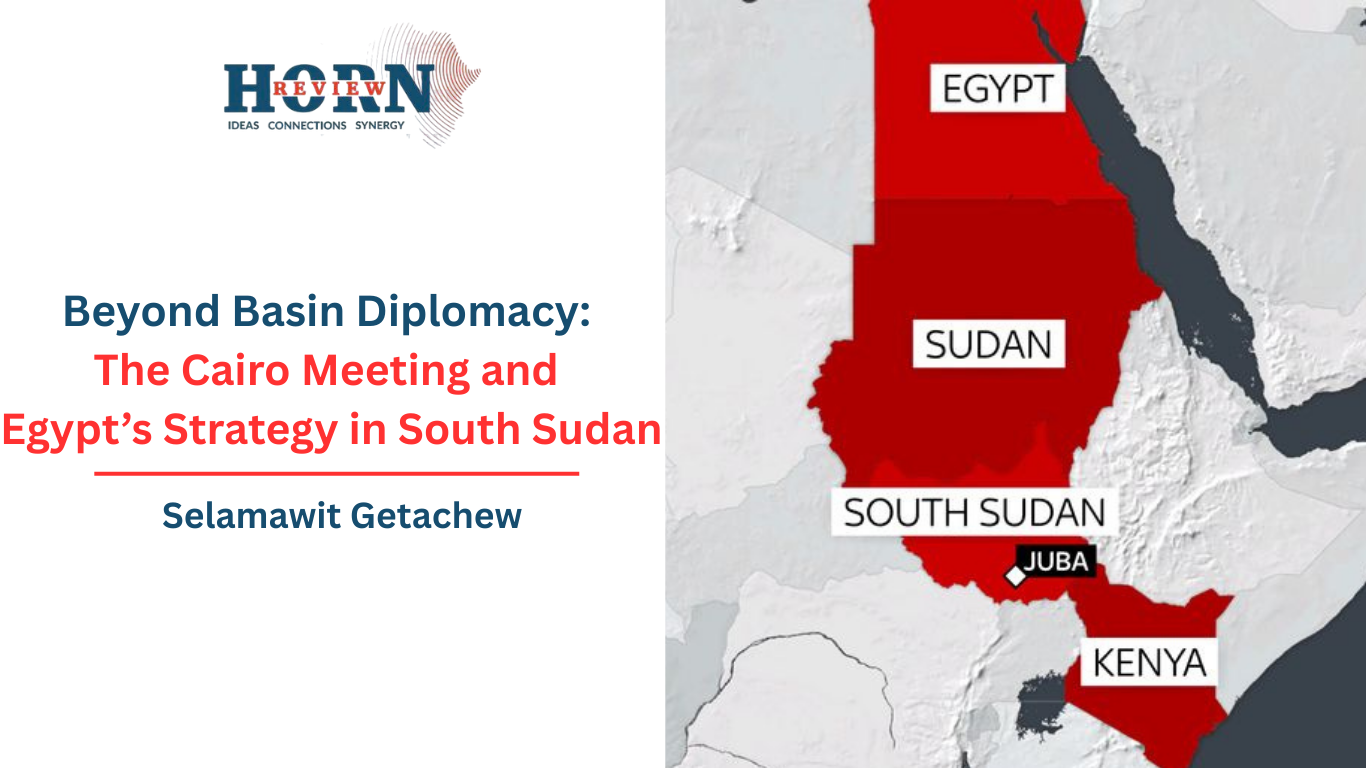
The February 2026 Cairo meeting between Egyptian Foreign Minister Badr Abdelatty and South Sudan’s Foreign Minister Ramadan Mohamed Abdallah Goc (Simaya Kumba), convened under the Nile Basin Initiative framework and attended by Presidential Advisor on National Security Affairs Tut Gatluak, was publicly presented as routine basin cooperation. Official statements emphasized international water law, prior notification, opposition to unilateralism, and the principle of no harm. On the surface, it appeared procedural another technical reaffirmation of dialogue.
However, the timing, composition and political context focus of the meeting signal a deeper strategic recalibration. Egypt intents to consolidate influence around peripheral riparian state at a moment when Ethiopian upstream consolidation taken as threat to traditional downstream leverage. In this sense, Egypt attempting to offset its structural disadvantages in upstream Nile negotiations through political environment around key Horn of African states.
For decades, Nile governance rested on a downstream-centered architecture anchored in colonial-era treaties of 1929 Nile Waters Agreement and the 1959 Egypt-Sudan Treaty. Through these arrangements, Egypt fused legal entitlement with geopolitical alignment, converting downstream geography into enforceable control. Sudan was not merely a co-signatory; it functioned as the southern pillar of this order. Egyptian water security structurally embedded rather than contested in many turn.
Ethiopia never accepted this framework. It rejected the treaties as colonial relics concluded without participation or consent, and therefore lacking legal validity. This foundational divergence acquired rights versus equitable utilization has long defined basin politics.
With South Sudan’s independence in 2011 disrupted the territorial and political coherence of the downstream order. Egypt recognized the state immediately. What had once been a consolidated downstream alignment became divided. Cairo-Khartoum coordination could no longer be assumed, and the emergence of a new midstream sovereign actor introduced uncertainty into an already strained system.
For years, the old order persisted rhetorically. The Nile Basin Initiative, created in 1999, expanded basin participation but did not immediately dissolve the historical asymmetry. Egypt initially approached it as manageable multilateralism. The decisive rupture came with the activation of the Cooperative Framework Agreement following threshold ratification in 2024, including South Sudan’s accession. By institutionalizing equitable and reasonable utilization, the CFA displaced treaty-based allocation as the basin’s normative center. Egypt suspended its participation due to disagreements over water allocation and attempts to establish a new status quo. Yet rejection did not restore authority; It confirmed that the transition to post-monopoly basin.
In this transformed landscape, What is emerging is not Egyptian retreat but strategic repositioning. Sudan’s internal conflict after 2023 further weakened Egypt’s traditional downstream pillar. In this vacuum, South Sudan’s importance increased. Juba occupies a dual position: as a CFA member, it contributes to upstream institutional legitimacy; as a politically fragile state with unresolved security and economic dependencies, it remains permeable to external influence. This duality makes South Sudan a pivotal actor than a passive participant in contemporary Nile politics.
Egypt’s rsponse mirrors a dual-track strategy. Cairo remains outside the CFA while staying active through the Nile Basin Initiative and bilateral channels. Simultaneously, it deepens influence via technical cooperation, capacity-building, security engagement, and regional alignments through the Nile arena. Formal institutional rejection is thus separated from sustained political penetration.
South Sudan fragility functions as leverage. In states where regime stability and foreign policy are inseparable, influence operates through access rather than treaties. Egypt has pursued this logic consistently since 2011, intensifying engagement rather than retreating after South Sudan joined the CFA. High-level exchanges in 2017 focused on security cooperation, while 2022 meetings emphasized economic and development agreements. Crucially, this engagement accelerated as upstream institutional momentum increased. This relational leverage was evident at South Sudan’s February 2026 Nile Day celebration in Juba, where Water Minister James Mawich Makuach publicly urged Egypt and Sudan to join the CFA.
Parallel to diplomacy, water-sector cooperation reinforces this leverage. Egyptian technical assistance, irrigation support, implemented through the Ministry of Water Resources and Irrigation. Training programs for South Sudanese water officials and Nile-related technical support embed Egyptian expertise within South Sudan’s water bureaucracy. These initiatives create familiarity, informational access, and long-term dependency below the threshold of formal treaty politics. They are instruments of influence, not solely development altruism.
The securitized dimension is equally revealing. The participation of South Sudan’s Presidential Advisor on National Security Advisor in basin-level diplomacy signals that Nile politics intersects with internal power management and regime stability. In fragile political systems, foreign policy decisions are inseparable from internal power management. The Cairo meeting therefore extended beyond water governance; it functioned as a negotiation over alignment, security guarantees, and political access.
In Upstream states, Ethiopia has led CFA implementations through the Grand Ethiopian Renaissance Dam and sustained advocacy of equitable utilization. Other upstream states display differentiated risk calculations. Uganda and Kenya balances relations with Egypt alongside their regional commitments. South Sudan balances hydrological proximity to Ethiopia against developmental and security dependencies. This differentiation reflects a behavior under asymmetric constraints. Egypt’s strategy exploits this reality by treating South Sudan as a swing state whose ambiguity can be preserved.
What now governs the Nile is not singular authority but layered legitimacy and competitive alignment. Egypt working to shape the political environment in which that change is expressed. South Sudan is not a proxy, but a lever. The Nile is no longer governed by who controls the water through treaty, but by who can structure the political terrain through which water decisions are influenced.
By Selamawit Getachew, Researcher, Horn Review