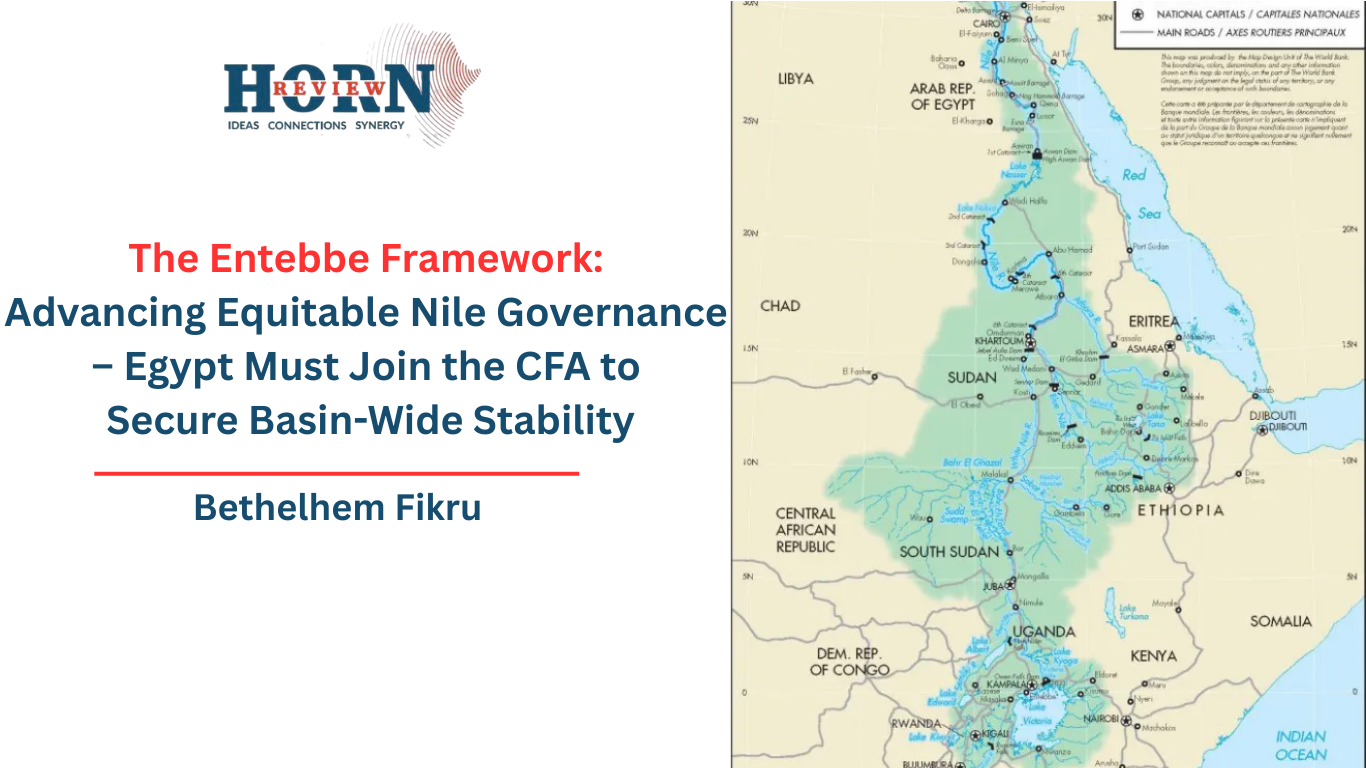
South Sudan’s call for Egypt and Sudan to join the Cooperative Framework Agreement (CFA) should be interpreted as a structural intervention in the political economy of the Nile rather than as a rhetorical exchange. The CFA represents the maturation of basin governance from bilateral allocation toward multilateral legal equality. Its foundation rests on principles that now define contemporary international water law: equitable and reasonable utilization, the obligation not to cause significant harm, and sustained cooperation. These principles are reflected in the 1997 UN Watercourses framework and have become the normative reference for transboundary river systems globally. The CFA does not redistribute water by decree, nor does it invalidate prior arrangements automatically. It reframes the governing logic of the basin. That shift, more than any single clause, explains both its significance and the resistance it encounters.
Egypt’s historical claim is anchored in the 1929 and 1959 agreements, which allocated approximately 55.5 billion cubic meters annually to Egypt and 18.5 billion to Sudan, effectively reserving the vast majority of measured flow for downstream use. These arrangements were concluded in a geopolitical context defined by colonial administration and unequal bargaining power. Upstream states were either not sovereign or not included as negotiating parties. Ethiopia, which contributes the majority of Blue Nile waters that sustain the main Nile, was not a signatory. Over time, basin demographics have transformed. Egypt’s population has expanded from fewer than 30 million in the mid-twentieth century to well over 100 million today, while Ethiopia and other upstream states have experienced similar growth trajectories. Governance frameworks designed for a smaller, less interconnected basin now confront hydrological variability, climate stress, and infrastructural expansion across all riparians.
The CFA addresses this reality through institutional design rather than numerical reallocation. It establishes a basin commission to coordinate data exchange, project notification, and dispute management. A core element of the CFA’s significance lies in its institutional provisions for regular data and information exchange (as mandated in Part II of the agreement), which enable transparent monitoring and coordinated responses to basin-wide challenges. This includes mechanisms that could facilitate structured management of major infrastructure such as the Grand Ethiopian Renaissance Dam, supporting phased filling under cooperative safeguards, joint modeling of flows, and integrated operation during drought periods to mitigate downstream shortages while optimizing upstream hydropower and storage. Such arrangements, facilitated through the Nile River Basin Commission, promote adaptive drought management, flood control, and overall resilience without unilateral imposition.
Articles on equitable utilization require that water use consider geographic contribution, population, development needs, and ecological sustainability. The principle of no significant harm sets a legal threshold that obliges states to avoid material damage, while still allowing development under cooperative safeguards. Article 14(b), the most debated provision, frames water security in terms that avoid significant impact rather than enshrining fixed volumes. Egypt has sought language that explicitly protects “current uses and rights,” effectively constitutionalizing historic allocations. The adopted formulation preserves protection against harm without freezing historical entitlements. This distinction is central: international water law protects against significant injury; it does not guarantee immutability.
The demand for “full consensus” further illustrates the divergence in interpretation. Consensus is valuable as a diplomatic objective, but when elevated to a precondition for institutional entry, it functions as veto authority. Under established treaty practice, agreements enter into force when ratified by a defined number of states. Those that choose not to ratify are not bound, yet they do not possess the capacity to block the legal development of others. The CFA’s entry into force among a critical mass of upstream states demonstrates that basin governance can proceed without unanimity. To insist that no institutional mechanism may operate absent universal agreement is to convert dialogue into paralysis. Consensus should emerge from participation; it should not serve as an instrument to delay institutional evolution indefinitely.
Water security, in its internationally recognized sense, refers to reliable access to water resources in a manner that balances human need, environmental sustainability, and transboundary responsibility. It encompasses equitable access, prevention of significant harm, transparency, and cooperative management. It does not equate to permanent priority for historic users regardless of demographic or climatic change. In a basin projected to experience increased variability due to climate change, adaptive governance becomes essential. Fixed allocation models may offer predictability under stable conditions, but they are less suited to fluctuating hydrology. Security in such an environment is better achieved through data-sharing, joint modeling, and coordinated operation than through rigid entitlement.
The broader strategic context reveals that the CFA is not an instrument targeting Egypt. It is a basin-wide framework that seeks to equalize legal standing among all riparians. South Sudan’s advocacy reflects this institutional perspective. By urging accession, it positions the CFA as the legitimate center of governance rather than a peripheral initiative. Participation would allow Egypt and Sudan to shape commission procedures, oversight mechanisms, and technical standards from within the system. Institutional engagement offers influence over rule-making; external opposition offers limited leverage once norms consolidate among ratifying states.
Historical critique of Egypt’s position does not negate its security concerns, but it situates them within evolving legal standards. International practice increasingly favors equitable utilization over inherited exclusivity. Treaty stability is a principle, yet it operates alongside sovereign equality and the changing circumstances doctrine embedded in contemporary jurisprudence. No river system can remain governed indefinitely by agreements that excluded key contributors and predated present population and climate realities. Legitimacy in transboundary governance derives from inclusivity and adaptability. Agreements that incorporate these features tend to endure; those that do not often face progressive marginalization.
South Sudan’s role is therefore significant. Its call for accession does not demand abandonment of downstream interests. It suggests that those interests are more effectively protected through institutional participation than through sustained abstention. By joining the CFA, Egypt could reinforce no-significant-harm safeguards, formalize notification procedures, and integrate flood and drought management into a binding framework. The treaty’s amendment provisions demonstrate that concerns can be addressed within its structure. Engagement transforms critique into contribution.
The Nile’s governance trajectory is ultimately a question of legal order. The basin is transitioning from a system anchored in historical allocation toward one governed by shared principles. That transition is consistent with global trends in transboundary water management. It does not eliminate disputes; it relocates them into structured negotiation. South Sudan’s appeal reflects confidence in that evolution. The choice confronting Egypt and Sudan is not whether the basin will change, but whether they will participate in shaping the institutional architecture that will define its future. In multilateral systems, durable influence is exercised through engagement, and legitimacy consolidates around participation. The CFA represents that institutional pathway.
By Bethelhem Fikru, Researcher, Horn Review