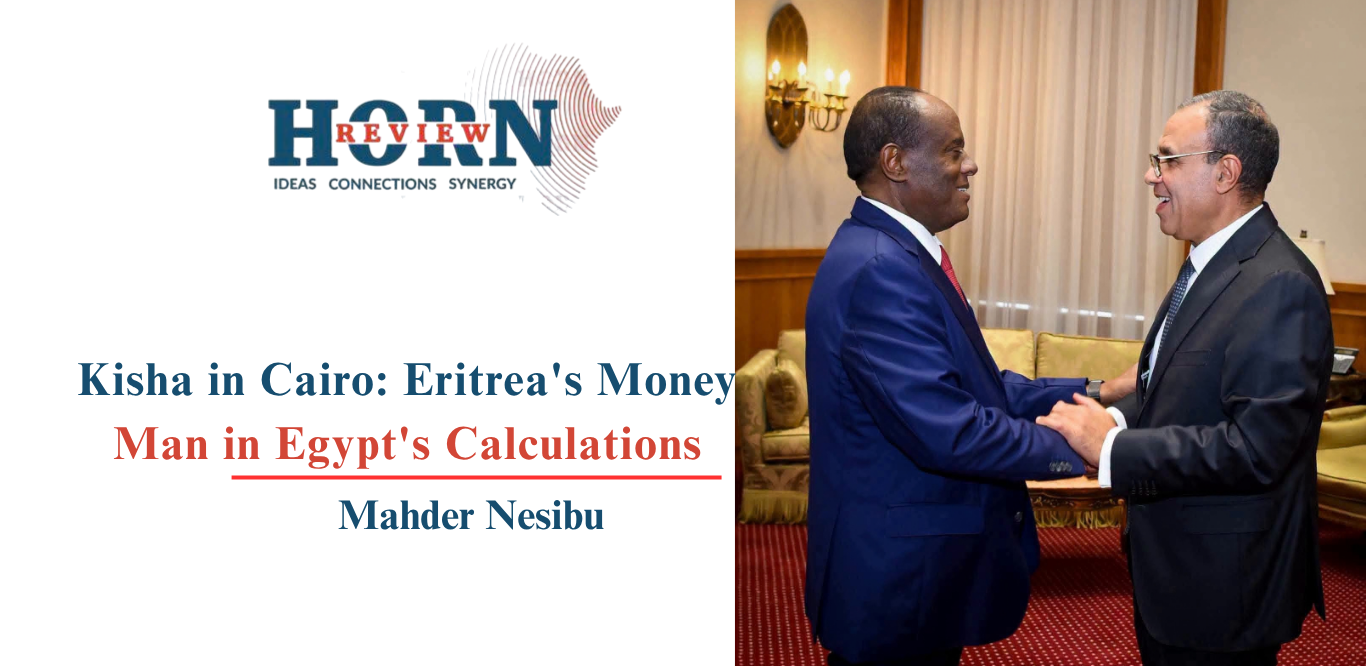
Hagos Gebrehiwet, economic adviser to Eritrean President Isaias Afwerki, travelled to Cairo in the closing days of September to meet Badr Abdelatty, Egypt’s foreign minister. The visit followed the outbreak of fighting in Ethiopia days earlier, when on 23 September a coalition of armed groups inside Ethiopia, itself formed only days before, launched attacks against the federal government. That coalition, acting primarily through its most prominent member, the Tigray People’s Liberation Front, has been moving into increasing alignment with Asmara, forming a trilateral arrangement that links Eritrea, the coalition, and the Sudanese Armed Forces in Sudan. Egypt has emerged as an important player in this apparently anti-Ethiopian bloc, largely through its own contacts with Asmara and with the SAF leadership.
Hagos is one of several Eritrean officials who maintain regular contact with Cairo. Isaias himself has met Egyptian leadership repeatedly over the past year, travelling to Cairo in June on the heels of a five-day visit the previous October. Badr Abdelatty travelled to Asmara in May this year and met Isaias during that visit.
These contacts have run alongside the deterioration of relations between Ethiopia and Eritrea, a decline that has culminated in fighting inside Ethiopia between the armed coalition, primarily the TPLF, and the Ethiopian National Defence Force and allied militias. The fighting has centred on Tigray, where the TPLF previously held firm control, and on the adjacent Afar region, whose president told Al Jazeera that Eritrean personnel were fighting alongside TPLF forces. Addis Ababa holds a similar view of the picture. The head of the ENDF, Birhanu Jula, has stated that an alignment between Eritrea, Egypt, and the Sudanese Armed Forces is backing the armed coalition and its launch of the fighting.
This web of alignments rests on an overlapping and often distinct set of calculations for each actor. The Egypt-Eritrea relationship rests on several grounds. Cairo, locked since the completion of the Grand Ethiopian Renaissance Dam in an escalating standoff with Addis Ababa over the Nile, has been building alliances around Ethiopia’s periphery in what amounts to a ring of pressure points, with Eritrea arguably its linchpin. Asmara’s own tensions with Addis Ababa form part of that picture, having sharpened over the past year as Eritrea grew closer to the rebels inside Ethiopia and as Addis Ababa pressed its interest in the Eritrean port of Assab, part of its pursuit of renewed access to the Red Sea, which it regards as a core national interest.
Hagos Gebrehiwet is a central figure in Isaias’s regime. Known by the nickname “Kisha,” loosely translated from Tigrinya as “sack,” a label earned during his time as a tegadalai, or liberation fighter, that reflects his role as the EPLF’s financial manager. Hagos is more than the President’s economic advisor. His real position lies in heading at least two EPLF entities, the Hidri Trust and the Red Sea Trading Corporation. Hidri Trust sits atop the major companies operating inside Eritrea, an economy tightly controlled as part of the broader apparatus of Isaias’s authoritarian rule. The RSTC, in turn, holds a monopoly over the country’s imports and exports, giving it effective control of the regime’s foreign currency as well as its overseas assets and financial inflows, including remittances from the Eritrean diaspora and the tax the regime levies on that population.
Hard currency is critical to the regime and its security apparatus, particularly its intelligence service, which operates extensively across the Horn of Africa, and the Eritrean Defence Forces. Before the UN lifted sanctions on Eritrea in 2018, sanctions that had included an arms embargo since their imposition in 2009, Hagos played a central role in circumventing those restrictions to keep the regime financially afloat. When the United States sanctioned the regime over its involvement in Ethiopia’s Tigray conflict between 2020 and 2022, it named Hagos and his entities, Hidri Trust and the RSTC, as sources of finance and materiel for the regime’s role in that intervention.
Asmara and Cairo have both presented the meetings involving Hagos as matters of economic engagement. Yet that framing fails to encompass Egypt’s broader geopolitical calculations, given both the timing of the visits and the nature of the Eritrean economy itself. Egypt and Eritrea’s leaderships have been more or less constant allies for decades, but that alliance has historically tracked the state of relations between Addis Ababa and Asmara. During the brief periods of warmth between the two, in the early 1990s around Eritrean statehood, and during the short-lived rapprochement of 2018, Eritrea’s closeness to Egypt has tended to recede, since Ethiopia and Egypt remain in structural rivalry and Asmara has navigated that rivalry according to calculations that shift with circumstance. Despite the appearance of an enduring relationship, no significant Egyptian presence or investment exists inside the Eritrean economy. Tightly controlled by the regime, that economy has offered little room for outside investment, with the exception of some Chinese interest in Eritrea’s mining sector, and foreign activity inside the country otherwise remains negligible.
The relationship’s value has instead been rhetorical, projecting a visible alignment between Egypt and Eritrea that has already caused alarm in Addis Ababa. Its role in pressuring Ethiopia matters in its own right, evident in Egypt’s targeting of the port of Assab, in which Ethiopia holds a strong interest, through similar economic channels.
More consequentially, Hagos may be the link connecting Egyptian support to the proxy forces Asmara is backing. With the rebel coalition now engaged against the Ethiopian army, and with Eritrea growing more directly involved in backing that fight, including, if the Afar regional administration’s account holds, direct participation, Asmara may be seeking to shore up supplies for both its own forces and those of the rebels, chiefly the TPLF.
Egyptian support, in this sense, may rest on financial grounds. Cairo’s precise role in Ethiopia’s internal dynamics remains unclear, and direct Egyptian military support looks unlikely. Logistical and financial backing for Eritrea, paired with diplomatic support, along the lines of Cairo’s engagement with the SAF in Sudan, is the more probable shape of that involvement.
By Mahder Nesibu, Researcher, Horn Review