Somalia is exhibiting a constellation of structural warning signs that when viewed in aggregate bear a disquieting resemblance to the conditions that preceded the collapse of the Afghan government in 2021 and the fragmentation of the Syrian security state during its civil war. There are specific measurable indicators of institutional decomposition and the penetration of elite security services by an entrenched insurgency, a crisis of political legitimacy that has paralyzed constitutional order, the imminent drawdown of external forces whose commitment has reached its terminal phase and an insurgency that metabolizes state weakness into territorial and operational advantage.
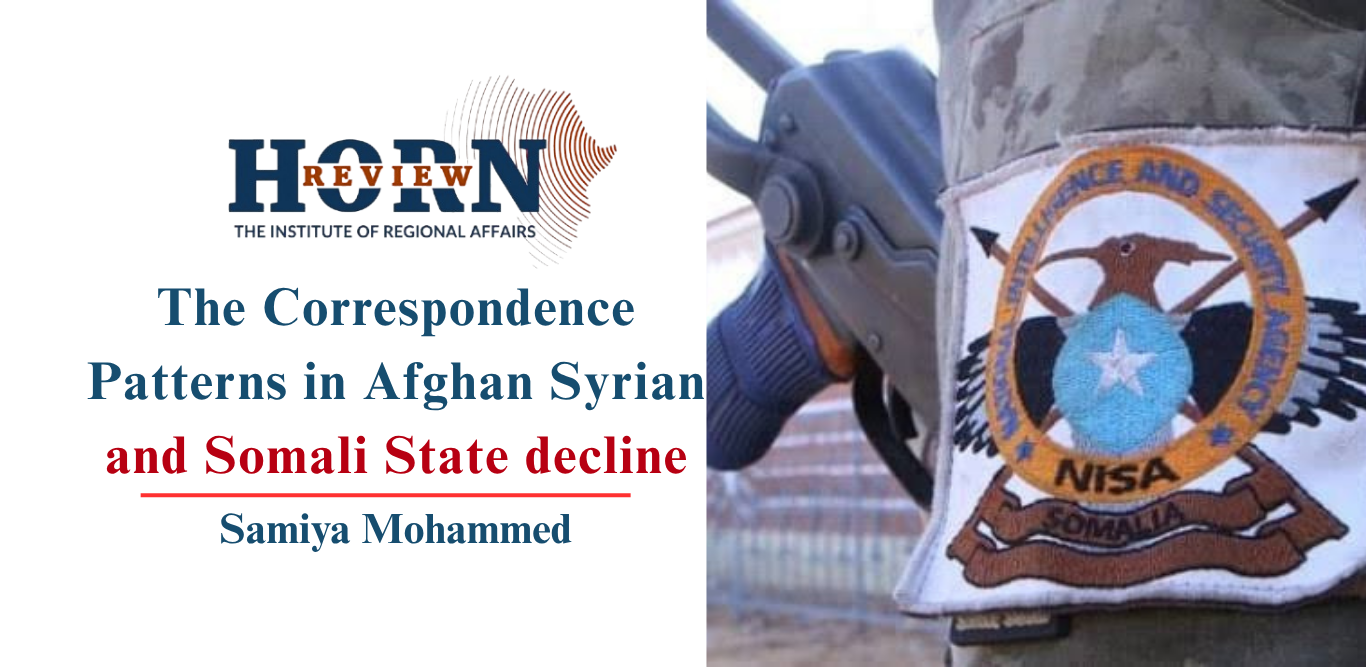
According to multiple sources the official identified by the code name Luqman absconded with unit assets including laptops, communications equipment and files. The implications are severe and specific. NISA is reportedly rushing to contain the crisis but the operational mathematics are unforgiving and if the data includes the identities and locations of informants operating in Al Shabaab controlled territory, the insurgency has acquired a targeting ledger. The risk of a wave of targeted killings of human sources is immediate. This is is the kind of event that causes intelligence networks to go dark as sources rationally maths that the state cannot protect them. The Afghan analog is direct in which the collapse of the Najibullah regime in 1992 and the Taliban’s subsequent consolidation were accelerated by the systematic fraying of KHAD/WAD networks where defections and penetrations rendered the intelligence apparatus incapable of distinguishing friend from foe. Syria under Assad witnessed a similar activity particularly in the early years of the civil war when mass defections from the security services including senior officers with access to detention records and informant lists provided rebel groups with the intelligence necessary to conduct targeted operations against regime assets. A high- evel walk-out with data is not a morale problem however it is an operational haemorrhage.
The defection is seen within the context of NISA’s structural vulnerabilities. The agency has been held with clan based recruitment patterns that prioritize patronage over professional competence and the integration of former Al Shabaab members into units like Dufaan while tactically useful for local knowledge has created persistent counterintelligence challenges. The August 2023 bombing of a military academy allegedly facilitated by a Dufaan member was an early indicator that the unit’s vetting structure was porous. The reported Luqman case if verified would confirm that the porosity extends to the command level.
Simultaneously the external security has underwritten the Somali state’s survival for nearly two decades is entering a phase of accelerated contraction. Uganda has commenced the withdrawal of its troops deployed under bilateral arrangements with the first cohort already returned to Uganda and has announced that all Ugandan forces including those serving under the African Union Support and Stabilization Mission in Somalia will depart by the close of 2027 . Uganda has been the backbone of the African Union mission since 2007 and its departure represents the removal of the most experienced and capable contingent from the battlefield. The timing is exquisitely dangerous and The United Nations political mission in Somalia closed on October 31 removing the primary international mediation mechanism at precisely the moment when Somalia faces its most acute political crisis in years.
The Afghan parallel is not just rhetorical with the U.S announcement of withdrawal in 2020 set in motion a chain of events the Doha Agreement, the release of prisoners, the collapse of Afghan security forces that culminated in the Taliban’s return to Kabul in August 2021. In Somalia the drawdown is not yet a rout but the path is set. The AUSSOM force has warned that the Ugandan withdrawal could leave parts of Lower Shabelle vulnerable to Al Shabaab attacks. Somali officials have acknowledged privately that a sudden pull out could create problems even as they publicly insist that conditions are not dire.
The political dimension compounds the security deterioration. President Hassan Sheikh Mohamud’s term expired in May and his attempt to extend it through parliamentary legislation was ruled unlawful by the Supreme Court on November 5. The court ordered elections within ninety days and gave political leaders thirty days to agree on an electoral framework. The president’s response dismissing the chief justice the day before the ruling has triggered a constitutional confrontation of the first order. The court declared the dismissal null and void and the presidency has not indicated compliance. Opposition leaders,including former President Sharif Sheikh Ahmed have characterized the situation as a gpolitical crisis. The regional administrations of Puntland and Jubaland have rejected the electoral timetable.
The United Nations mission that historically mediated such disputes is gone and no replacement mediator has been agreed upon. This is the legitimacy void that Al Shabaab exploits with patience. The Afghan precedent is instructive with the political rivalries and corruption that hollowed out Kabul’s control were not just background noise to the military struggle and they were the mechanism through which the Taliban’s political commission negotiated surrenders and co opted local power brokers. In Somalia, the federal government’s preoccupation with political survival including the reported deployment of troops around the Supreme Court diverts security resources from the counterinsurgency campaign at the precise moment when Al Shabaab is recovering territory in Hiiraan and Middle Shabelle.
The insurgency meanwhile is not static. Al Shabaab has demonstrated an adaptive capacity that mirrors the Taliban’s post 2001 evolution and it controls rural areas, taxes trade, isolates garrisons, and waits for the state’s external props to weaken. Recent reporting indicates that Al Shabaab has recovered towns in central Somalia including Adan Yabaal, Hawadley and El Baraf and that local clan militias that once partnered with the government such as the Macawisley in Hiiraan have begun reaching accommodations with the insurgency as federal support fails to materialize. This is the Afghan historical play in its essential form in way the Taliban did not defeat the Afghan security forces in conventional battle, it waited for the political will of the external patron to erode for the local militias to calculate that the government was a losing bet and for the security forces to fragment along the same fissures that divided the political class. The Somali National Army like the Afghan National Army before it suffers from clan based recruitment, corruption, and limited cohesion. A high level intelligence defection is the visible tip of a submerged structure of eroding loyalty.
There is a further complication that distinguishes the Somali case from the Afghan and Syrian templates and that is the regionalization of the insurgency’s external support networks. Reporting has documented a deepening operational relationship between Al Shabaab and the Houthi movement including the transfer of expertise in improvised explosive device construction, drone modification, and weapons maintenance. Houthi military engineers have reportedly traveled to Al Shabaab strong holds in southern Somalia and Somali operatives have traveled in the opposite direction for training. The implications are not just tactical. If Al Shabaab acquires the capacity to manufacture or modify drones independently, the threat to African Union forces and to the Somali government’s already limited air mobility becomes qualitatively different. The Houthi relationship also introduces an Iranian proxy dimension to a conflict that has historically been analyzed through the lens of Al Qaeda affiliates and local clan activities. The question of what happens if Al Shabaab achieves a decisive victory whether it would align with the Houthis and the broader Shia axis is speculative but the structural conditions for such an alignment are being constructed through these transfers of material and expertise. The Afghan Taliban maintained a relationship with external patrons, balancing Pakistani, Gulf and Iranian interests and a victorious Al Shabaab would face similar pressures but the Houthi connection would position it within a network that is actively hostile to the maritime order in the Red Sea and Gulf of Aden.
The convergence of these factors like the intelligence penetration, external withdrawal, political illegitimacy and an adaptive insurgency does not guarantee state collapse. Somalia has survived near death experiences before and the federal project retains constituencies that would resist an Al Shabaab takeover. But the warning signs are structural and not incidental. The Afghan government did not fall because of a single battle and it fell because its security services were penetrated, its political class was divided, its external patron had lost the will to sustain it and its opponent understood that the war would be decided by the accumulation of these weaknesses rather than by force of arms alone. Syria’s security apparatus did not disintegrate in a day however it eroded through defections, the loss of external cohesion and the emergence of armed alternatives that filled the space. Somalia is not Afghanistan and it is not Syria. But the institutional pathologies are recognizable and the path is downward. NISA’s scramble to contain the defection crisis may succeed in limiting the immediate damage or it may not. What is clear is that the state’s security is being tested at its most vulnerable point.
By Samiya Mohammed, Researcher, Horn Review