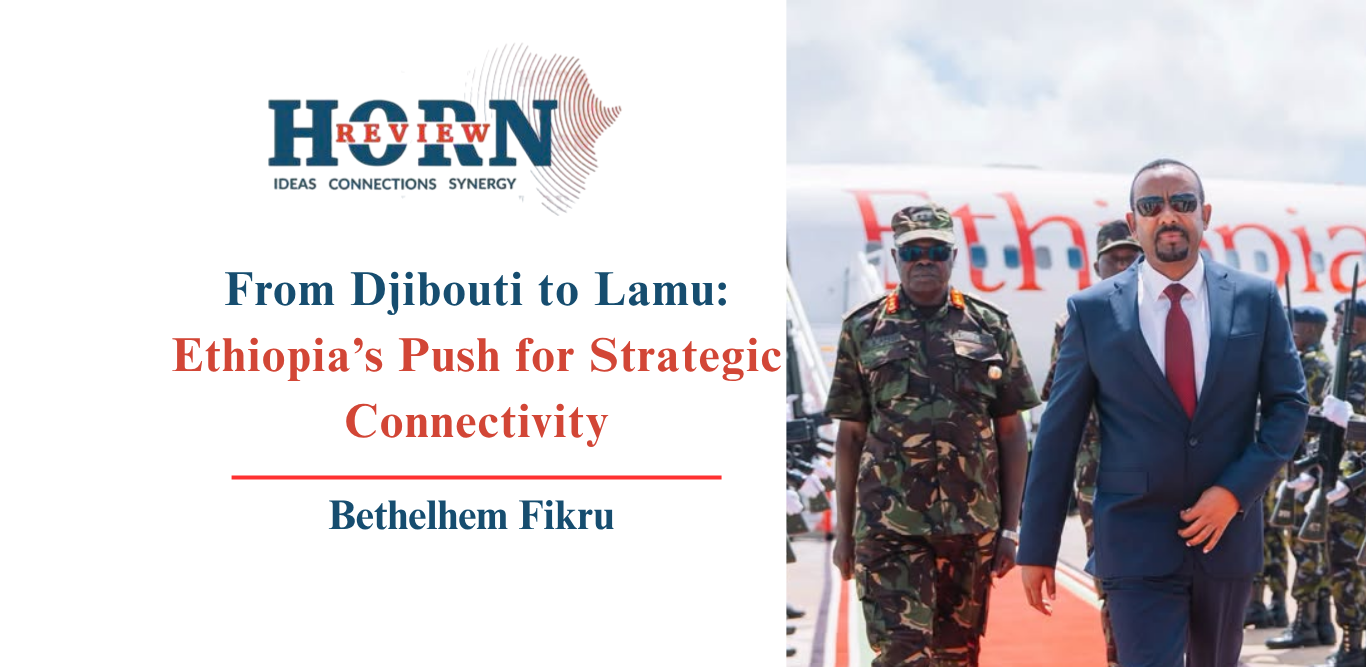
On September 30, Prime Minister Abiy Ahmed travelled to Lamu, Kenya, to attend the groundbreaking of the proposed $16 billion East Africa Petroleum Refinery, a 700,000-barrel-per-day project backed by the Dangote Group. For Ethiopia, however, the significance of the visit extends beyond the ceremony itself. It comes as the country faces renewed fighting in northern Ethiopia while simultaneously pursuing longer-term economic commitments across the region. Prime Minister Abiy’s presence in Lamu therefore offers a window into a broader Ethiopian strategy, maintaining economic and regional engagement even as immediate security pressures intensify, and using connectivity to expand the country’s strategic options.
What makes the visit distinctive is the strategic distance Ethiopia has travelled to make connectivity a pillar of its economic security. The timing is particularly important. Only six days before Abiy arrived in Kenya, Addis Ababa moved to strengthen its established Djibouti fuel corridor through a $660 million refined-petroleum-products pipeline linking Damerjog in Djibouti with Dewele in Ethiopia. The project is intended to improve the movement and storage of petroleum products and make an existing supply route more efficient and resilient.
Six days later, Prime Minister Abiy appeared in Lamu, where another regional energy network is beginning to take shape. The proposed refinery is expected to supply refined petroleum products to markets across East Africa. Dangote has offered East African governments a combined 30 percent stake, with Kenya allocated 10 percent, while Ethiopia and Rwanda have expressed interest in participating. Ethiopia’s final share has not been publicly established. The significance of Addis Ababa’s involvement therefore lies not in a confirmed ownership percentage, but in its effort to position itself within an emerging regional energy asset.
The two developments reveal a coherent calculation. Ethiopia is not replacing Djibouti with Lamu. It is reinforcing the corridor on which its economy already depends while simultaneously developing another potential connection through Kenya. For a landlocked country, this distinction is fundamental. Connectivity is not simply a development objective, it is part of economic security. The more routes Ethiopia can access for fuel, trade and investment, the greater its ability to manage disruptions and reduce the vulnerability associated with dependence on a limited number of external gateways.
This search for alternatives has a much longer history. Ethiopia’s loss of direct maritime access following Eritrea’s cessation in 1993 fundamentally altered its economic geography, making Djibouti the principal maritime outlet for Ethiopian commerce. The resulting relationship became one of the most important economic linkages in the Horn. But the strategic response has increasingly been to complement that established route rather than rely exclusively upon it.
LAPSSET fits directly into this longer search for connectivity. Conceived as a corridor connecting Kenya’s northern coast with Ethiopia and South Sudan, the project was designed to combine port, transport, energy and logistics infrastructure. For Ethiopia, Lamu consequently represents more than access to another Kenyan port. It offers a potential eastern extension of the country’s wider effort to diversify the physical networks through which its economy connects to the outside world.
The importance of this shift becomes clearer when infrastructure moves from plans into actual commercial use. In 2024, an Ethiopian shipment of 60,000 tonnes of fertiliser passed through Lamu Port. The significance was not that the shipment displaced Djibouti. It demonstrated that Lamu could function as another channel for Ethiopian trade. The refinery could take that possibility further by creating a major energy and industrial hub around the port and strengthening the commercial logic of the wider LAPSSET corridor.
This helps explain what Ethiopia is seeking from the Lamu project. The first objective is optionality. Ethiopia’s landlocked geography makes alternative corridors strategically valuable even when they do not immediately operate at the scale of Djibouti. The second is energy security. A major regional refinery could provide an additional source of refined petroleum products and broaden Ethiopia’s supply options. Prime Minister Abiy himself emphasized at the groundbreaking that the project could provide Ethiopia with an additional regional source of refined petroleum and broaden its supply options.
The third objective is economic participation. An eventual Ethiopian equity position would give Addis Ababa an opportunity to participate directly in a regional energy asset rather than remaining solely a consumer of imported petroleum products. The fourth is corridor development. If Lamu becomes a significant regional energy and logistics hub, the economic value of the wider LAPSSET network increases, potentially creating additional opportunities for Ethiopian trade and investment.
The Kenya relationship therefore acquires a broader strategic meaning. Kenya has direct access to the Indian Ocean and is seeking to develop Lamu as a regional gateway. Ethiopia has a large inland market and a structural requirement for dependable external connections. LAPSSET brings those two geographic realities together. Abiy’s presence at the groundbreaking reinforces a relationship in which infrastructure and economic geography are increasingly becoming instruments of regional cooperation.
The role of Dangote adds another dimension. Within the same week, Dangote appeared alongside Ethiopia in two different infrastructure initiatives, the Djibouti-Ethiopia petroleum pipeline and the proposed Lamu refinery. The two projects are not a single integrated undertaking, but their proximity illustrates the growing role of African private capital in connecting national economies across borders. For Addis Ababa, engagement with such capital can help link domestic economic requirements to larger regional infrastructure systems.
The timing of PM Abiy’s visit is also important because renewed fighting has erupted in northern Ethiopia. The latest hostilities involve federal forces and Tigrayan forces and have spread across parts of Tigray and neighbouring areas of Amhara and Afar, placing renewed pressure on the Pretoria peace arrangement reached in 2022. The fighting has created new humanitarian and security concerns and has raised questions about the stability of important regional routes.
Yet the continuation of high-level economic engagement under these circumstances is itself significant. Ethiopia is dealing with immediate security pressures while pursuing infrastructure whose strategic value is measured over years rather than weeks. The Lamu visit should therefore not be read as evidence that domestic security concerns have become secondary. Rather, it shows that Addis Ababa continues to treat economic connectivity as a long-term national requirement even while managing renewed instability in the northern part of the country.
This is what makes the September sequence particularly revealing. On September 24, Ethiopia was strengthening the infrastructure around the corridor it already relies upon. On September 30, Prime Minister Abiy Ahmed was standing in Lamu at the beginning of a project that could strengthen another regional energy corridor. One move reinforces an existing connection; the other creates the possibility of a new one. The logic is cumulative rather than substitutive.
For Ethiopia, therefore, the strategic value of Lamu is not simply that it provides another place through which fuel could eventually enter the country. Its deeper value is the possibility of building greater room for manoeuvre around a structural geographic constraint. Djibouti remains indispensable. Lamu does not need to replace it to be strategically useful. The value lies precisely in having more than one viable pathway and in developing relationships that make those pathways increasingly commercially meaningful.
Prime Minister Abiy’s September 30 visit should consequently be understood as another stage in Ethiopia’s long search for strategic connectivity. The ceremony in Lamu is the visible event, but the larger story is the infrastructure emerging behind it: an established Djibouti corridor being strengthened, a Lamu corridor being developed, and a regional energy system becoming increasingly interconnected. At a moment when renewed fighting in northern Ethiopia is demanding immediate attention, Addis Ababa is continuing to invest in an economic architecture whose importance extends beyond the present crisis. For a landlocked state, connectivity is not an optional development ambition. It is a central component of economic resilience and strategic room for manoeuvre.
By Bethelhem Fikru, Researcher, Horn Review