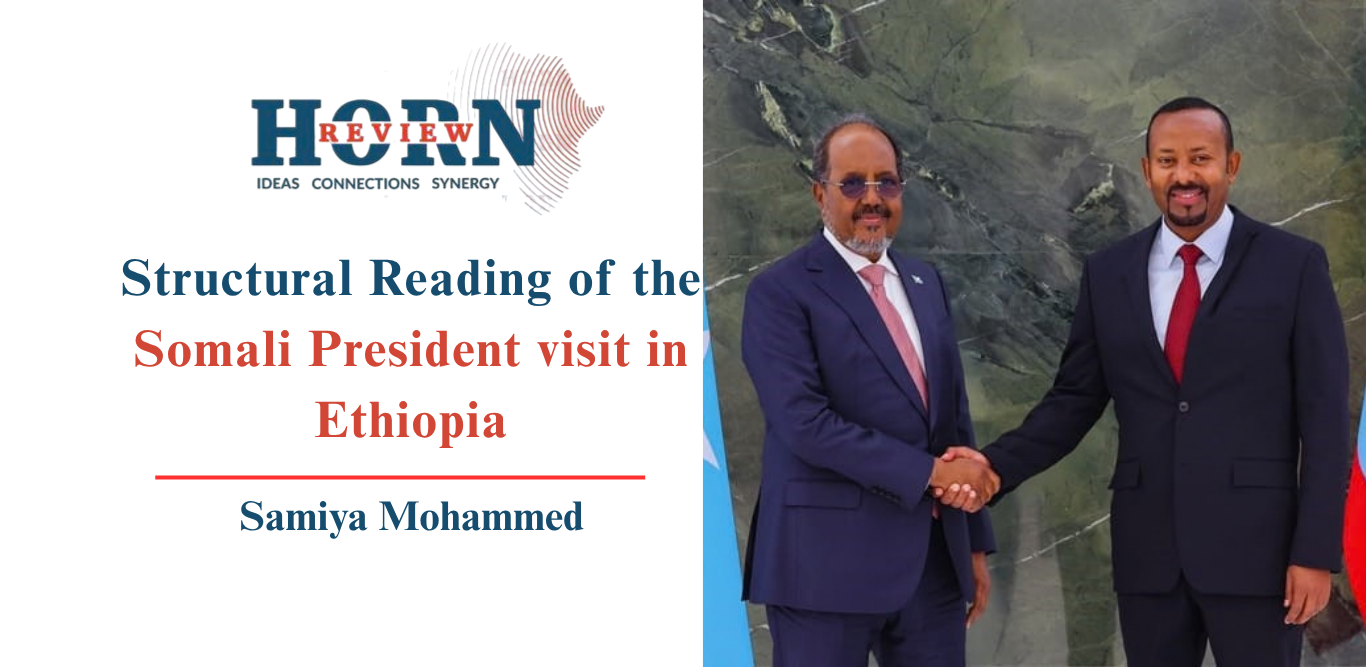
Somali President Hassan Sheikh Mohamud held a one day working visit with Prime Minister Abiy Ahmed on 29 September. The stated purpose was bilateral consultation and Horn security. No deals were published and the working content was not disclosed. Four connected files were live that these files form the probable private agenda. The defence of Baidoa is the first file and following the 28 September assault. Somali soldiers detained in Ethiopia’s Somali Regional State are the second file. The continuation of Ethiopian troops under AUSSOM after earlier withdrawals in Bay is the third file. The political meaning of the president’s immediate travel toward Egypt is the fourth file. A wider meeting with Egypt, Eritrea and Sudan is possible.
The counter terrorism mandate question concerns Somalia’s effort to secure active Ethiopian National Defense Force participation in the defence of Baidoa. Somalia is losing control of the city. It states that it possesses evidence that forces aligned with Laftagareen are coordinating attacks on Baidoa with Al Shabaab. On that basis it argues that ENDF engagement in the city’s defence would fall within the AUSSOM counter terrorism mission. This is a mandate expansion argument and It seeks to convert an intra Somali political and military contest into a counter terrorism operation thereby creating a legal and operational basis for direct Ethiopian involvement in urban combat.
Ethiopia’s position on this question is one of strict neutrality. The ENDF posture in Sector 3 has consisted of forward operating bases and installations rather than street fighting. Ethiopia already declined to intervene to save Laftagareen in March. The structural logic of that decision remains unchanged. Accepting Somalia’s framing would require Ethiopia to choose a side against a former useful regional actor, abandon neutrality and assume responsibility for the outcome if the city still falls. Ethiopia therefore treats the claim of Al Shabaab coordination as brief rather than as a verified finding. The analytical distinction Ethiopia maintains is between Al Shabaab as the common enemy and Somali factional war as a separate matter. The AUSSOM mandate language is not treated as an order to fight Laftagareen in the city.
The sustainability of Ethiopian troop presence forms a related question. Somalia’s concern is that a protracted and widening conflict may catalyze an Ethiopian military retreat from Bay and Bakool creating a space that Al Shabaab is positioned to fill. The AUSSOM funding crisis has already compelled Ethiopia to pull out troops from Qansaxdheere and other localities. The Somali President’s argument is therefore one of security continuity. He seeks maintenance of Ethiopian troop support and warns that what happens in Baidoa does not stay in Baidoa. Ethiopia’s structural position is that the drawdown is funding driven and that any replacement must be real SNA forces rather than a press release. This is a conditionality framework and not an open ended commitment.
The detainee file is a separate structural question. Approximately two hundred Somali army soldiers crossed into the Somali Regional State of Ethiopia ostensibly to see family. They are being interrogated for possible links to the ONLF. Somalia describes the crossings as family leave justified by the unsafe condition of Somali roads. Ethiopia’s structural questions are different and They concern Ethiopian nationals serving in a foreign army, the arms involved, the command structure, the question of ONLF links and dual loyalty and broader concerns about a Saudi funded pipeline and rumours of onward use. Ethiopia’s position is that detainees are a security file not a favour. Release should follow screening and a written protocol for future crossings. It should not take the form of a photo op amnesty. The Somali Region sovereignty question is prior to any transactional release arrangement.
President Mohamud is scheduled to travel to Egypt immediately after Addis but no public Somali statement has defined that stop as unconnected to Ethiopia’s internal conflict or presented it as just political hygiene. The itinerary is sequential yet Ethiopia’s concern is structural which is a bilateral Egypt visit is one category of diplomacy while a possible Egypt, Eritrea and Sudan format is another because those three states have already issued a joint line on Ethiopia’s internal war including an external peace mechanism. Somali presence in that room would convert an ordinary stop into participation in a third party political frame. Ethiopia’s position follows mandate boundaries rather than courtesy. Somalia may visit Egypt but it does not acquire a role in the management of Ethiopia’s internal conflict, language on non interference, territorial integrity or Red Sea order cannot be imported from that table as Somali policy and ENDF presence in Somalia remains a counter terrorism and frontier function under AUSSOM and not payment for seating arrangements elsewhere. The test is therefore conduct after the meeting with no Somali endorsement of the three state initiative, no joint framing of Ethiopia as the regional problem and no substitution of Egyptian military presence for Ethiopian posts in Bay and Bakool. Somali neutrality is a policy status not a vehicle for another coalition’s Ethiopia file.
The Kenyan consideration operates as a second order matter. If the ENDF pulls out of Bay and Bakool, Al-Shabaab fills the space and insecurity spills into Mandera and Wajir. Kenya’s concern is real as contagion risk. It is not however a reason for Ethiopia to bleed in Baidoa. Bay is depth and Gedo is the hinge. If the SNA collapses and Al Shabaab moves west, Ethiopia’s Somali Region feels the effect before Kenya does. The Kenyan concern is acknowledged but subordinated to Ethiopian frontier logic.
The structural conclusions follow from the same linked questions rather than from any published communiqué. Ethiopia will not convert the ENDF into Somalia’s instrument in Baidoa and AUSSOM mandate language does not authorise urban combat against Laftagareen aligned forces. Any further adjustment of the Ethiopian presence is funding driven so replacement has to be an actual SNA occupation of vacated ground rather than a paper handover. The detained Somali soldiers are a border security file and they leave after screening and a written crossing procedure not as a political favour. Egypt can be noted as itinerary and Ethiopia’s internal security is not Somali mediation brief. Somalia does not endorse an external mechanism over Ethiopia’s civil conflict and no joint statement should treat Ethiopia as the regional problem. Egyptian forces in Somalia stay out of Bay and Bakool and off the logic of the Ethiopian frontier. Red Sea language cannot be turned into a veto on Ethiopian maritime access. The Somali president may visit Cairo but Somali neutrality is a policy status,not a channel through which another coalition’s Ethiopia file is brought home.
The analytical requirement is to keep those categories apart. Ethiopia’s posture is therefore defined by mandate and not by concession. The posture consists of neutrality in Somali factional contest a thin and useful ENDF presence tied to counter terrorism and frontier logic, no urban combat against Laftagareen aligned forces under AUSSOM language, no Somali endorsement of an external mechanism over Ethiopia’s civil conflict,no joint framing of Ethiopia as the regional problem, no Egyptian military substitution in Bay and Bakool and no conversion of Red Sea language into a veto on Ethiopian maritime access. The Somali governments task is to argue for Ethiopian engagement inside those boundaries and not to treat Ethiopian internal security as a bargaining chip. The visit has set the terms and Implementation is the test
By Samiya Mohammed, Researcher, Horn Review