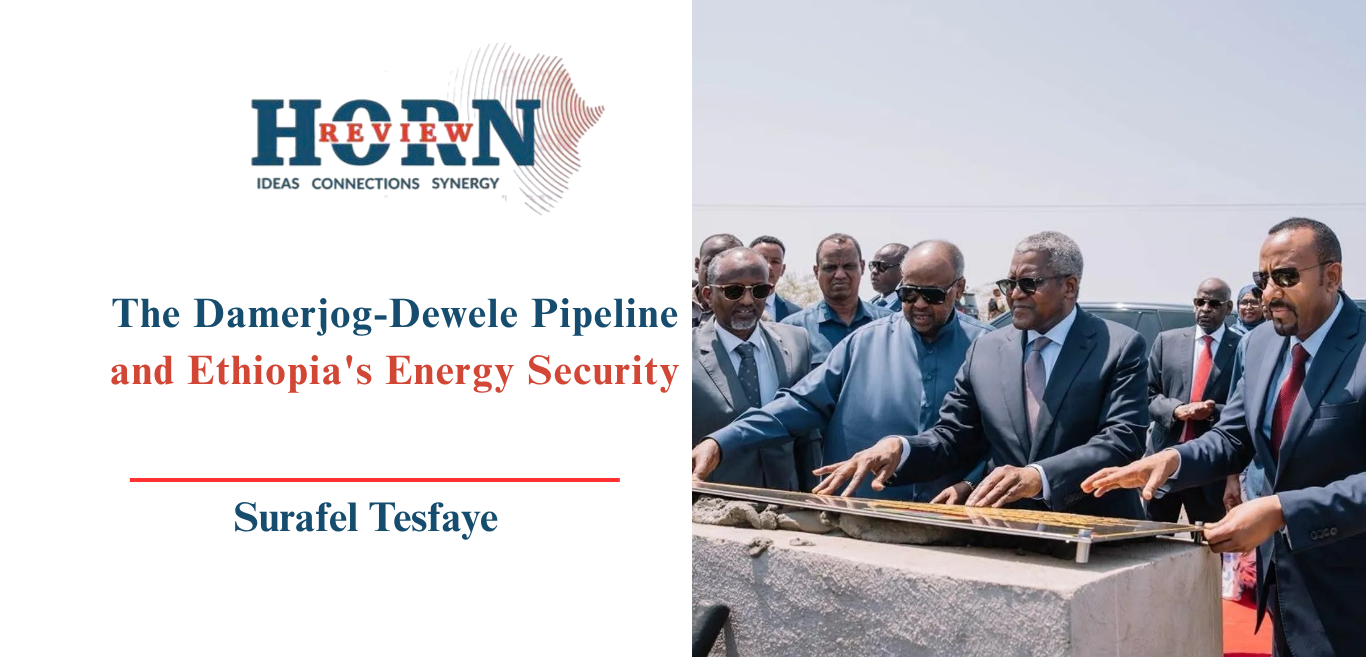
Ethiopia and Djibouti, alongside the Dangote Group, have moved forward with a project that could reshape how Ethiopia secures its most critical imported commodity. The plan involves a 120-kilometer refined petroleum products pipeline running from Damerjog in Djibouti to Dewele on the Ethiopian side of the border. On the Djiboutian end, the project includes roughly 375,000 cubic meters of storage capacity at Damerjog. On the Ethiopian side, the Dewele facility will add approximately 800,000 cubic meters of storage, bringing combined capacity to more than one million cubic meters. The pipeline is expected to begin operations within eighteen months, and Prime Minister Abiy Ahmed has described it as a joint venture between the Dangote Group and Ethiopia that will reduce the time needed to move fuel from Djibouti’s port to Addis Ababa from five days to one.
To understand the significance of this project, one has to look at the system it replaces. Ethiopia has depended on thousands of tanker trucks to move fuel roughly 750 kilometers from Djibouti’s port to distribution points inside the country. That arrangement has been functional, but it carries costs that are not always visible on paper. When fuel vessels dock at Djibouti and face delays because inland storage is full or trucks are stuck in traffic, Ethiopia pays demurrage fees in United States dollars to international shipping lines. These penalties compound quickly and drain hard currency that the country cannot easily replace. A significant portion of Ethiopia’s scarce foreign exchange reserves also goes toward buying truck spare parts, tires, and maintenance equipment just to keep the fleet of more than a thousand daily tankers running. The pipeline removes the most volatile cargo, petroleum and jet fuel, from both the highway and the rail lines. That leaves the railway free to focus on dry container traffic, which in turn reduces pressure on the transport systems supporting industries such as aviation, agriculture, and construction.
The storage dimension of the project addresses a vulnerability that has affected Ethiopia for years. By installing more than one million cubic meters of combined capacity at both ends of the corridor, the pipeline gives Ethiopia a strategic reserve cushion that it has not previously possessed. When a maritime blockade, a port delay, or a sudden disruption interrupts the supply chain, the state can draw on stored reserves rather than face immediate domestic energy paralysis. That cushion matters because Ethiopia’s fuel supply has historically been exposed to forces beyond its control. Before the war in Sudan, Ethiopia sourced a portion of its refined fuel from the Sudanese Petroleum Corporation. The conflict in Sudan has pushed the Ethiopian Petroleum Supply Enterprise to rely almost exclusively on the international market, sourcing primarily from Saudi Aramco, Kuwait Petroleum Corporation, and increasingly from ADNOC of the United Arab Emirates through the port of Djibouti. The pipeline does not change where the fuel comes from, but it changes how reliably and how quickly that fuel can be moved inland once it arrives.
There is a broader industrial logic to the project that extends beyond fuel. The Dangote Group is concurrently developing a natural gas extraction plant, a power station, and what is expected to become East Africa’s largest urea fertilizer plant in the Ogaden Basin. The refined fuel imported through the new Djibouti pipeline serves as the industrial energy anchor for that complex. In practical terms, the pipeline stabilizes the domestic fuel supply that the Gode industrial complex needs to operate, while the gas and fertilizer produced there generate future foreign currency through exports to regional markets. The two projects reinforce each other. Fuel security enables industrial production, and industrial production creates the export earnings that pay for fuel imports.
The Ogaden Basin carries a complicated history. It has been a flashpoint for ethnic tensions and insurgent activity, most notably through the historical presence of the Ogaden National Liberation Front. Introducing massive infrastructure into that environment, including natural gas export pipelines, a power station, and a fertilizer plant, requires a significant federal security presence. The transformation of the region into an economic zone carries political weight alongside its economic value. When the state brings large-scale investment and employment into a peripheral region, it changes the relationship between the center and the periphery in ways that go beyond revenue collection. The development of the Ogaden as an industrial corridor represents a long-term commitment to integrating the region into the national economy through investment rather than through security measures alone.
At the regional level, the project deepens the engagement between Ethiopia and Djibouti in a way that reflects what interdependence means in practice. Ethiopia relies on Djibouti’s port for the overwhelming majority of its imports, including petroleum products. Djibouti, in turn, derives significant revenue from serving as Ethiopia’s gateway. The pipeline formalizes and expands that relationship by creating physical infrastructure that ties the two economies more closely together. For Ethiopia, the benefit is not only speed and cost reduction but also a measure of insulation from the kinds of disruptions that arise from conflict in the wider region, including the Red Sea corridor and the Gulf states. The combined storage at both ends of the pipeline allows the system to absorb difficult periods and to keep functioning when maritime routes or port operations are interrupted.
This is where the concept of the economics of conflict becomes relevant. Ethiopia has historically been vulnerable to choke points, particularly because its trade routes pass through narrow corridors that can be disrupted by conflict or political tension. The pipeline does not eliminate that vulnerability, but it reduces the number of ways in which it can be exploited. A trucking fleet can be blocked at a border crossing or slowed by road conditions. A pipeline is a fixed asset that can be protected and monitored. By moving a substantial share of the corridor’s cargo into a pipeline, Ethiopia reduces the operational dollar drain that comes with maintaining a large trucking fleet and shifts that money toward other priorities. The pipeline also reduces the time fuel spends in transit, which matters both for cost and for the reliability of supply to consumers and industry.
The project also represents a shift toward African mega-capital. The involvement of the Dangote Group, a private African conglomerate with a track record in large-scale industrial projects, signals a different model of financing and development than the traditional reliance on Western or Chinese contractors. This is infrastructure built by African capital, for African markets, and it reflects a broader trend of intra-African investment that has gained momentum in recent years.
What this project ultimately offers Ethiopia is a measure of control over a supply chain that has always been precarious. By investing in storage, pipelines, and industrial capacity, Ethiopia is building the kind of infrastructure that turns a geographic constraint into a manageable logistical challenge. The Damerjog-Dewele pipeline addresses the immediate need for faster, cheaper, and more reliable fuel delivery. The Ogaden industrial complex addresses the longer-term need for domestic energy production and export revenue. Together, they represent a coherent strategy for strengthening Ethiopia’s economic position in a region where disruption is more common than stability.
By Surafel Tesfaye, Researcher, Horn Review