The recalibration of United States–Ethiopia relations recently reflects a deeper structural shift in how Washington approaches the architecture of regional order in the Horn of Africa. Rather than treating the relationship as a residual legacy of earlier eras or a reactive instrument of crisis management, the sequence of institutional, military and political measures undertaken during this period indicates a deliberate effort to restore functional pathways of cooperation with a capable regional actor. This restoration arises from a convergence of incentives in which the United States seeks reliable institutional partners capable of generating strategic depth along the Red Sea corridor without large-scale direct intervention, while Ethiopia seeks external partnerships that reinforce its capacity to shape regional security outcomes without sacrificing decision-making autonomy. The resulting dynamic privileges institutional consolidation and long-term positioning over episodic tactical engagement. Understanding the significance of the present moment requires situating it within a century of evolving strategic interaction rather than treating recent events as an isolated rapprochement.
Diplomatic relations between Ethiopia and the United States trace back more than a century to the 1903 treaty of commerce signed under Emperor Menelik II, establishing one of the earliest formal connections between the United States and an independent African state. During the Italian invasion of 1935–1936 and the subsequent occupation, the United States maintained a legation in Addis Ababa and never formally recognized Italian sovereignty. In February 1937, following the Yekatit 12 massacre, American Minister Resident Cornelius Van H. Engert provided refuge to approximately seven hundred Ethiopian civilians within the legation compound. This episode represented limited but concrete humanitarian protection amid the broader constraints of American isolationism, no substantial military assistance was extended. The episode illustrated an early pattern of intermittent diplomatic presence without institutional depth.
The postwar period transformed Ethiopia’s strategic value. After the Allied liberation, an American military communications facility was established in Asmara in 1943 on the site of the former Italian Radio Marina. Named Kagnew Station in reference to Ethiopian military tradition, including the Kagnew Battalion that fought under United Nations command alongside American forces in the Korean War, the facility was formalized by the 1953 Mutual Defense Assistance Agreement and Defense Installations Agreement. For the United States, Kagnew provided tangible strategic advantages: it served as a major node in global strategic communications, a Navy communications station supporting forces east and south of Suez, an earth terminal for satellite systems and a significant signals-intelligence site. Its high-altitude location near the equator offered exceptional conditions for high-frequency propagation and interception.
For Ethiopia, the arrangement delivered substantial military assistance, training, and equipment that expanded the capacity of the imperial armed forces, along with enhanced international strategic relevance as a partner of a major power. The exchange rested on complementary interests: American requirements for reliable facilities in a contested region and Ethiopian interest in external support that reinforced rather than subordinated its regional standing. The 1974 revolution and subsequent realignment with the Soviet Union ruptured these institutional pathways. Partial recovery occurred after 1991, but the relationship remained limited until the post-2001 period.
The post-Cold War and post-2001 periods demonstrated a different form of strategic utility. Under Prime Minister Meles Zenawi, Ethiopia positioned itself firmly against the expansion of political Islam and militant movements in the Horn, a stance that increasingly converged with Washington’s counterterrorism priorities. Ethiopia’s strategic location and established military relationship also reinforced its relevance during the wider American security campaigns of the early 2000s, including the period surrounding the U.S.-led war against Saddam Hussein’s Iraq. In Sudan and the wider Horn, Ethiopia’s opposition to Islamist militancy and its capacity to engage regional conflicts made it an important security interlocutor for Washington. This convergence became most visible in Somalia.
In late 2006, Ethiopian forces intervened against the Islamic Courts Union, whose consolidation of power raised concerns in Addis Ababa and Washington. Ethiopia feared an Islamist government that could support irredentist claims, provide space for Ethiopian insurgent groups, and strengthen ties with Eritrea, while the United States saw Ethiopia as the region’s most capable military partner and a means of confronting Islamist threats without a major American ground deployment. With U.S. intelligence and logistical support, Ethiopian forces rapidly removed the Courts from Mogadishu, although the conflict subsequently contributed to the emergence of Al-Shabaab as a more radical and durable insurgency. Ethiopia’s role in regional peacekeeping and conflict management, including in Sudan and South Sudan, further demonstrated that its strategic value to Washington extended beyond geography to military capability and regional influence. These partnerships, however, remained largely driven by specific security crises rather than the permanent institutional architecture that had characterized the Kagnew era.
The 2020 northern conflict exposed the limits of the previous partnership. Sanctions, arms-export restrictions, and heightened scrutiny narrowed institutional channels and revealed the vulnerability of cooperation when domestic political and human-rights concerns diverged from security interests. The Pretoria Agreement reopened political space, the measures now underway test whether that space can support more resilient mechanisms.
If the Cold War partnership was built primarily around Ethiopia’s strategic geography, and the post-2001 relationship around its counterterrorism capacity, the current defence emerging partnership of is increasingly being shaped by Ethiopia’s value as an autonomous regional actor capable of influencing security, diplomacy, logistics and political outcomes across the Horn of Africa.
The contemporary developments form a cumulative chain of evidence rather than isolated events. The Bilateral Structured Dialogue Framework, signed in May 2026 in Washington by the Ethiopian Foreign Minister and U.S. Under Secretary for Political Affairs formalized three interconnected pillars,economic engagement, defense and security cooperation, and regional peace and stability, moving the relationship from ad-hoc interaction toward predictable transmission mechanisms. The agreement reflected a mutual interest in institutionalizing dialogue after years of narrowed channels, providing both sides with a structured framework through which converging security and economic priorities could be pursued more consistently.
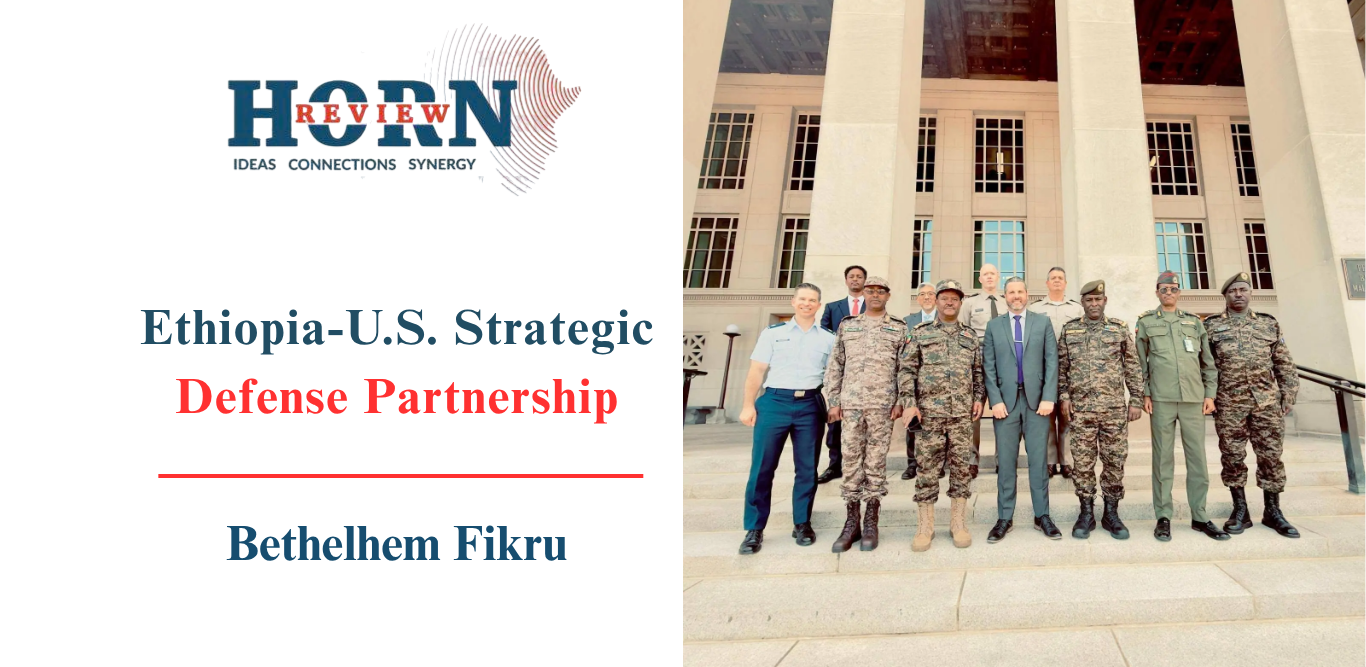
Concurrently, the termination of the arms-export policy of denial replaced a presumption of rejection with case-by-case evaluation, restoring institutional pathways for potential transfers, training, and technical collaboration. The visit of the AFRICOM commander in late July, including the co-hosting of a logistics and communications symposium with the Ethiopian National Defense Force and high-level discussions with civilian and military leadership, demonstrated operational recognition of Ethiopia’s capacity. The August Pentagon consultations between senior Ethiopian defense officials and their American counterparts produced agreement to expand institutional cooperation and strengthen strategic coordination. Targeted visa restrictions on hardline elements associated with the Tigray People’s Liberation Front clarified political signaling by distinguishing actors assessed as undermining the Pretoria framework from the broader federal system. Each step reveals a preference for embedding cooperation within professional military and defense-diplomatic networks rather than relying solely on episodic political summitry or large permanent bases.
This recalibration matters now because the regional environment has changed. Red Sea insecurity, the conflict in Sudan, Somalia’s security transition and the persistence of Al-Shabaab, expanding Gulf influence, and intensified great-power competition have increased the premium on capable regional partners that can act without requiring large-scale American direct intervention. Washington’s preference has shifted toward institutional partnerships that generate influence and situational awareness at lower political and material cost. Ethiopia, for its part, continues to pursue strategic autonomy through diversified partnerships while recognizing that selective cooperation with the United States can reinforce defense capacity, diplomatic standing, and economic opportunity. Its landlocked geography generates enduring imperatives around maritime access and trade corridors; neighboring states interpret these policies through their own security lenses. Somalia has viewed certain approaches as challenges to territorial integrity, Egypt has assessed Ethiopian hydro-politics in light of Nile concerns, other external actors pursue parallel agendas that sometimes align and sometimes complicate Ethiopian objectives.
Deeper institutional cooperation could strengthen bilateral predictability and raise the costs of future disconnection. It could also enhance capacity for addressing transnational threats, contributing to maritime security, and managing regional conflicts in Somalia, Sudan, and the wider Horn. These arenas of cooperation promise to strengthen a relationship that is not without constraints.
The current relationship is not a return to the Kagnew model of territorial access and large-scale basing geopolitical conditions, technology, and Ethiopian strategic autonomy have all changed. Continuity lies in the underlying strategic logic that cooperation between the two systems can generate mutual utility when interests align and institutions function. The fundamental difference lies in the preference for flexible institutional mechanisms over fixed physical presence.The present moment therefore represents not a simple restoration of an old alliance but a new phase of strategic repositioning. Its durability will depend on whether both countries can convert renewed engagement into sustained institutional cooperation under fundamentally different regional conditions.
Bethelhem Fikru, Researcher, Horn Review