
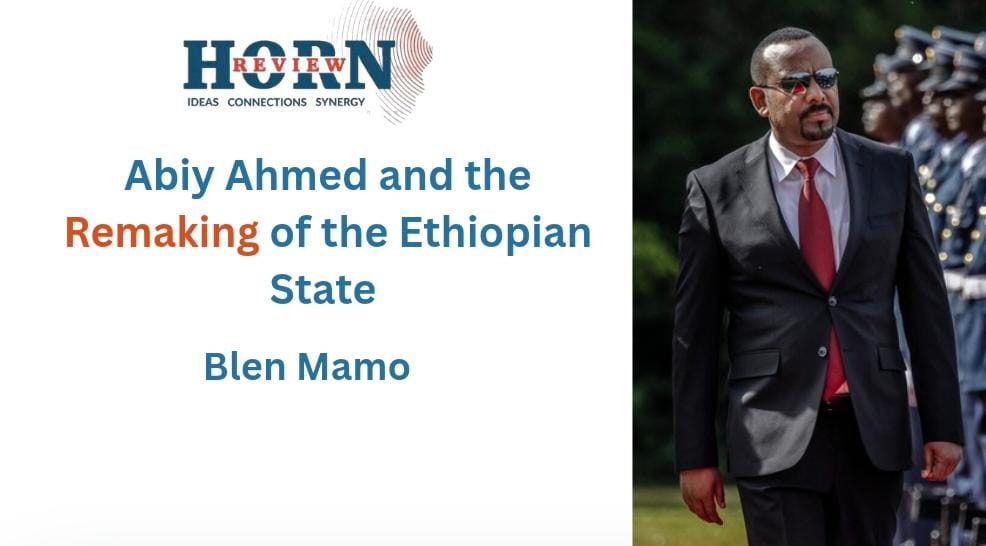
Abiy Ahmed and the Remaking of the Ethiopian State
Blen Mamo
The political trajectory of Abiy Ahmed cannot be adequately understood through the conventional categories of Ethiopian political debate. To describe his political project simply as democratization, authoritarian consolidation, ethnic federalism, or centralization is to capture fragments of a larger political phenomenon. At its deepest level, Abiy’s leadership represents an attempt to answer a question that has confronted the Ethiopian state across successive historical epochs: what kind of state can preserve Ethiopia as a coherent political community while releasing the economic, cultural, institutional, and geopolitical potential contained within its extraordinary historical inheritance? The answer Abiy has pursued emerges from a distinctive conception of Ethiopia itself. His political imagination appears to begin less with an externally prescribed model of statehood than with Ethiopia as a historical and civilizational formation. This is consequential because much of modern Ethiopian political history has involved the incorporation of intellectual and institutional models originating beyond the country’s own political experience.
Imperial modernization, revolutionary socialism, Marxism-Leninism, developmentalism, and ethnic federalism each provided different answers to the problem of how Ethiopia should be organized. Abiy’s distinctive proposition is that the starting point should instead be Ethiopia: its history, civilizational continuity, social plurality, economic possibilities, geopolitical position, and accumulated political experience. This inward point of departure provides the intellectual foundation for understanding both the appeal and the controversy surrounding his leadership. Abiy does not appear to approach the Ethiopian state merely as an administrative apparatus requiring reform. He approaches it as the institutional expression of a much older political civilization whose capacities have been constrained by fragmented political identities, weak institutions, economic underdevelopment, and imported conceptual frameworks. His political project consequently seeks not simply to modify the existing state but to remake the relationship between state, citizen, nation, and historical identity. Yet the attempt to remake the state inevitably raises a second question: what kind of political personality is capable of undertaking such a project?
Abiy’s leadership cannot be separated from his particular mode of political reasoning. His public discourse, emphasis on synthesis, preference for expansive national narratives, confidence in the transformative capacity of the state, and recurring invocation of Ethiopia’s historical and civilizational significance suggest a leader who understands politics not principally as the management of existing institutions but as the reconstruction of political possibility. His concept of Medemer is therefore significant not only as a doctrine but as a window into his political personality. It reveals a preference for synthesis over permanent antagonism, integration over political fragmentation, and historical continuity over rupture. This orientation also helps explain the significance of his approach to the Ethiopian state. The central question is not whether Ethiopia requires a stronger state, but what kind of political community that state should serve and what institutional framework can give expression to Ethiopia’s diversity while preserving its common national interests. Abiy’s emphasis on national institutions, common citizenship, economic integration, infrastructure, and a broader conception of Ethiopian identity can therefore be understood as part of an effort to redefine the relationship between Ethiopia’s diverse political communities and the state as a whole. This does not mean that the transformation he seeks is without tensions or contradictions. Abiy inherited a political system in which ethnic, linguistic, regional, and national identities became deeply embedded in the organization of political power. Any attempt to strengthen common national institutions therefore necessarily raises questions about the appropriate balance between national cohesion and political diversity. The challenge is not simply to choose between centralization and decentralization, but to determine how national institutions and regional political identities can coexist within a coherent constitutional order.
From this perspective, the strengthening of national institutions should not be understood in isolation from the broader problem of state capacity. Ethiopia entered Abiy’s tenure with deep institutional fragmentation, contested national narratives, unresolved questions of sovereignty, and an uneven distribution of state capacity. The challenge facing his government was therefore not merely how to distribute power among existing political structures, but how to determine whether the Ethiopian state could continue to function as a coherent political entity while responding to the country’s extraordinary social and political diversity. Abiy Ahmed should thus be understood as a state-builder whose political imagination is rooted in an internally generated conception of Ethiopia as a civilizational state, and whose project seeks to reconcile national cohesion, institutional capacity, economic transformation, and Ethiopia’s profound internal diversity. His significance lies precisely in the attempt to bring these dimensions together. This perspective also places Medemer in a broader context. Rather than treating it merely as a political slogan or ideological formulation, it can be understood as an expression of a wider attempt to overcome inherited political binaries. The objective is not necessarily to erase differences but to establish a political framework in which difference does not inevitably translate into institutional fragmentation. In this sense, synthesis becomes a political principle: the search for forms of statehood capable of accommodating diversity while maintaining a shared national project.
Abiy’s political personality dimension is also indispensable to the debate over whether he represents an imperial restoration or a republican reconstruction. The question arises because, as stated above, his conception of Ethiopian statehood draws simultaneously upon historical continuity and the requirements of a modern political order. The important analytical question here is what political meaning these debates acquired within the institutional and constitutional framework of contemporary Ethiopia. The imperial interpretation emphasizes continuity. From this perspective, Abiy’s national narrative, his emphasis on Ethiopian historical identity, and his preference for a strong and coherent center can be read as drawing upon political ideas associated with earlier Ethiopian state formation. The concern is not necessarily that Abiy literally seeks to reproduce the imperial order, but that his conception of national unity may resonate with older understandings of Ethiopia in which political coherence was closely associated with the strength of the center. This interpretation therefore places particular emphasis on historical continuity and on the possibility that inherited political ideas continue to shape contemporary state-building. The republican interpretation begins from a different premise. It argues that national cohesion and a strong state need not belong exclusively to an imperial political tradition. A republic also requires capable national institutions. Territorial integrity, equal citizenship, equitable public infrastructure, economic coordination, national security, and a common legal and political framework all require forms of authority that extend beyond regional or communal institutions. From this perspective, Abiy’s project can be understood not as an attempt to reproduce an earlier political order, but as an effort to construct a civic Ethiopian political community in which common citizenship can coexist with profound ethnic, linguistic, religious, and regional diversity.
Abiy’s emphasis on national cohesion is well interpreted as both a continuity with Ethiopia’s older traditions of state formation and national authority as a political foundation, and as an attempt to construct a modern republican state capable of integrating a highly diverse society. Ethiopia is drawing upon historical and civilizational continuity without reproducing the institutional arrangements of an earlier era. Likewise, his republican state-building efforts cannot be understood independently of the country’s unusually deep historical experience of statehood. His emphasis on synthesis through Medemer provides a conceptual framework within which historical continuity and institutional transformation can coexist. Rather than treating Ethiopia’s past as something from which the modern state must decisively separate itself, his political imagination appears to regard that past as a source of political resources that can be reinterpreted for contemporary purposes. The question Abiy is attempting to resolve is therefore not whether Ethiopia should choose between its historical inheritance and republican modernity, but whether its historical inheritance can be transformed into the foundations of a modern Ethiopian republic. Abiy’s political personality thus inhabits the republican state-builder and a political figure committed to form a strong national executive.
Abiy favors stronger national authority, but that authority is intended to contribute to the construction of durable republican institutions and a political community organized around citizenship. His political project, therefore, cannot be reduced to one conventional category. Such a binary obscures the historical process underway. The more consequential question is whether his attempt to recover Ethiopia’s internal civilizational resources, strengthen state capacity, develop common national institutions, respond to the limitations of the existing political order, and reposition Ethiopia within the contemporary international system can be translated into institutions that outlast his political tenure. This is where the remaking of the Ethiopian state becomes the central object of analysis. Abiy’s project should neither be oversimplified as an uncomplicated national renaissance nor reduced to a familiar historical category. It is better understood as a contested attempt to reconstruct Ethiopian statehood from within – drawing upon Ethiopia’s historical and civilizational inheritance while seeking to adapt it to a post-modern, technologically transformed, economically interconnected, and institutionally plural twenty-first century. The political legacy of Abiy Ahmed will ultimately depend upon whether this process succeeds in producing a political order capable of combining national cohesion with institutional durability, state capacity with political inclusion, and historical continuity with adaptation to the demands of the contemporary context of the Ethiopian state. The central issue is therefore not the restoration of a previous political order, but the possibility of building a new Ethiopian republic from the resources of Ethiopia’s own historical experience.
Authors Bio
Blen Mamo is Executive Director of Horn Review and a researcher specializing in law, international security, and geopolitics in the Horn of Africa. She holds an LL.B and an M.Sc. in International Security and Global Governance.

RELATED
Posts
17
Oct
Russia’s Mediation Offer Between Ethiopia and Eritrea
Russia’s decision to offer a platform for contacts between Ethiopia...
15
Oct
The Aswan Dam and Ethiopia’s Longstanding Rejection of Egypt’s Nile Veto
On 29 May 1956, before construction of the Aswan High...
15
Oct
Why Somalia’s Hedge between Ethiopia and Egypt Cannot Last
The public position articulated by Somalia’s Deputy Foreign Minister Hassan...
15
Oct
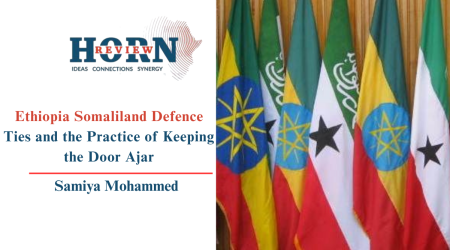
Ethiopia Somaliland Defence Ties and the Practice of Keeping the Door Ajar
The recent meeting between Brigadier General Nimcaan at the...
15
Oct
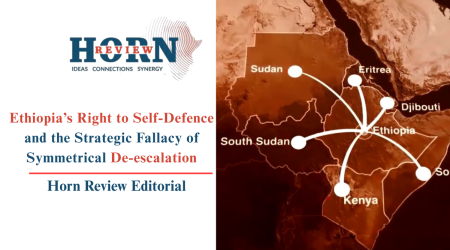
Ethiopia’s Right to Self-Defence and the Strategic Fallacy of Symmetrical De-escalation
The growing calls for de-escalation to the Ethiopia–Eritrea crisis risks...
12
Oct
Ethiopia or Eritrea, Who Is the Aggressor?
Eritrea has answered, in kind, a letter that Ethiopia...
9
Oct
Eritrea’s Post-Pretoria Strategy and the Escalation in Ethiopia
Our latest report examines Eritrea’s post-Pretoria trajectory and how selective...
8
Oct
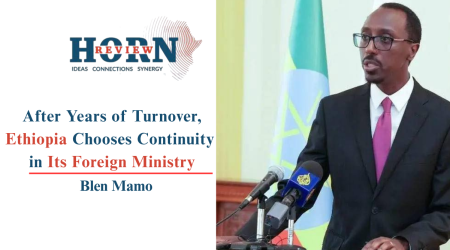
After Years of Turnover, Ethiopia Chooses Continuity in Its Foreign Ministry
Abiy Ahmed’s decision to retain Gedion Timothewos as foreign minister...
8
Oct
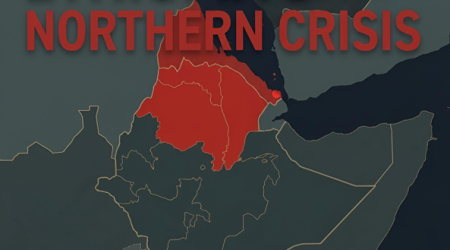
Ethiopia’s Northern Crisis: Actors, Interests and the Anatomy of Escalation
Our latest report, examines the renewed conflict in northern Ethiopia...
7
Oct
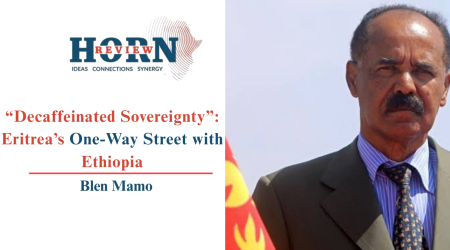
“Decaffeinated Sovereignty”: Eritrea’s One-Way Street with Ethiopia
There is a peculiar contradiction at the heart of Eritrea’s...