
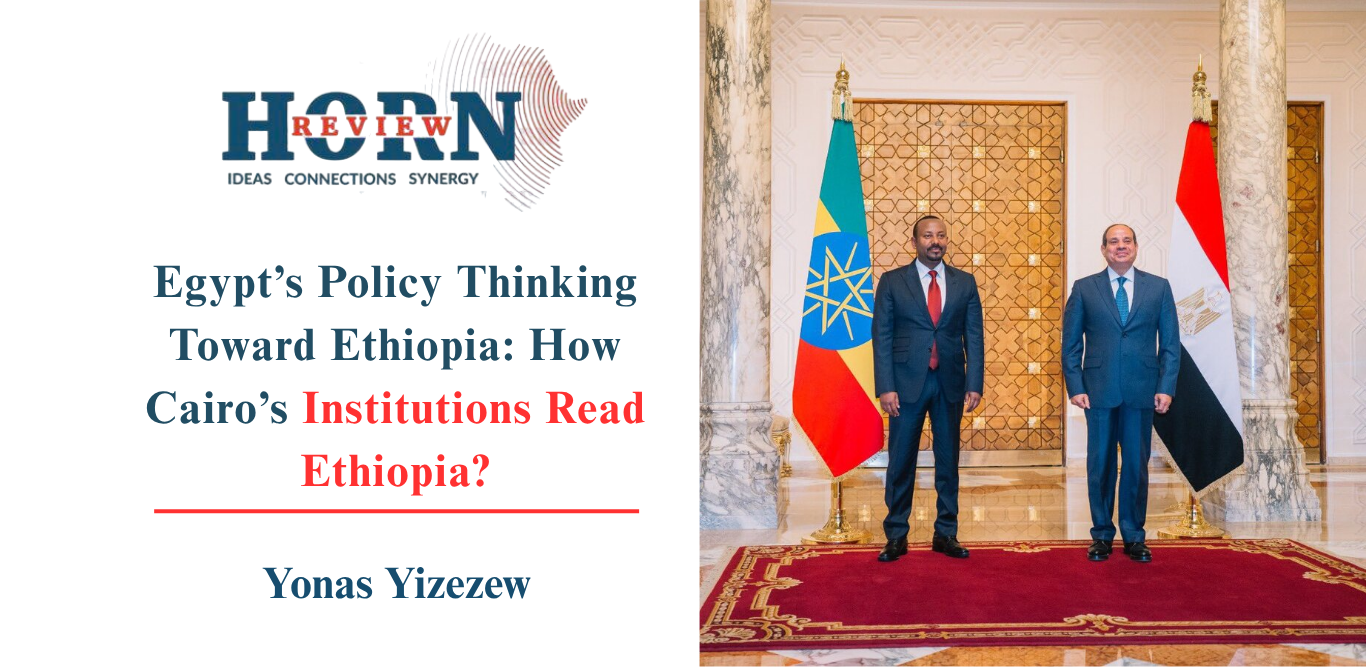
Egypt’s Policy Thinking Toward Ethiopia: How Cairo’s Institutions Read Ethiopia?
Egypt’s policy thinking toward Ethiopia has evolved from a primarily bilateral water dispute into a multi-layered regional strategy that integrates public mobilization, institutional security assessments, and operational partnerships across the Horn of Africa and Red Sea. This approach blends simplified threat narratives for domestic audiences with calculations of Ethiopian state cohesion, geographic leverage, and shifting power balances. Public rhetoric and security-institution analysis operate on complementary tracks, producing a policy that is detailed in its internal assessments, sometimes fragmented in its instruments, and interconnected in its strategic logic.
Foreign policy is often presented through the language of national interest, security and sovereignty, but the politics behind it can take different forms. One such form is a demagoguery foreign policy, which relies heavily on simplified threat narratives, political mobilization, emotionally charged appeals, and selective interpretations of events in ways that serve broader political objectives. In contrast, pragmatic foreign policy is more closely shaped by interests, constraints, capabilities and changing strategic circumstances. Egypt’s approach to Ethiopia provides a useful case for examining this distinction, particularly when Egypt’s public rhetoric is compared with the diplomatic, security and institutional behavior surrounding the Ethiopian file. Egypt’s usage of public narratives to shape domestic perceptions and justify its external posture can be categorized into the above concepts.
What distinguishes Egypt’s security establishment from its public diplomacy is institutional mandate as much as tone. The repeated and increasingly specialized involvement of Egypt’s General Intelligence Service in Ethiopia, Eritrea, Somalia, Sudan and others indicate that the Horn of Africa is treated within the service as a distinct intelligence portfolio, likely supported by a dedicated regional desk or equivalent analytical structure. The GIS chief has participated directly in high-level discussions on Ethiopia and the Nile, travelled to Asmara to assess developments in the Horn and Red Sea, and engaged with issues involving Sudanese civil war and Somalia’s security architecture. Egypt’s broader policy has also increasingly connected Ethiopia’s domestic and regional posture with developments in Somalia, Eritrea, Sudan and the Red Sea. The cumulative pattern suggests an intelligence structure capable of maintaining continuous country files and cross-border assessments, including Ethiopian elite alignments, regional political loyalties, armed-group activity, military developments and diaspora networks. While the internal designation of such a unit is not publicly disclosed, the breadth, continuity and geographic specificity of the GIS’s activities provide a reasonable basis for describing it as a specialized Horn of Africa intelligence portfolio, potentially organized through a dedicated desk within the service.
Civilian-military interfaces translate these assessments into policy recommendations. A clear window into this thinking appeared in the Egyptian Centre for Strategic Studies (ECSS) workshop of 14 September 2026, titled “Ethiopia’s Regional Project: Domestic and External Calculations.” Participants—including former Assistant Foreign Minister for African Affairs figures, national-security specialists, and individuals with experience in Addis Ababa—examined Ethiopia not simply as the operator of the Grand Ethiopian Renaissance Dam (GERD) but as a state whose foreign policy is shaped by ethnic-federal tensions, elite realignments, opposition activity, diaspora mobilization, and regional instability.
The core analytical question is Ethiopian resilience. A state that manages internal tensions effectively may become a more durable negotiating party with a strong position, yet also a more effective regional competitor capable of converting demographic weight, hydropower exports, and diplomatic centrality into sustained influence. A state weakened by internal conflict may be more susceptible to external pressure limiting its capability to execute its policies and strategies. Egyptian security thinking therefore treats ethnic balances, regional administrations, and elite coalitions as early-warning indicators of future state behavior. Conditions that constrain Ethiopia’s political cohesion and regional agency are viewed as strategically useful, particularly where they limit Addis Ababa’s ability to project power into the Red Sea and neighboring states. This institutional architecture explains the simultaneous pursuit of aggressive diplomatic engagement and deepening military partnerships surrounding Ethiopia. The tracks are complementary in which the Foreign Ministry manages public-facing and multilateral diplomacy, while the security establishment pursues operational constraints on Ethiopian options.
The most consequential conceptual shift is the merging of the Nile and Red Sea files. The logic is spatial in that once it became clear that the GERD could not be stopped or tightly constrained through negotiation alone, Cairo determined to prevent Ethiopia from securing a meaningful position on the Red Sea. Maritime access would convert Ethiopia’s landlocked status into a platform for broader regional agency, energy exports, and security presence. Denying or complicating that access preserves a structural asymmetry. This merger is operationalized through partnerships that create pressure points along Ethiopia’s perimeter. The result is a containment architecture rather than a single-issue bilateral contest.
Egypt’s relationship with Somalia has become one of the clearest instruments of this strategy. In August 2024, Egypt and Somalia signed a military cooperation protocol and defense agreement, timed after Ethiopia’s memorandum of understanding with Somaliland that sought maritime access in exchange for eventual recognition. The arrangement was publicly framed around Somali sovereignty, territorial integrity, and security cooperation against al-Shabaab. Subsequent Egyptian actions—arms deliveries, training, capacity-building for the Somali National Army, and contribution of troops to the African Union Support and Stabilization Mission in Somalia (AUSSOM)—have deepened the relationship by extension increasing Egypt’s leverage.
In September, Foreign Minister Badr Abdelatty continued high-level discussions with his Somali counterpart on Egyptian participation in AUSSOM and institutional support. Recent military delegations have focused on establishing training facilities and providing equipment. These moves serve multiple objectives simultaneously including strengthening ties with Mogadishu, securing a multilateral security role for Egypt in the Horn, and linking Somali sovereignty to broader Red Sea security narratives. For Ethiopia the consequences are material. Egyptian military and political cooperation increase the security variables Addis Ababa must manage on its eastern flank and narrows room for maneuver in various aspects. What Egypt appears to be doing is a sustained investment in limiting Ethiopian options.
On the other hand,Sudan connects the Nile dispute to Egypt’s western and southern security concerns and is the theater in which Egyptian and Ethiopian strategic calculations most directly overlap. Cairo has maintained close alignment with the Sudanese Armed Forces (SAF) which would give the necessary sphere of influence Egypt wants to acquire in Sudan and a close partner in Nile negotiations. Therefore, Egyptian political cover, assistance, and coordination with Port Sudan form part of a broader effort to retain influence along Ethiopia’s western frontier regardless of the internal outcome of Sudan’s conflict. Instability in Sudan creates both risks and opportunities. Uncontrolled fragmentation could threaten Egyptian interests, yet a coherent SAF-aligned Sudan provides a partner capable of applying pressure or at least complicating Ethiopian calculations near the Blue Nile and disputed border areas. The GERD itself sits near this sensitive zone, amplifying the linkage between water infrastructure and conventional security.
Coming to the presidency, it does not manage the Ethiopia file at a permanently high intensity. Intense presidential attention tends to coincide with moments when Ethiopian actions intersect broader national-security concerns. For instance, GERD inauguration and operation (completed and inaugurated in September 2025), Ethiopian maritime-access initiatives, developments in Sudan, the political trajectory of Somalia, closer Egypt–Eritrea coordination, or shifts involving external powers such as Türkiye, Gulf states, the United States, or Israel. At other times the issue is handled through bureaucratic channels, technical officials, and calibrated public statements. This selective elevation allows the security establishment to maintain continuous analytical and operational work while the political leadership calibrates visibility according to strategic necessity.
Regarding the GERD, Egyptian thinking has progressed through three identifiable stages. The first (roughly 2011–2020) centered on preventing or constraining the GERD and securing a binding agreement on filling and operation. Diplomatic internationalization through the United Nations Security Council, the Arab League, and bilateral lobbying assumed that pressure could force Ethiopian concessions—an assumption that proved untenable once filling began.
The second stage saw Egypt seek to embed the dispute in broader frameworks involving the AU, Sudan, and continued multilateral diplomacy. Failed talks in 2021–2022 and Ethiopia’s completion of filling shifted the contest from whether the dam would proceed to how it would operate. The absence of a binding agreement left Cairo with limited direct leverage.
The third stage, accelerating from 2024 and continuing through 2026, regionalizes the file. Engagements with Somalia, Eritrea, and Sudan, combined with efforts to shape Red Sea security governance as the exclusive responsibility of ‘littoral states’, constitute a containment architecture. High-level Egypt–Eritrea engagements have repeatedly emphasized this littoral principle, implicitly excluding non-littoral actors such as Ethiopia from institutional roles.
This regionalization reflects a clear recognition in which Ethiopia cannot be assessed solely through water negotiations. Its power is shaped by relations with neighbors and external actors. If Ethiopia consolidates internal authority, gains reliable maritime access, strengthens ties with Gulf or Asian partners, and expands energy exports, its capacity to resist Egyptian pressure increases. Conversely, Egyptian partnerships that constrain Ethiopian options across multiple theaters reduce the need for direct military confrontation. The objective is not total isolation as it would be unrealistic goal given Ethiopia’s size, economic weight, and centrality in African diplomacy. The more plausible aim is to prevent Ethiopia from converting geographic and demographic advantages into unchecked regional predominance.
Ultimately, Egyptian elite thinking about Ethiopia is detailed in its security assessments, fragmented across institutional mandates and geographic theaters, and deeply interconnected in strategic logic. Public narratives mobilize domestic support and frame the dispute in existential terms. Intelligence and defense institutions map Ethiopian internal vulnerabilities and regional pressure points. Operational partnerships in Somalia, Eritrea, and Sudan translate analysis into constraints. Additionally, the Nile and Red Sea files have been fused into a single spatial problem with presidential attention rises and falls according to intersecting crises, while the underlying architecture remains continuous.
The result is a policy that is neither purely demagogic nor purely technocratic. It is a hybrid in which emotionally resonant rhetoric sustains the political foundation, while pragmatic, multi-vector pressure seeks to shape the environment in which Ethiopia operates. Whether this architecture succeeds in producing durable constraints or generates new instabilities that rebound on Egyptian interests—will depend on the resilience of Ethiopian internal cohesion, the durability of Cairo’s regional partnerships, and the responses of external powers that continue to engage both states. The analytical framework already in place treats these variables as interdependent, ensuring that developments in any one domain are read through the lens of the whole.
Yonas Yizezew, Researcher, Horn Review

RELATED
Posts
21
Sep
Sudan’s Rejection of War with Ethiopia Despite Hardline Voices in Khartoum
The closed door meeting in Djibouti in early May...

21
Sep
Somalia’s Informal Economy in U.S. Security and Financial Policy
In various settings, the line between formal and informal economic...
21
Sep
Security Dependencies and Al Shabaab’s Dominance
The Federal Government of Somalia exists in a condition that...
19
Sep
Eritrea’s Sanctions Expired, Not Formally Lifted
The U.S. sanctions on several Eritrean entities and individuals did...
16
Sep
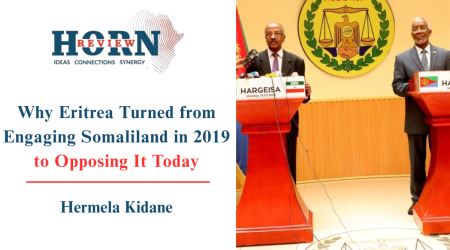
Why Eritrea Turned from Engaging Somaliland in 2019 to Opposing It Today
In March 2019 Eritrean Foreign Minister Osman Saleh accompanied by...
16
Sep
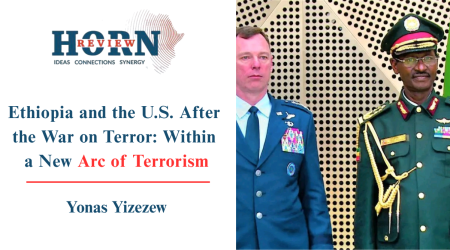
Ethiopia and the U.S. After the War on Terror: Within a New Arc of Terrorism
The War on Terror began as a direct response to...
16
Sep
Why the Abraham Accords Will Not Expand Yet
The claim that Israel is unlikely to find an...
16
Sep
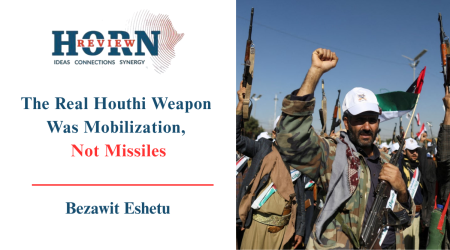
The Real Houthi Weapon Was Mobilization, Not Missiles
Fatima Abo Alasrar frames the Houthi ground strategy as...
16
Sep
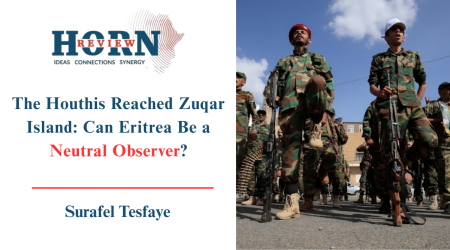
The Houthis Reached Zuqar Island: Can Eritrea Be a Neutral Observer?
The island of Zuqar sits in the southern Red Sea,...
15
Sep
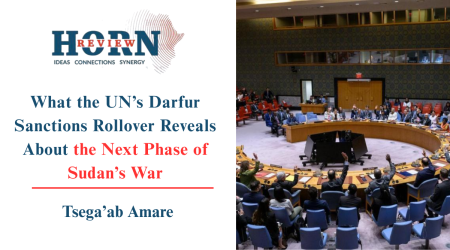
What the UN’s Darfur Sanctions Rollover Reveals About the Next Phase of Sudan’s War
On paper, Resolution 2828 is a housekeeping measure. It...