Egyptian officials have repeatedly made a revealing distinction about the Nile Basin: ‘Egypt has no problem with any Nile Basin country except Ethiopia.’ The statement points beyond diplomatic rhetoric to the underlying political character of the Nile dispute. Egypt’s confrontation with Ethiopia intensified as Ethiopia leveraged its position as the major source of Nile water to assert greater economic and political influence. Through the construction of the Grand Ethiopian Renaissance Dam (GERD), Ethiopia gained the capacity to develop the Nile on a scale beyond that of most other upstream states. The dispute is therefore not simply about dams, nor is it adequately explained by Egypt’s frequently stated concerns over water security. At a deeper level, Ethiopia’s rise as a capable upstream developer has challenged a historically Egypt-dominated Nile order, in which Egypt possessed extensive capacity to utilise the river while upstream states had limited means to develop their own water resources at a comparable scale.
The historical basis of this asymmetry becomes clearer when the Nile’s water system is considered alongside its political use. The Ethiopian highlands provide a substantial proportion of the Nile’s waters, particularly through the Blue Nile. Yet Ethiopia’s upstream position did not historically translate into comparable economic or political capacity to develop and utilise its water resources for electricity, industry and broader economic development. Egypt, by contrast, built an extensive economy around the Nile and developed considerable capacity to utilise and politically defend its interests in the river. The result was a structural asymmetry: Ethiopia occupied a critical position in the Nile’s hydrology without being able to fully convert that position into economic and political power, while Egypt, despite being downstream, developed greater capacity to derive benefits from and shape the utilisation of the river.
The historical foundations of this conflict are equally important. Egypt’s privileged position in Nile politics was reinforced by arrangements such as the 1929 Anglo-Egyptian Nile waters Agreement and the 1959 agreement between Egypt and Sudan, under which Egypt was allocated 55.5 billion cubic metres annually and Sudan 18.5 billion cubic metres. Ethiopia was not a party to the 1959 agreement, yet Egypt has continued to invoke historical water arrangements as an important basis for its position. From Ethiopia’s perspective, however, the central question is why agreements negotiated without Ethiopia and other upstream states should determine the limits of their future development. Historical utilisation cannot automatically become a permanent entitlement that determines the developmental choices of states excluded from its creation.
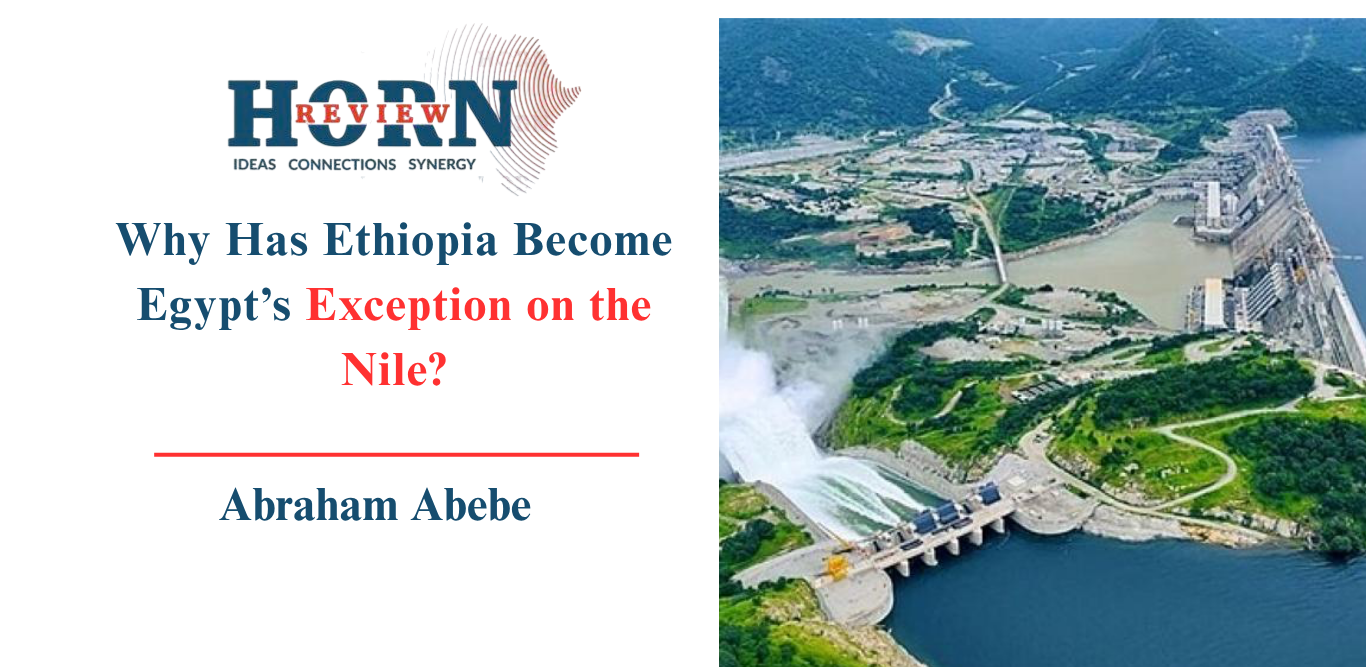
The GERD represents the most important break with this historical pattern. When Ethiopia began constructing the dam in 2011, it was not merely building another piece of infrastructure. It demonstrated that Ethiopia possessed both the capability and political will to harness the Blue Nile for its own economic development. The project’s principal purpose is hydropower generation, addressing Ethiopia’s longstanding electricity deficit while creating potential for industrial development and regional electricity exports. Ethiopia has maintained that it seeks to utilise the Nile equitably while ensuring that downstream countries are not subject to significant harm. The GERD therefore challenges Egypt’s position not because Ethiopia has declared that Egypt should lose its water, but because Ethiopia has demonstrated that an upstream state can pursue national development without accepting that a downstream state should possess a veto over that development.
This explains why Ethiopia has become Egypt’s exception. Egypt does not confront every Nile Basin country with the same intensity because most have not yet reached Ethiopia’s level of capacity to develop their Nile resources independently on a similar scale. Ethiopia’s experience makes the distinction particularly clear: once an upstream state acquires the capacity to finance, build and operate a major Nile project according to its own national priorities, Egypt’s response becomes considerably more confrontational. At the heart of the confrontation is therefore not simply the protection of water, but the preservation of Egypt’s ability to shape how the Nile is utilised. Ethiopia’s challenge is consequently to an established political and legal order in which Egypt has exercised disproportionate influence over the utilisation of a river whose major upstream flows originate outside Egypt.
Egyptian water security cannot become a permanent veto over Ethiopian development. Ethiopia can be expected to use its Nile waters for electricity generation, industrialisation and economic transformation just as Egypt has historically used the river to sustain its own economy. A system in which Ethiopia remains unable to develop its water resources because Egypt is downstream would make the developmental rights of upstream populations subordinate to established downstream consumption. Ethiopia therefore cannot be expected to indefinitely subordinate its national development to Egyptian preferences simply because Cairo regards its projects as threats.
The implications extend beyond Ethiopia. The Nile Basin contains countries with substantial unmet demand for electricity, irrigation and infrastructure. As these countries build stronger economies and institutions, they will confront the same fundamental question: can they pursue independent development of their water resources, or must their choices continue to align with Cairo’s preferences? Ethiopia has confronted that question first because it possessed the capacity and determination to do so. The GERD has therefore transformed Ethiopia from a largely constrained upstream state into an active participant in determining the future of the Nile.
Ethiopia has already demonstrated that the old logic can be challenged. The GERD is therefore not simply a dam; it is evidence that the political economy of the Nile is changing. Egypt now faces a different challenge: adapting to a reality in which its established interests no longer define the limits of upstream development. If Egypt continues to treat Ethiopia’s development as uniquely unacceptable, it risks mistaking the first successful challenge to the old order for the cause of the problem. Ethiopia is not the reason the historical Nile arrangement is becoming unsustainable. Ethiopia is the country that has made its unsustainability impossible to ignore.
Abraham Abebe, Researcher, Horn Review